


Page 1118 - Clinical Immunology_ Principles and Practice ( PDFDrive )
P. 1118
1082         Part eight  Immunology of Neoplasia


                                                                   Ref      G       A       M        K      L

           0.305
           0.290
           0.274
           0.259
           0.244
           0.229
           0.214
           0.198
           0.183
           0.168
           0.153
           0.137
           0.122
           0.107
           0.091
           0.078
           0.061
           0.048
           0.030
           0.015
           0.000                                                 B
         A    0  20  40  60  80  100  120  140  160  180  200  220  240  260  280  300
                                                                    Ref      G       A       M        K       L
           0.40
           0.38                                     1
           0.36
           0.34
           0.32
           0.30
           0.28
           0.26
           0.24
           0.22
           0.20
           0.18
           0.16
           0.14
           0.12
           0.10
           0.08
           0.06
           0.04
           0.02
           0.00
              0  20  40  60  80  100  120  140  160  180  200  220  240  260  280  300
         C                                                       D
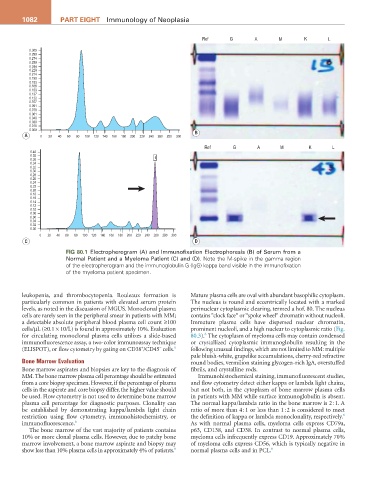
                       Fig 80.1  Electropherogram (A) and Immunofixation Electrophoresis (B) of Serum from a
                       Normal Patient and a Myeloma Patient (C) and (D). Note the M-spike in the gamma region
                       of the electropherogram and the immunoglobulin G (IgG) kappa band visible in the immunofixation
                       of the myeloma patient specimen.
        leukopenia, and thrombocytopenia. Rouleaux formation is   Mature plasma cells are oval with abundant basophilic cytoplasm.
        particularly common in patients with elevated serum protein   The nucleus is round and eccentrically located with a marked
        levels, as noted in the discussion of MGUS. Monoclonal plasma   perinuclear cytoplasmic clearing, termed a hof. 80. The nucleus
        cells are rarely seen in the peripheral smear in patients with MM;   contains “clock face“ or “spoke wheel“ chromatin without nucleoli.
        a detectable absolute peripheral blood plasma cell count ≥100   Immature plasma cells have dispersed nuclear chromatin,
        cells/µL (≥0.1 × 10/L) is found in approximately 10%. Evaluation   prominent nucleoli, and a high nuclear to cytoplasmic ratio (Fig.
                                                                    6
        for circulating monoclonal plasma cells utilizes a slide-based   80.3).  The cytoplasm of myeloma cells may contain condensed
        immunofluorescence assay, a two-color immunoassay technique   or crystallized cytoplasmic immunoglobulin resulting in the
                                               +
                                                     −
        (ELISPOT), or flow cytometry by gating on CD38 /CD45  cells. 6  following unusual findings, which are not limited to MM: multiple
                                                               pale bluish-white, grapelike accumulations, cherry-red refractive
        Bone Marrow Evaluation                                 round bodies, vermilion staining glycogen-rich IgA, overstuffed
        Bone marrow aspirates and biopsies are key to the diagnosis of   fibrils, and crystalline rods.
        MM. The bone marrow plasma cell percentage should be estimated   Immunohistochemical staining, immunofluorescent studies,
        from a core biopsy specimen. However, if the percentage of plasma   and flow cytometry detect either kappa or lambda light chains,
        cells in the aspirate and core biopsy differ, the higher value should   but not both, in the cytoplasm of bone marrow plasma cells
        be used. Flow cytometry is not used to determine bone marrow   in patients with MM while surface immunoglobulin is absent.
        plasma cell percentage for diagnostic purposes. Clonality can   The normal kappa/lambda ratio in the bone marrow is 2 : 1. A
        be established by demonstrating kappa/lambda light chain   ratio of more than 4 : 1 or less than 1 : 2 is considered to meet
                                                                                                                 6
        restriction using flow cytometry, immunohistochemistry, or   the definition of kappa or lambda monoclonality, respectively.
        immunofluorescence. 6                                  As with normal plasma cells, myeloma cells express CD79a,
           The bone marrow of the vast majority of patients contains   p63,  CD138,  and  CD38.  In  contrast  to  normal  plasma  cells,
        10% or more clonal plasma cells. However, due to patchy bone   myeloma cells infrequently express CD19. Approximately 70%
        marrow involvement, a bone marrow aspirate and biopsy may   of myeloma cells express CD56, which is typically negative in
                                                          6
        show less than 10% plasma cells in approximately 4% of patients.    normal plasma cells and in PCL. 6

