


Page 1119 - Clinical Immunology_ Principles and Practice ( PDFDrive )
P. 1119
ChaPter 80  Monoclonal Gammopathies                 1083


                                                                      Ref    GAM       K         L      fK      fL
             0.200
             0.190
             0.180
             0.170
             0.160
             0.150
             0.140
             0.130
             0.120
             0.110
             0.100
             0.090
             0.080
             0.070
             0.060
             0.050
             0.040
             0.030
             0.020
             0.010
             0.000                                                 B
           A    0  20  40  60  80  100  120  140  160 180  200  220  240  260  280  300
            0.200                                                      Ref     GAM      K      L        fK     fL
            0.190
            0.180
            0.170
            0.160
            0.150
            0.140
            0.130
            0.120
            0.110
            0.100
            0.090
            0.080
            0.070
            0.060
            0.050
            0.040                              1
            0.030
            0.020
            0.010
            0.000
                                                                   D
                0  20  40  60  80  100  120  140  160  180  200  220  240  260  280  300
           C
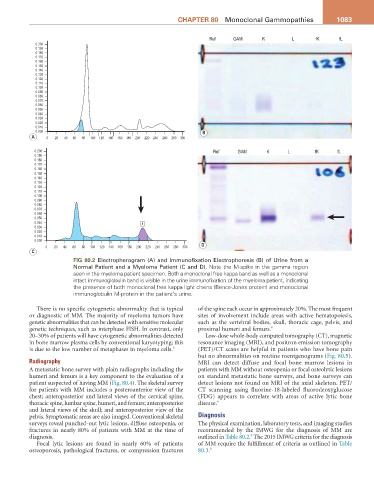
                         Fig 80.2  Electropherogram (A) and Immunofixation Electrophoresis (B) of Urine from a
                         Normal Patient and a Myeloma Patient (C and D). Note the M-spike in the gamma region
                         seen in the myeloma patient specimen. Both a monoclonal free kappa band as well as a monoclonal
                         intact immunoglobulin band is visible in the urine immunofixation of the myeloma patient, indicating
                         the presence of both monoclonal free kappa light chains (Bence-Jones protein) and monoclonal
                         immunoglobulin M-protein in the patient’s urine.

             There is no specific cytogenetic abnormality that is typical   of the spine each occur in approximately 20%. The most frequent
           or diagnostic of MM. The majority of myeloma tumors have   sites of involvement include areas with active hematopoiesis,
           genetic abnormalities that can be detected with sensitive molecular   such as the vertebral bodies, skull, thoracic cage, pelvis, and
           genetic techniques, such as interphase FISH. In contrast, only   proximal humeri and femurs. 6
           20–30% of patients will have cytogenetic abnormalities detected   Low-dose whole-body computed tomography (CT), magnetic
           in bone marrow plasma cells by conventional karyotyping; this   resonance imaging (MRI), and positron emission tomography
           is due to the low number of metaphases in myeloma cells. 6  (PET)/CT scans are helpful in patients who have bone pain
                                                                  but no abnormalities on routine roentgenograms (Fig. 80.5).
           Radiography                                            MRI can detect diffuse and focal bone marrow lesions in
           A metastatic bone survey with plain radiographs including the   patients with MM without osteopenia or focal osteolytic lesions
           humeri and femurs is a key component to the evaluation of a   on standard metastatic bone surveys, and bone surveys can
           patient suspected of having MM (Fig. 80.4). The skeletal survey   detect lesions not found on MRI of the axial skeleton. PET/
           for patients with MM includes a posteroanterior view of the   CT scanning using fluorine-18-labeled fluorodeoxyglucose
           chest; anteroposterior and lateral views of the cervical spine,   (FDG) appears to correlate with areas of active lytic bone
           thoracic spine, lumbar spine, humeri, and femurs; anteroposterior   disease. 6
           and lateral views of the skull; and anteroposterior view of the
           pelvis. Symptomatic areas are also imaged. Conventional skeletal   Diagnosis
           surveys reveal punched-out lytic lesions, diffuse osteopenia, or   The physical examination, laboratory tests, and imaging studies
           fractures in nearly 80% of patients with MM at the time of   recommended by the IMWG for the  diagnosis of MM are
                                                                                   8
           diagnosis.                                             outlined in Table 80.2.  The 2015 IMWG criteria for the diagnosis
             Focal lytic lesions are found in nearly 60% of patients;   of MM require the fulfillment of criteria as outlined in Table
           osteoporosis, pathological fractures, or compression fractures   80.3. 8

