


Page 1122 - Clinical Immunology_ Principles and Practice ( PDFDrive )
P. 1122
1086         Part eight  Immunology of Neoplasia


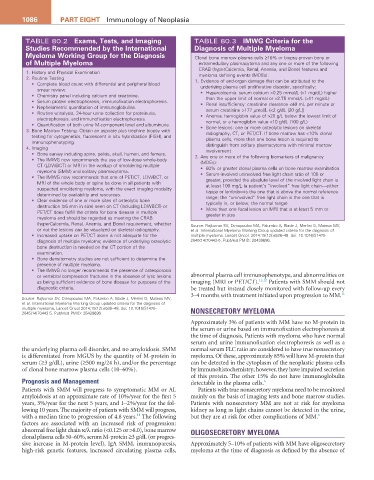
         TABLE 80.2  exams, tests, and imaging                   TABLE 80.3  iMWg Criteria for the
         Studies recommended by the international                Diagnosis of Multiple Myeloma
         Myeloma Working group for the Diagnosis                 Clonal bone marrow plasma cells ≥10% or biopsy-proven bony or
         of Multiple Myeloma                                      extramedullary plasmacytoma and any one or more of the following
                                                                  CRAB (hyperCalcemia, Renal, Anemia, and Bone) features and
          1. History and Physical Examination                     myeloma defining events (MDEs):
          2. Routine Testing
           •  Complete blood count with differential and peripheral blood   1. Evidence of end-organ damage that can be attributed to the
                                                                   underlying plasma cell proliferative disorder, specifically:
             smear review.
           •  Chemistry panel including calcium and creatinine.    •  Hypercalcemia: serum calcium >0.25 mmol/L (>1 mg/dL) higher
                                                                    than the upper limit of normal or >2.75 mmol/L (>11 mg/dL)
           •  Serum protein electrophoresis, immunofixation electrophoresis.
           •  Nephelometric quantitation of immunoglobulins.       •  Renal insufficiency: creatinine clearance <40 mL per minute or
                                                                    serum creatinine >177 µmol/L (<2 g/dL [20 g/L])
           •  Routine urinalysis, 24-hour urine collection for proteinuria,
             electrophoresis, and immunofixation electrophoresis.  •  Anemia: hemoglobin value of >20 g/L below the lowest limit of
           •  Quantification of both urine M-component level and albuminuria.  normal, or a hemoglobin value <10 g/dL (100 g/L)
          3. Bone Marrow Testing: Obtain an aspirate plus trephine biopsy with   •  Bone lesions: one or more osteolytic lesions on skeletal
                                                                    radiography, CT, or PET/CT. If bone marrow has <10% clonal
           testing for cytogenetics, fluorescent in situ hybridization (FISH), and
           immunophenotyping.                                       plasma cells, more than one bone lesion is required to
          4. Imaging                                                distinguish from solitary plasmacytoma with minimal marrow
                                                                    involvement
           •  Bone survey including spine, pelvis, skull, humeri, and femurs.  2. Any one or more of the following biomarkers of malignancy
           •  The IMWG now recommends the use of low-dose whole-body
             CT (LDWBCT) or MRI in the workup of smoldering multiple   (MDEs):
                                                                   •  60% or greater clonal plasma cells on bone marrow examination
             myeloma (SMM) and solitary plasmacytoma.
           •  The IMWG now recommends that one of PET/CT, LDWBCT, or   •  Serum-involved uninvolved free light chain ratio of 100 or
                                                                    greater, provided the absolute level of the involved light chain is
             MRI of the whole body or spine be done in all patients with
             suspected smoldering myeloma, with the exact imaging modality   at least 100 mg/L (a patient’s “involved” free light chain—either
                                                                    kappa or lambda—is the one that is above the normal reference
             determined by availability and resources.
           •  Clear evidence of one or more sites of osteolytic bone   range; the “uninvolved” free light chain is the one that is
                                                                    typically in, or below, the normal range)
             destruction (≥5 mm in size) seen on CT (including LDWBCT) or
             PET/CT does fulfill the criteria for bone disease in multiple   •  More than one focal lesion on MRI that is at least 5 mm or
                                                                    greater in size
             myeloma and should be regarded as meeting the CRAB
             (hyperCalcemia, Renal, Anemia, and Bone) requirement, whether   Source: Rajkumar SV, Dimopoulos MA, Palumbo A, Blade J, Merlini G, Mateos MV,
             or not the lesions can be visualized on skeletal radiography.  et al. International Myeloma Working Group updated criteria for the diagnosis of
           •  Increased uptake on PET/CT alone is not adequate for the   multiple myeloma. Lancet Oncol. 2014;15(12):e538–48. doi: 10.1016/S1470-
             diagnosis of multiple myeloma; evidence of underlying osteolytic   2045(14)70442-5. PubMed PMID: 25439696.
             bone destruction is needed on the CT portion of the
             examination.
           •  Bone densitometry studies are not sufficient to determine the
             presence of multiple myeloma.
           •  The IMWG no longer recommends the presence of osteoporosis
             or vertebral compression fractures in the absence of lytic lesions   abnormal plasma cell immunophenotype, and abnormalities on
             as being sufficient evidence of bone disease for purposes of the   imaging (MRI or PET/CT). 11,12  Patients with SMM should not
             diagnostic criteria.                              be treated but instead closely monitored with follow-up every
                                                               3–4 months with treatment initiated upon progression to MM. 11
        Source: Rajkumar SV, Dimopoulos MA, Palumbo A, Blade J, Merlini G, Mateos MV,
        et al. International Myeloma Working Group updated criteria for the diagnosis of
        multiple myeloma. Lancet Oncol 2014;15(12):e538–48. doi: 10.1016/S1470-  NONSECRETORY MYELOMA
        2045(14)70442-5. PubMed PMID: 25439696.
                                                               Approximately 3% of patients with MM have no M-protein in
                                                               the serum or urine based on immunofixation electrophoresis at
                                                               the time of diagnosis. Patients with myeloma who have normal
                                                               serum and urine immunofixation electrophoresis as well as a
        the underlying plasma cell disorder, and no amyloidosis. SMM   normal serum FLC ratio are considered to have true nonsecretory
        is differentiated from MGUS by the quantity of M-protein in   myeloma. Of these, approximately 85% will have M-protein that
        serum (≥3 g/dL), urine (≥500 mg/24 h), and/or the percentage   can be detected in the cytoplasm of the neoplastic plasma cells
        of clonal bone marrow plasma cells (10–60%).           by immunohistochemistry; however, they have impaired secretion
                                                               of this protein. The other 15% do not have immunoglobulin
        Prognosis and Management                               detectable in the plasma cells. 6
        Patients with SMM will progress to symptomatic MM or AL   Patients with true nonsecretory myeloma need to be monitored
        amyloidosis at an approximate rate of 10%/year for the first 5   mainly on the basis of imaging tests and bone marrow studies.
        years, 3%/year for the next 5 years, and 1–2%/year for the fol-  Patients with nonsecretory MM are not at risk for myeloma
        lowing 10 years. The majority of patients with SMM will progress,   kidney as long as light chains cannot be detected in the urine,
                                              11
        with a median time to progression of 4.8 years.  The following   but they are at risk for other complications of MM. 6
        factors are associated with an increased risk of progression:
        abnormal free light chain κ/λ ratio (<0.125 or >8.0), bone marrow   OLIGOSECRETORY MYELOMA
        clonal plasma cells 50–60%, serum M-protein ≥3 g/dL (or progres-
        sive increase in M-protein level), IgA SMM, immunoparesis,   Approximately 5–10% of patients with MM have oligosecretory
        high-risk genetic features, increased circulating plasma cells,   myeloma at the time of diagnosis as defined by the absence of

