


Page 1127 - Clinical Immunology_ Principles and Practice ( PDFDrive )
P. 1127
ChaPter 80  Monoclonal Gammopathies                 1091


           thickening, easy bruising, and subcutaneous nodules or plaques.   of AL amyloidosis. Kidney or liver biopsy is positive for amyloid
           Amyloidosis may also be directly associated with a bleeding   deposition in over 90% of cases; however, a high success rate
           diathesis. Approximately 10% of patients have coexisting MM. 24  can also be achieved by less invasive procedures, such as abdominal
                                                                  fat  pad  aspirate,  rectal  biopsy,  bone  marrow  biopsy,  or  skin
               KeY CONCePtS                                       biopsy. 24
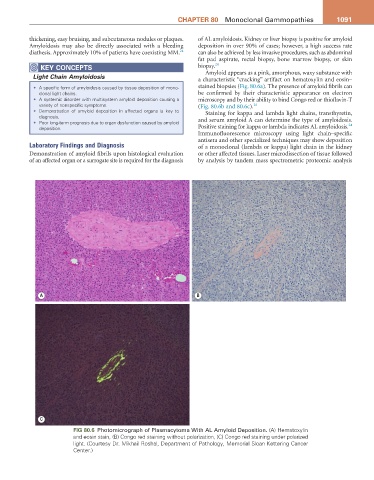
                                                                    Amyloid appears as a pink, amorphous, waxy substance with
            Light Chain Amyloidosis                               a characteristic “cracking” artifact on hematoxylin and eosin–
            •  A specific form of amyloidosis caused by tissue deposition of mono-  stained biopsies (Fig. 80.6a). The presence of amyloid fibrils can
              clonal light chains.                                be confirmed by their characteristic appearance on electron
            •  A systemic disorder with multisystem amyloid deposition causing a   microscopy and by their ability to bind Congo red or thioflavin-T
              variety of nonspecific symptoms.                    (Fig. 80.6b and 80.6c). 24
            •  Demonstration  of amyloid  deposition in affected organs is key to   Staining for kappa and lambda light chains, transthyretin,
              diagnosis.
            •  Poor long-term prognosis due to organ dysfunction caused by amyloid   and serum amyloid A can determine the type of amyloidosis.
                                                                                                                   24
              deposition.                                         Positive staining for kappa or lambda indicates AL amyloidosis.
                                                                  Immunofluorescence microscopy using light chain–specific
                                                                  antisera and other specialized techniques may show deposition
           Laboratory Findings and Diagnosis                      of a monoclonal (lambda or kappa) light chain in the kidney
           Demonstration of amyloid fibrils upon histological evaluation   or other affected tissues. Laser microdissection of tissue followed
           of an affected organ or a surrogate site is required for the diagnosis   by analysis by tandem mass spectrometric proteomic analysis


              A                                                  B


              C
                         Fig 80.6  Photomicrograph of Plasmacytoma With AL Amyloid Deposition. (A) Hematoxylin
                         and eosin stain, (B) Congo red staining without polarization, (C) Congo red staining under polarized
                         light. (Courtesy Dr. Mikhail Roshal, Department of Pathology, Memorial Sloan Kettering Cancer
                         Center.)

