


Page 1125 - Clinical Immunology_ Principles and Practice ( PDFDrive )
P. 1125
ChaPter 80  Monoclonal Gammopathies                 1089


           IgM gammopathy in the blood. The diagnosis of WM is made   present with symptoms due to hyperviscosity should undergo
           when the following two criteria are met: (i) presence of an IgM   immediate therapeutic plasmapheresis, followed by chemotherapy
                                                                                              21
           monoclonal paraprotein on serum immunofixation and (ii) 10%   for control of the malignant clone.  Median survival in WM is
           or more of the bone marrow biopsy sample demonstrates infiltra-  approximately 5–8 years from the time of diagnosis. However,
           tion by small lymphocytes that exhibit plasmacytoid or plasma   outcomes are highly variable. A staging system for WM has been
           cell differentiation (lymphoplasmacytic features or lymphoplas-  developed based on a prospective multicenter observational study
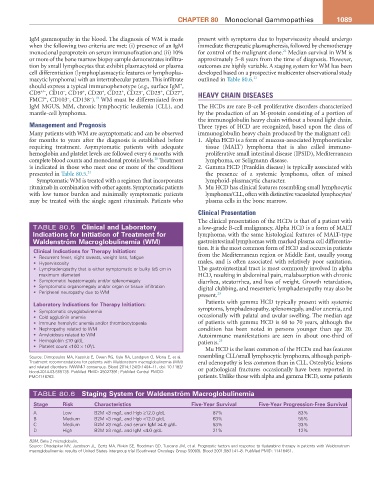
           macytic lymphoma) with an intertrabecular pattern. This infiltrate   outlined in Table 80.6. 22
                                                            +
           should express a typical immunophenotype (e.g., surface IgM ,
                                  +
                      −
                                               −
                                         +
                                                            +
                                                      +
                            +
              +/−
           CD5 , CD10 , CD19 , CD20 , CD22 , CD23 , CD25 , CD27 ,   HEAVY CHAIN DISEASES
                       −
                +
                              −
                                19
           FMC7 , CD103 , CD138 ).  WM must be differentiated from
           IgM MGUS, MM, chronic lymphocytic leukemia (CLL), and   The HCDs are rare B-cell proliferative disorders characterized
           mantle-cell lymphoma.                                  by the production of an M-protein consisting of a portion of
                                                                  the immunoglobulin heavy chain without a bound light chain.
           Management and Prognosis                               Three types of HCD are recognized, based upon the class of
           Many patients with WM are asymptomatic and can be observed   immunoglobulin heavy chain produced by the malignant cell:
           for months to years after the diagnosis is established before   1.  Alpha HCD is a form of mucosa-associated lymphoreticular
           requiring treatment.  Asymptomatic patients with adequate   tissue (MALT) lymphoma that is also called immuno-
           hemoglobin and platelet levels are followed every 6 months with   proliferative small intestinal disease (IPSID), Mediterranean
                                                    20
           complete blood counts and monoclonal protein levels.  Treatment   lymphoma, or Seligmann disease.
           is indicated in those who meet one or more of the conditions   2.  Gamma HCD (Franklin disease) is typically associated with
           presented in Table 80.5. 21                              the presence of a systemic lymphoma, often of mixed
             Symptomatic WM is treated with a regimen that incorporates   lymphoid-plasmacytic character.
           rituximab in combination with other agents. Symptomatic patients   3.  Mu HCD has clinical features resembling small lymphocytic
           with low tumor burden and minimally symptomatic patients   lymphoma/CLL, often with distinctive vacuolated lymphocytes/
           may be treated with the single agent rituximab. Patients who   plasma cells in the bone marrow.
                                                                  Clinical Presentation
                                                                  The clinical presentation of the HCDs is that of a patient with
            TABLE 80.5  Clinical and Laboratory                   a low-grade B-cell malignancy. Alpha HCD is a form of MALT
            indications for initiation of treatment for           lymphoma, with the same histological features of MALT-type
            Waldenström Macroglobulinemia (WM)                    gastrointestinal lymphomas with marked plasma cell differentia-
            Clinical indications for therapy initiation:          tion. It is the most common form of HCD and occurs in patients
            •  Recurrent fever, night sweats, weight loss, fatigue  from the Mediterranean region or Middle East, usually young
            •  Hyperviscosity                                     males, and is often associated with relatively poor sanitation.
            •  Lymphadenopathy that is either symptomatic or bulky (≥5 cm in   The gastrointestinal tract is most commonly involved in alpha
              maximum diameter)                                   HCD, resulting in abdominal pain, malabsorption with chronic
            •  Symptomatic hepatomegaly and/or splenomegaly       diarrhea, steatorrhea, and loss of weight. Growth retardation,
            •  Symptomatic organomegaly and/or organ or tissue infiltration  digital clubbing, and mesenteric lymphadenopathy may also be
            •  Peripheral neuropathy due to WM                          23
                                                                  present.
            Laboratory indications for therapy initiation:          Patients with gamma HCD typically present with systemic
            •  Symptomatic cryoglobulinemia                       symptoms, lymphadenopathy, splenomegaly, and/or anemia, and
            •  Cold agglutinin anemia                             occasionally with palatal and uvular swelling. The median age
            •  Immune hemolytic anemia and/or thrombocytopenia    of patients with gamma HCD is 60 to 70 years, although the
            •  Nephropathy related to WM                          condition has been noted in persons younger than age 20.
            •  Amyloidosis related to WM                          Autoimmune manifestations are seen in about one-third of
            •  Hemoglobin ≤10 g/dL                                patients. 23
                              9
            •  Platelet count <100 × 10 /L
                                                                    Mu HCD is the least common of the HCDs and has features
           Source: Dimopoulos MA, Kastritis E, Owen RG, Kyle RA, Landgren O, Morra E, et al.   resembling CLL/small lymphocytic lymphoma, although periph-
           Treatment recommendations for patients with Waldenstrom macroglobulinemia (WM)   eral adenopathy is less common than in CLL. Osteolytic lesions
           and related disorders: IWWM-7 consensus. Blood 2014;124(9):1404–11. doi: 10.1182/  or pathological fractures occasionally have been reported in
           blood-2014-03-565135. PubMed PMID: 25027391; PubMed Central PMCID:
           PMC4148763.                                            patients. Unlike those with alpha and gamma HCD, some patients
            TABLE 80.6  Staging System for Waldenström Macroglobulinemia

            Stage     risk      Characteristics                 Five-Year Survival    Five-Year Progression-Free Survival
            A         Low       B2M <3 mg/L and Hgb ≥12.0 g/dL         87%                         83%
            B         Medium    B2M <3 mg/L and Hgb <12.0 g/dL         63%                         55%
            C         Medium    B2M ≥3 mg/L and serum IgM ≥4.0 g/dL    53%                         33%
            D         High      B2M ≥3 mg/L and IgM <4.0 g/dL          21%                         12%
           B2M, Beta 2 microglobulin.
           Source: Dhodapkar MV, Jacobson JL, Gertz MA, Rivkin SE, Roodman GD, Tuscano JM, et al. Prognostic factors and response to fludarabine therapy in patients with Waldenstrom
           macroglobulinemia: results of United States intergroup trial (Southwest Oncology Group S9003). Blood 2001;98(1):41–8. PubMed PMID: 11418461.

