


Page 1128 - Clinical Immunology_ Principles and Practice ( PDFDrive )
P. 1128
1092         Part eight  Immunology of Neoplasia


        may be helpful in identifying the type of amyloid protein (e.g.,   due to cardiac or hepatic failure as well as infection. There is,
        monoclonal light chain versus other forms of amyloid proteins).   however, significant variability in median survival, depending
        An alternative to mass spectrometry is to use immunoelectron   on the nature, number, and extent of organ involvement. Median
        microscopy, if available. 24                           survival may range from 4 to 6 months in patients diagnosed
           Patients with AL amyloidosis frequently have chromosomal   at an advanced stage, to in excess of 5 years in patients with
        abnormalities, but there is no single chromosomal change that   limited organ involvement. Two key prognostic factors include
        is diagnostic of this disease. Chromosomal abnormalities reported   the presence and severity of cardiac involvement and the presence
        with moderate to high frequency in patients with AL amyloidosis   of concurrent myeloma. 26
        include t(11;14)(q13;q32), del(13q14), and gain of 1q21. 24
           Most patients with AL amyloidosis have little or no intact   MONOCLONAL IMMUNOGLOBULIN
        monoclonal immunoglobulin, but are characterized by the   DEPOSITION DISEASES
        presence of monoclonal free light chain. The monoclonal light
        chain type is lambda in approximately 70% of cases, kappa in   Monoclonal  immunoglobulin deposition  diseases  are a  non-
        25%, and biclonal in 5%. SPEP demonstrates a localized band   amyloid monoclonal immunoglobulin chain deposition disease
        or peak in less than 50% of patients with  AL amyloidosis.   that is caused by a clonal plasma cell proliferative disorder. These
        Immunofixation electrophoresis detects a serum or urinary   diseases are characterized by the deposition of immunoglobulin
        monoclonal protein in nearly 90% of cases of AL amyloidosis.   light or heavy chain fragments, leading to organ dysfunction.
        When serum and urine immunofixation electrophoresis is   There are two types of immunoglobulin deposition diseases:
        combined with serum free light chain ratio analysis, a monoclonal   heavy chain deposition disease (HCDD) and LCDD. They are
        protein can be detected in virtually all cases. 24     differentiated from light chain and heavy chain amyloidosis in
           Bone marrow biopsy specimens typically demonstrate a slightly   that the light chain fragments do not have the necessary biochemi-
        increased percentage of plasma cells that may appear morphologi-  cal characteristics to form amyloid fibrils.
        cally normal. Less commonly, the bone marrow demonstrates
        overt myeloma or lymphoplasmacytic lymphoma. A clonal excess   Clinical Presentation
        of plasma cells (lambda or kappa) can also be demonstrated     HCDD is extremely rare, with 37 cases reported in the literature
        by immunoperoxidase staining or flow cytometric analysis of   from 1992 to 2011. The majority of patients present with hyper-
                                       24
        specimens of involved bone marrow.  Diagnostic criteria for   tension, progressive renal dysfunction, anemia, and nephrotic
                                                                                          27
        AL amyloidosis have been developed by the Mayo Clinic and   syndrome with microhematuria.  Patients with LCDD usually
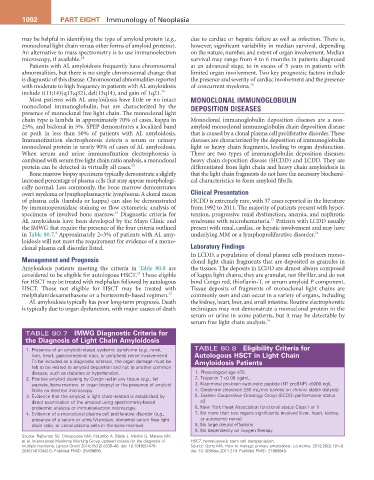
        the IMWG that require the presence of the four criteria outlined   present with renal, cardiac, or hepatic involvement and may have
                   8
        in Table 80.7.  Approximately 2–3% of patients with AL amy-  underlying MM or a lymphoproliferative disorder. 24
        loidosis will not meet the requirement for evidence of a mono-
        clonal plasma cell disorder listed.                    Laboratory Findings
                                                               In LCDD, a population of clonal plasma cells produces mono-
        Management and Prognosis                               clonal light chain fragments that are deposited as granules in
        Amyloidosis patients meeting the criteria in  Table 80.8 are   the tissues. The deposits in LCDD are almost always composed
                                              25
        considered to be eligible for autologous HSCT.  Those eligible   of kappa light chains; they are granular, not fibrillar, and do not
        for HSCT may be treated with melphalan followed by autologous   bind Congo red, thioflavin-T, or serum amyloid P component.
        HSCT. Those not eligible for HSCT may be treated with   Tissue  deposits  of fragments  of monoclonal light  chains  are
        melphalan/dexamethasone or a bortezomib-based regimen. 25  commonly seen and can occur in a variety of organs, including
           AL amyloidosis typically has poor long-term prognosis. Death   the kidney, heart, liver, and small intestine. Routine electrophoretic
        is typically due to organ dysfunction, with major causes of death   techniques may not demonstrate a monoclonal protein in the
                                                               serum or urine in some patients, but it may be detectable by
                                                               serum free light chain analysis. 26
         TABLE 80.7  iMWg Diagnostic Criteria for
         the Diagnosis of Light Chain amyloidosis

          1. Presence of an amyloid-related systemic syndrome (e.g., renal,   TABLE 80.8  eligibility Criteria for
           liver, heart, gastrointestinal tract, or peripheral nerve involvement).   autologous hSCt in Light Chain
           To be included as a diagnostic criterion, the organ damage must be   amyloidosis Patients
           felt to be related to amyloid deposition and not to another common
           disease, such as diabetes or hypertension.            1. Physiological age ≤70
          2. Positive amyloid staining by Congo red in any tissue (e.g., fat   2. Troponin T <0.06 ng/mL
           aspirate, bone marrow, or organ biopsy) or the presence of amyloid   3. N-terminal pro-brain natriuretic peptide (NT proBNP) <5000 ng/L
           fibrils on electron microscopy.                       4. Creatinine clearance ≥30 mL/min (unless on chronic stable dialysis)
          3. Evidence that the amyloid is light chain–related is established by   5. Eastern Cooperative Oncology Group (ECOG) performance status
           direct examination of the amyloid using spectrometry-based   ≤2
           proteomic analysis or immunoelectron microscopy.      6. New York Heart Association functional status Class I or II
          4. Evidence of a monoclonal plasma cell proliferative disorder (e.g.,   7. No more than two organs significantly involved (liver, heart, kidney,
           presence of a serum or urine M-protein, abnormal serum free light   or autonomic nerve)
           chain ratio, or clonal plasma cells in the bone marrow).  8. No large pleural effusions
                                                                 9. No dependency on oxygen therapy
        Source: Rajkumar SV, Dimopoulos MA, Palumbo A, Blade J, Merlini G, Mateos MV,
        et al. International Myeloma Working Group updated criteria for the diagnosis of   HSCT, hematopoietic stem cell transplantation.
        multiple myeloma. Lancet Oncol 2014;15(12):e538–48. doi: 10.1016/S1470-  Source: Gertz MA. How to manage primary amyloidosis. Leukemia. 2012;26(2):191–8.
        2045(14)70442-5. PubMed PMID: 25439696.                doi: 10.1038/leu.2011.219. PubMed PMID: 21869840.

