


Page 1124 - Clinical Immunology_ Principles and Practice ( PDFDrive )
P. 1124
1088         Part eight  Immunology of Neoplasia


        and absence of anemia, hypercalcemia, or renal insufficiency   TABLE 80.4  iMWg Diagnostic Criteria for
        attributable to a clonal plasma cell proliferative disorder. 16  the Diagnosis of POeMS Syndrome
           Some patients may have a small amount of M-protein, usually
        IgA, in the serum or urine, which often disappears after treatment.   Both Mandatory Criteria:
        The bone marrow of patients with SEP does not have clonal   1. Polyneuropathy
        plasma cells, whereas some patients with a solitary extramedullary   2. Monoclonal plasma cell proliferative disorder
        lesion may demonstrate up to 10% clonal plasma cells, in which   Plus at Least One Major Criterion:
        case the diagnosis is SEP with minimal marrow involvement. 15  3. Osteosclerotic or mixed sclerotic/lytic lesion visualized on plain
                                                                    films or computed tomography (CT)
        Management and Prognosis                                  4. Castleman disease
        The treatment of choice for SEP is RT. Small lesions may be   5. Elevated serum or plasma vascular endothelial growth factor
        cured with surgery alone; no adjuvant RT is indicated unless   (VEGF) levels (at least three to four times the upper limit of
        there is suspicion of residual local disease. 15            normal)
           Less than 7% of patients with SEP will develop a local recur-  Plus at Least One Minor Criterion:
        rence after tumoricidal radiation.  Approximately 10–15% of
        patients ultimately will develop MM; the progression rate is   1. Organomegaly (splenomegaly, hepatomegaly, or
                                                                    lymphadenopathy)
        higher (20%) in patients with SEP with minimal marrow involve-  2. Extravascular volume overload (peripheral edema, ascites, or
        ment. Five-year overall survival rates range from 40–85%. 15  pleural effusion)
                                                                  3. Endocrinopathy (adrenal, thyroid, pituitary, gonadal, parathyroid, or
                                                                    pancreatic disorder excluding diabetes mellitus or hypothyroidism)
        POEMS SYNDROME                                            4. Skin changes (hyperpigmentation, hypertrichosis, glomeruloid
                                                                    hemangiomata, plethora, acrocyanosis, flushing, white nails)
        POEMS (polyneuropathy, organomegaly, endocrinopathy,      5. Papilledema
        monoclonal protein, skin changes) syndrome is characterized   6. Thrombocytosis or polycythemia
        by the presence of a monoclonal plasma cell disorder, peripheral
        neuropathy, and one or more of the following features: osteo-  POEMS, polyneuropathy, organomegaly, endocrinopathy, monoclonal protein, skin
        sclerotic myeloma, Castleman disease, increased levels of serum   changes.
                                                               Source: Rajkumar SV, Dimopoulos MA, Palumbo A, Blade J, Merlini G, Mateos MV,
        vascular endothelial growth factor (VEGF), organomegaly,   et al. International Myeloma Working Group updated criteria for the diagnosis of
        endocrinopathy, edema, typical skin changes, and papilledema.   multiple myeloma. Lancet Oncol 2014;15(12):e538–48. doi: 10.1016/S1470-
        The cause of POEMS syndrome is unknown, although chronic   2045(14)70442-5. PubMed PMID: 25439696.
        overproduction of proinflammatory and other cytokines such
        as VEGF appears to be a major feature of this disorder. POEMS
        syndrome is a rare disorder, but the exact incidence is unknown.
        POEMS syndrome commonly presents in the fifth to sixth   macytic cells and a monoclonal IgM gammopathy in the blood.
        decade. 17                                             WM is a rare disorder with an incidence of approximately 3/
                                                               million people/year, with 1400 new cases diagnosed in the United
        Clinical Presentation                                  States each year. The median age at diagnosis is 64 years; less
        By definition, all patients have peripheral neuropathy and a   than 1% of patients are diagnosed under 40 years of age, and
        monoclonal plasma cell disorder, almost always of the lambda   approximately 60% are males. WM is more common in Caucasians
        light chain type. In addition, almost all patients have osteosclerotic   than in other ethnic groups, and familial predisposition is present
        lesions, whereas Castleman disease is present in approximately   in up to 20%. 18
        15%. 17
                                                               Clinical Presentation
        Diagnosis                                              Patients usually present in their seventh decade with symptoms
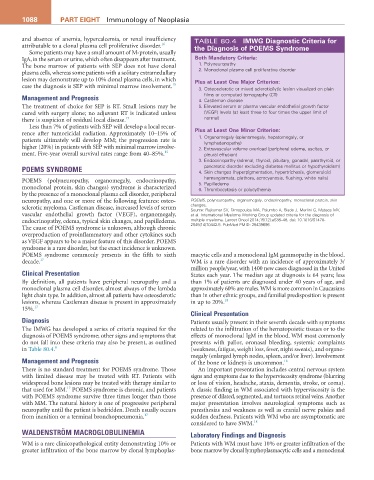
        The IMWG has developed a series of criteria required for the   related to the infiltration of the hematopoietic tissues or to the
        diagnosis of POEMS syndrome; other signs and symptoms that   effects of monoclonal IgM in the blood. WM most commonly
        do not fall into these criteria may also be present, as outlined   presents  with  pallor,  oronasal  bleeding,  systemic  complaints
        in Table 80.4. 8                                       (weakness, fatigue, weight loss, fever, night sweats), and organo-
                                                               megaly (enlarged lymph nodes, spleen, and/or liver). Involvement
        Management and Prognosis                               of the bone or kidneys is uncommon. 18
        There is no standard treatment for POEMS syndrome. Those   An important presentation includes central nervous system
        with  limited  disease  may  be  treated  with  RT.  Patients  with   signs and symptoms due to the hyperviscosity syndrome (blurring
        widespread bone lesions may be treated with therapy similar to   or loss of vision, headache, ataxia, dementia, stroke, or coma).
                       17
        that used for MM.  POEMS syndrome is chronic, and patients   A classic finding in WM associated with hyperviscosity is the
        with POEMS syndrome survive three times longer than those   presence of dilated, segmented, and tortuous retinal veins. Another
        with MM. The natural history is one of progressive peripheral   major presentation involves neurological symptoms such as
        neuropathy until the patient is bedridden. Death usually occurs   paresthesias and weakness as well as cranial nerve palsies and
        from inanition or a terminal bronchopneumonia. 17      sudden deafness. Patients with WM who are asymptomatic are
                                                               considered to have SWM. 18
        WALDENSTRÖM MACROGLOBULINEMIA                          Laboratory Findings and Diagnosis

        WM is a rare clinicopathological entity demonstrating 10% or   Patients with WM must have 10% or greater infiltration of the
        greater infiltration of the bone marrow by clonal lymphoplas-  bone marrow by clonal lymphoplasmacytic cells and a monoclonal

