


Page 1133 - Clinical Immunology_ Principles and Practice ( PDFDrive )
P. 1133
CHaPter 81  Concepts and Challenges in Organ Transplantation                1099


                                                                                                Recipient APC
                                   Direct presentation                 Semidirect presentation

                           Donor APC
                                                                        Donor APC
                                            Class I MHC

                                                          CD8 +


                                                                                 Exosome               +
                                 Class II MHC                                  Class II MHC         CD4
                                                                   C


                               CD4 +
                   A

                                                       Indirect presentation


                                                          Recipient APC


                                                                                 CD4 +

                                          B
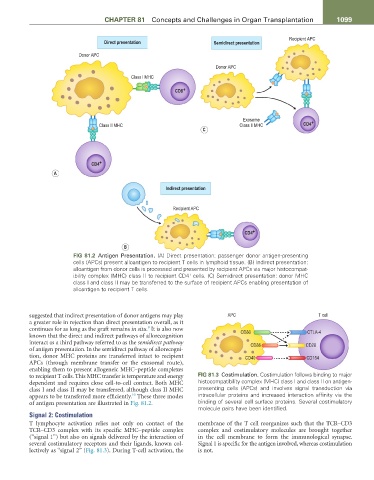
                         FiG 81.2  Antigen Presentation. (A) Direct presentation: passenger donor antigen-presenting
                         cells (APCs) present alloantigen to recipient T cells in lymphoid tissue. (B) Indirect presentation:
                         alloantigen from donor cells is processed and presented by recipient APCs via major histocompat-
                         ibility complex (MHC) class II to recipient CD4  cells. (C) Semidirect presentation: donor MHC
                                                               +
                         class I and class II may be transferred to the surface of recipient APCs enabling presentation of
                         alloantigen to recipient T cells.


           suggested that indirect presentation of donor antigens may play   APC                         T cell
           a greater role in rejection than direct presentation overall, as it
                                                 9
           continues for as long as the graft remains in situ.  It is also now   CD80                 CTLA-4
           known that the direct and indirect pathways of allorecognition
           interact as a third pathway referred to as the semidirect pathway       CD86              CD28
           of antigen presentation. In the semidirect pathway of allorecogni-
           tion, donor MHC proteins are transferred intact to recipient          CD40                CD154
           APCs  (through  membrane  transfer  or  the  exosomal  route),
           enabling them to present allogeneic MHC–peptide complexes
           to recipient T cells. This MHC transfer is temperature and energy   FiG 81.3  Costimulation. Costimulation follows binding to major
           dependent and requires close cell-to-cell contact. Both MHC   histocompatibility complex (MHC) class I and class II on antigen-
           class I and class II may be transferred, although class II MHC   presenting cells (APCs) and involves signal transduction via
                                            10
           appears to be transferred more efficiently.  These three modes   intracellular proteins and increased interaction affinity via the
           of antigen presentation are illustrated in Fig. 81.2.  binding of several cell surface proteins. Several costimulatory
                                                                  molecule pairs have been identified.
           Signal 2: Costimulation
           T lymphocyte activation relies not only on contact of the   membrane of the T cell reorganizes such that the TCR–CD3
           TCR–CD3 complex with its specific MHC–peptide complex   complex and costimulatory molecules are brought together
           (“signal 1”) but also on signals delivered by the interaction of   in the cell membrane to form the immunological synapse.
           several costimulatory receptors and their ligands, known col-  Signal 1 is specific for the antigen involved, whereas costimulation
           lectively as “signal 2” (Fig. 81.3). During T-cell activation, the   is not.

