


Page 1161 - Clinical Immunology_ Principles and Practice ( PDFDrive )
P. 1161
1126         Part NINE  Transplantation


        remains a severe disorder with a rather high risk of complications   However, a subgroup of these patients fail to respond to G-CSF,
                                                         37
        and death, especially in patients with oxidase-null phenotype.    and some of them are at high risk for development of myelogenous
        Therefore there has been a renewed interest in HSCT for CGD.   leukemia. A retrospective multicenter study of 136 patients with
        In a survey of the European experience in 1985–2000, 27 patients   SCN who underwent allogeneic HSCT between 1990 and 2012
        with CGD were treated with HSCT; most of them received   reported a 3-year overall survival rate of 82%, with 17%
                                                                                          41
        unmodified bone marrow from an HLA-identical sibling after   transplantation-related mortality.  Transplantation at a younger
        myeloablative conditioning. Overall, 23 of the 27 patients were   age (<10 years) and use of matched related or unrelated donors
        reported to have survived, and the disease had been cured in 22   were associated with an improved outcome.
               38
        of them.  In this study, all 18 patients who were infection-free
        at the time of transplantation survived. However, a real break-  Other Primary Immune Deficiencies
        through in the treatment of CGD was provided by a prospective   IFN-γ receptor 1 deficiency  leads to severe mycobacterial
        multicenter study in 56 patients with CGD, 42 of whom had   infections, with a high rate of mortality early in life. Although
        high-risk features, including treatment-refractory infections and   HSCT should theoretically correct the disease, results have been
                                      39
        severe inflammatory complications.  In this study, reduced-  disappointing, with few exceptions. An international survey of
        intensity conditioning (with low-dose or targeted busulfan   eight transplanted patients showed that only two were in full
        administration,  high-dose  fludarabine,  and  serotherapy)  and   remission 5 years after transplantation. The high level of IFN-γ
        transplantation from matched related (n = 21) or unrelated (n   in these patients inhibits engraftment of donor-derived HSCs,
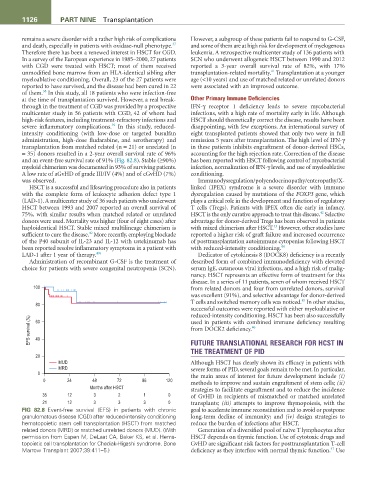
        = 35) donors resulted in a 2-year overall survival rate of 96%   accounting for the high rejection rate. Correction of the disease
        and an event-free survival rate of 91% (Fig. 82.8). Stable (≥90%)   has been reported with HSCT following control of mycobacterial
        myeloid chimerism was documented in 93% of surviving patients.   infection, normalization of IFN-γ levels, and use of myeloablative
        A low rate of aGvHD of grade III/IV (4%) and of cGvHD (7%)   conditioning.
        was observed.                                             Immunodysregulation/polyendocrinopathy/enteropathy/X-
           HSCT is a successful and lifesaving procedure also in patients   linked (IPEX) syndrome is a severe disorder with immune
        with the complete form of leukocyte adhesion defect type 1   dysregulation caused by mutations of the FOXP3 gene, which
        (LAD-1). A multicenter study of 36 such patients who underwent   plays a critical role in the development and function of regulatory
        HSCT between 1993 and 2007 reported an overall survival of   T cells (Tregs). Patients with IPEX often die early in infancy.
                                                                                                          42
        75%, with similar results when matched related or unrelated   HSCT is the only curative approach to treat this disease.  Selective
        donors were used. Mortality was higher (four of eight cases) after   advantage for donor-derived Tregs has been observed in patients
                                                                                           43
        haploidentical HSCT. Stable mixed multilineage chimerism is   with mixed chimerism after HSCT.  However, other studies have
                              40
        sufficient to cure the disease.  More recently, employing blockade   reported a higher risk of graft failure and increased occurrence
        of the P40 subunit of IL-23 and IL-12 with ustekinumab has   of posttransplantation autoimmune cytopenias following HSCT
        been reported resolve inflammatory symptoms in a patient with   with reduced-intensity conditioning. 44
        LAD-1 after 1 year of therapy. 40a                        Dedicator of cytokinesis 8 (DOCK8) deficiency is a recently
           Administration of recombinant G-CSF is the treatment of   described form of combined immunodeficiency with elevated
        choice for patients with severe congenital neutropenia (SCN).   serum IgE, cutaneous viral infections, and a high risk of malig-
                                                               nancy. HSCT represents an effective form of treatment for this
                                                               disease. In a series of 11 patients, seven of whom received HSCT
            100                                                from related donors and four from unrelated donors, survival
                                                               was excellent (91%), and selective advantage for donor-derived
                                                                                                    45
             80                                                T cells and switched memory cells was noticed.  In other studies,
                                                               successful outcomes were reported with either myeloablative or
                                                               reduced-intensity conditioning. HSCT has been also successfully
           EFS survival (%)  60                                used in patients with combined immune deficiency resulting
                                                                                   46
                                                               from DOCK2 deficiency.
             40
                                                               FUTURE TRANSLATIONAL RESEARCH FOR HCST IN
                                                               THE TREATMENT OF PID
             20
                    MUD                                        Although HSCT has clearly shown its efficacy in patients with
                    MRD                                        severe forms of PID, several goals remain to be met. In particular,
             0                                                 the main areas of interest for future development include (i)
               0       24      48      72      96      120     methods to improve and sustain engraftment of stem cells; (ii)
                              Months after HSCT                strategies to facilitate engraftment and to reduce the incidence
               35      12       3       2       1       0      of GvHD in recipients of mismatched or matched unrelated
               21      12       3       3       3       0      transplants;  (iii) attempts to improve thymopoiesis, with the
        FIG 82.8  Event-free survival (EFS) in patients  with chronic   goal to accelerate immune reconstitution and to avoid or postpone
        granulomatous disease (CGD) after reduced-intensity conditioning   long-term decline of immunity; and  (iv) design strategies to
        hematopoietic stem cell transplantation (HSCT) from matched   reduce the burden of infections after HSCT.
        related donors (MRD) or matched unrelated donors (MUD). (With   Generation of a diversified pool of naïve T lymphocytes after
        permission from Eapen M, DeLaat CA, Baker KS, et al. Hema-  HSCT depends on thymic function. Use of cytotoxic drugs and
        topoietic cell transplantation for Chediak-Higashi syndrome. Bone   GvHD are significant risk factors for posttransplantation T-cell
                                                                                                             47
        Marrow Transplant 2007;39:411–5.)                      deficiency as they interfere with normal thymic function.  Use

