


Page 118 - Clinical Immunology_ Principles and Practice ( PDFDrive )
P. 118
102          Part one  Principles of Immune Response


        third form of the proteasome, the thymoproteasome, has alternative
        forms of the β 5  subunit, β 5t . The thymoproteasome is selectively   Endoplasmic reticulum  Trafficking to  Phagosomes or
        expressed in the thymus and permits the use of alternative peptides   TAP-independent  Golgi and surface  endosomes
        for positive selection of CD8 T cells during development (Chapter   peptides from
        8). This leads to a broader CD8 TCR repertoire with diminished   secreted proteins            Endocytosed or
        reactivity to self peptides expressed in the periphery.                                        phagocytosed
                                                                                    Release from        antigens
        Import of Antigenic Peptides Into the Endoplasmic Reticulum                 class I loading
        and Final Trimming                                                            complex
        After antigenic or self peptides are generated by the proteasome   MHC class I                Cross-processing
        in the cytosol, they are imported into the ER for potential binding   heavy chain  TAP
        to newly synthesized MHC class I molecules. This transport    β m                        Cytosol
                                                                      2
        activity, which must cross the ER membrane, is mediated by a
        protein heterodimer termed TAP (for transporter associated with
        antigen processing). The TAP heterodimer consists of TAP1 and      Tapasin            Proteasome
        TAP2, each with 6 transmembrane domains, which within the                                      Unfolded or
        ER form a transmembrane channel. The adenosine triphosphate           TAP-dependent           partially degraded
        (ATP) binding domains are on the cytosolic side of the endo-            peptides                 protein
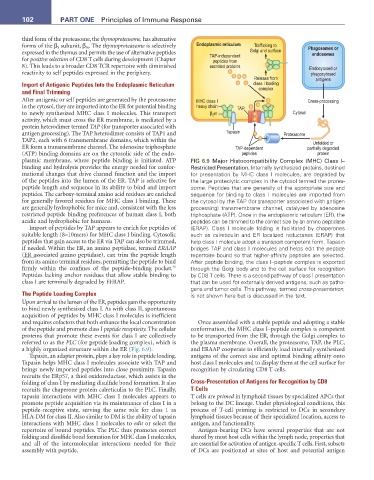
        plasmic membrane, where peptide binding is initiated.  ATP   FIG 6.9  Major Histocompatibility Complex (MHC) Class I–
        binding and hydrolysis provides the energy needed for confor-  Restricted Presentation. Internally synthesized proteins, destined
        mational changes that drive channel function and the import   for  presentation  by  MHC  class  I  molecules,  are  degraded  by
        of the peptides into the lumen of the ER. TAP is selective for   the large proteolytic complex in the cytosol termed the protea-
        peptide length and sequence in its ability to bind and import   some. Peptides that are generally of the appropriate size and
        peptides. The carboxy-terminal amino acid residues are enriched   sequence for binding to class I molecules are imported from
        for generally favored residues for MHC class I binding. These   the cytosol by the TAP (for transporter associated with antigen
        are generally hydrophobic for mice and, consistent with the less   processing) transmembrane channel, catalyzed by adenosine
        restricted peptide binding preferences of human class I, both   triphosphate (ATP). Once in the endoplasmic reticulum (ER), the
        acidic and hydrophobic for humans.                     peptides can be trimmed to the correct size by an amino peptidase
           Import of peptides by TAP appears to enrich for peptides of   (ERAP). Class I molecule folding is facilitated by chaperones
        suitable length (8–10mers) for MHC class I binding. Cytosolic   such as calreticulin and ER localized reductases (ERAP) that
        peptides that gain access to the ER via TAP can also be trimmed,   help class I molecule adopt a transport competent form. Tapasin
        if needed. Within the ER, an amino peptidase, termed ERAAP   bridges TAP and class I molecules and helps edit the peptide
        (ER associated amino peptidase), can trim the peptide length   repertoire bound so that higher-affinity peptides are selected.
        from its amino terminal residues, permitting the peptide to bind   After peptide binding, the class I–peptide complex is exported
                                                         36
        firmly within the confines of the peptide-binding pocket.    through the Golgi body and to the cell surface for recognition
        Peptides lacking anchor residues that allow stable binding to   by CD8 T cells. There is a second pathway of class I presentation
        class I are terminally degraded by EERAP.              that can be used for externally derived antigens, such as patho-
                                                               gens and tumor cells. This pathway, termed cross-presentation,
        The Peptide Loading Complex                            is not shown here but is discussed in the text.
        Upon arrival to the lumen of the ER, peptides gain the opportunity
        to bind newly synthesized class I. As with class II, spontaneous
        acquisition of peptides by MHC class I molecules is inefficient
        and requires cofactors that both enhance the local concentration   Once assembled with a stable peptide and adopting a stable
        of the peptide and promote class I peptide receptivity. The cellular   conformation, the MHC class I–peptide complex is competent
        proteins that promote these events for class I are collectively   to be transported from the ER, through the Golgi complex to
        referred to as the PLC (for peptide loading complex), which is   the plasma membrane. Overall, the proteasome, TAP, the PLC,
        a highly organized structure within the ER (Fig. 6.9).  and ERAAP cooperate to efficiently load internally synthesized
           Tapasin, an adapter protein, plays a key role in peptide loading.   antigens of the correct size and optimal binding affinity onto
        Tapasin helps MHC class I molecules associate with TAP and   host class I molecules and to display them at the cell surface for
        brings newly imported peptides into close proximity. Tapasin   recognition by circulating CD8 T cells.
        recruits the ERp57, a thiol oxidoreductase, which assists in the
        folding of class I by mediating disulfide bond formation. It also   Cross-Presentation of Antigens for Recognition by CD8
        recruits the chaperone protein calreticulin to the PLC. Finally,   T Cells
        tapasin interactions with MHC class I molecules appears to   T cells are primed in lymphoid tissues by specialized APCs that
        promote peptide acquisition via its maintenance of class I in a   belong to the DC lineage. Under physiological conditions, this
        peptide-receptive state, serving the same role for class 1 as   process of T-cell priming is restricted to DCs in secondary
        HLA-DM for class II. Also similar to DM is the ability of tapasin   lymphoid tissues because of their specialized location, access to
        interactions with MHC class I molecules to edit or select the   antigen, and functionality.
        repertoire of bound peptides. The PLC thus promotes correct   Antigen-bearing DCs have several properties that are not
        folding and disulfide bond formation for MHC class I molecules,   shared by most host cells within the lymph node, properties that
        and all of the intermolecular interactions needed for their   are essential for activation of antigen-specific T cells. First, subsets
        assembly with peptide.                                 of DCs are positioned at sites of host and potential antigen

