


Page 116 - Clinical Immunology_ Principles and Practice ( PDFDrive )
P. 116
100          Part one  Principles of Immune Response


           Studies in both intact APCs and in vitro with purified recom-
        binant class II and HLA-DM proteins suggest that DM selectively   Targeting of Antigen into the MHC Class II
        releases some peptides from class II molecules. Generally, these   Processing Pathway
        peptides possess low affinity for the class II molecule. Only those   MHC class II molecules use several mechanisms to access self,
        peptides that are stably bound to class II molecules will sustain   tumor, or pathogen-derived proteins. In the case of extracellular
        interactions with MHC class II and survive endosomal DM   antigens, proteins can access endosomal compartments through
        editing. These MHC class II complexes will be successfully   receptor-mediated uptake, fluid phase uptake, or via internaliza-
        exported to the cell surface, displayed at high density on the   tion of cell surface molecules. The major pathways utilized will
        APC and recruit CD4 T cells during an immune response. These   vary with the type and the activation state of APCs. For DCs
        DM-selected peptides are thus the targets of the focused CD4   and macrophages, calcium-dependent C-type lectins play a major
        T-cell response.                                       role in accessing exogenous protein antigens or pathogens. 27-29
           The relationship between DM sensitivity and the affinity of   These lectins recognize carbohydrate recognition domains (CRDs)
        the peptide–class II complex is not absolute. However, it is   specific for  different sugar side structures  on self or foreign
        generally a good predictive feature of immunodominant peptides.   proteins. Examples include O-linked or N-linked sugars on
        In some cases, the size and diversity of the CD4 T-cell repertoire   glycoproteins or O-linked sugars on glycolipid molecules. Among
        can also determine the abundance of responding CD4 after   the C-type lectins are those that recognize mannose-bearing
        encounter with pathogens or vaccines, but the qualitative ability   ligands (mannose receptor, SIGNR1, and langerin) and those
        of a peptide to successfully or ineffectively recruit CD4 T cells   that recognize complex sugars (dectin 1).
        can be generally attributed to how stably the peptide binds to   Receptors that have been implicated in antigen presentation
        host HLA-class II molecules and thus DM editing. Importantly,   include DEC205, expressed on lymphoid-resident DCs and DIR2
        modification of this parameter by increasing the affinity of peptide   (also known as Clec4) and its human orthologue DCIR2. Clec9A
        binding to class II can enhance the immunogenicity of peptides,   is a C-type lectin receptor that preferentially induces CD4
        and thus can be used to enhance immunogenicity of vaccine   T-follicular helper (Tfh) cells, which promote B-cell production
        candidates.                                            of  isotype-switched  high-affinity  antibodies.  Combined  with
                                                               ligands for pattern recognition receptors or immunostimulatory
                                                               agents, such as CD40-specific antibodies, antigens delivered
        HLA-DO                                                 through these cell surface proteins can activate CD4 T cells and
        A final critical component of the MHC class II presentation   induce protective immunity. Use of antibodies to these lectins,
        pathway is HLA-DO (DO) in humans (H-2O in mice). The   which allow precise targeting of specific subsets of APCs with
        expression can be regulated independently of invariant chain   antigen conjugates, has been exploited in vaccine design strategies
        and HLA-DM. DO is unevenly distributed in MHC class II–  to elicit the desired immune response to weakly immunogenic
        positive cells. Factors influencing expression include cell lineage   antigens, such as tumor antigens and HIV.
        and state of activation. The differential expression of DO has   In B cells, MHC-restricted antigen presentation is largely
        important biological consequences because it inhibits the activity   limited to those antigens taken up through the specific binding
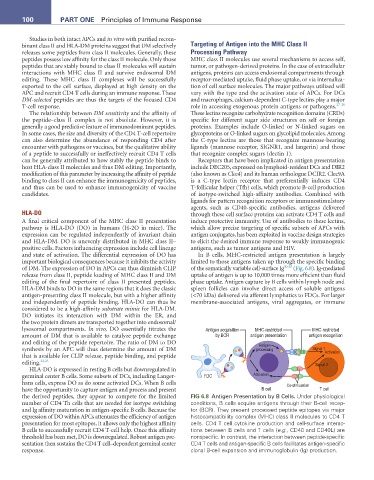
        of DM. The expression of DO in APCs can thus diminish CLIP   of the somatically variable cell-surface Ig 30-32  (Fig. 6.8). Ig-mediated
        release from class II, peptide loading of MHC class II and DM   uptake of antigen is up to 10,000 times more efficient than fluid
        editing of the final repertoire of class II presented peptides.   phase uptake. Antigen capture by B cells within lymph node and
        HLA-DM binds to DO in the same regions that it does the classic   spleen follicles can involve direct access of soluble antigens
        antigen-presenting class II molecule, but with a higher affinity   (<70 kDa) delivered via afferent lymphatics to FDCs. For larger
        and independently of peptide binding. HLA-DO can thus be   membrane-associated antigens, viral aggregates, or immune
        considered to be a high-affinity substrate mimic for HLA-DM.
        DO initiates its interaction with DM within the ER, and
        the two protein dimers are transported together into endosomal/
        lysosomal compartments.  In vivo, DO essentially titrates the   Antigen acquisition  MHC-restricted  MHC-restricted
        amount of DM that is available to catalyze peptide exchange     by BCR     antigen presentation  antigen recognition
        and editing of the peptide repertoire. The ratio of DM to DO                  Antigen
        synthesis by an APC will thus determine the amount of DM                     processing        Signal 1 Activation
        that is available for CLIP release, peptide binding, and peptide
        editing. 22,23                                                                                  Signal 2
           HLA-DO is expressed in resting B cells but downregulated in
        germinal center B cells. Some subsets of DCs, including Langer-  FDC        Activation
        hans cells, express DO as do some activated DCs. When B cells                          Co-stimulation
        have the opportunity to capture antigen and process and present                B cell             T cell
        the derived peptides, they appear to compete for the limited   FIG 6.8  Antigen Presentation by B Cells. Under physiological
        number of CD4 Th cells that are needed for isotype switching   conditions, B cells acquire antigens through their B-cell recep-
        and Ig affinity maturation in antigen-specific B cells. Because the   tor (BCR). They present processed peptide epitopes via major
        expression of DO within APCs attenuates the efficiency of antigen   histocompatibility complex (MHC) class II molecules to CD4 T
        presentation for most epitopes, it allows only the highest affinity   cells. CD4 T cell cytokine production and cell-surface interac-
        B cells to successfully recruit CD4 T-cell help. Once this affinity   tions between B cells and T cells (e.g., CD40 and CD40L) are
        threshold has been met, DO is downregulated. Robust antigen pre-  nonspecific. In contrast, the interaction between peptide-specific
        sentation then sustains the CD4 T cell–dependent germinal center     CD4 T cells and antigen-specific B cells facilitates antigen-specific
        response.                                              clonal B-cell expansion and immunoglobulin (Ig) production.

