


Page 120 - Clinical Immunology_ Principles and Practice ( PDFDrive )
P. 120
104          Part one  Principles of Immune Response


        in multiple allelic forms), this diversity of different peptide–class   transpeptidation event, creating new epitopes from noncontiguous
        II complexes displayed by APCs was unexpected.         segments.
           Several key features of MHC biology and biochemistry were   Besides the interest in understanding the precise mechanism
        revealed by this new technology. First, peptides derived from   responsible for generation of these epitopes is the practical
        alternative alleles of MHC proteins yield nonoverlapping sets   implication of these events. Epitope identification often involves
        of peptides. This permits assignment of peptide binding prefer-  derivation and testing of overlapping peptide libraries from the
        ences or motifs to different allelic and isotypic forms of MHC   pathogen or tumor-derived proteins that are based on known
        molecules (in humans, HLA-A, HLA-B, and HLA-C for class I,   protein databases. The cryptic epitopes will not be represented
        and HLA-DR, HLA-DQ, and HLA-DP for class II). This advance   in these libraries, and accordingly, epitopes recognized by many
        has enabled development and refinement of algorithms that   potential effector CD8 T cells will fail to be identified. Thus
        predict pathogen-associated epitopes as well as the definition of   future vaccine strategies will need to take into account the prob-
        preferred peptide-binding characteristics for MHC proteins that   ability that some of the existing and potentially protective host
        are  associated  with  susceptibility  to  autoimmune  disease  or   CD8 T cells may be dedicated to unpredicted peptides from
        infection. Sequencing of the peptidome presented by MHC class   pathogens or transformation.
        II molecules also modified our view of class II presented peptides,
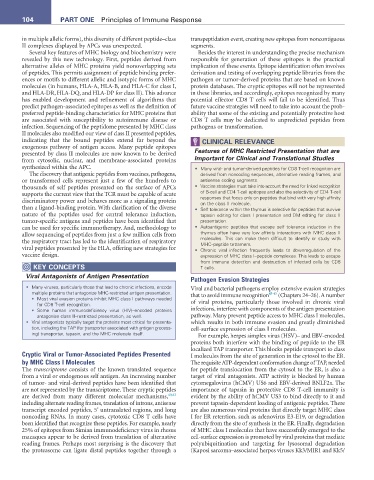
        indicating that the bound peptides extend far beyond the    CLInICaL reLeVanCe
        exogenous pathway of antigen access. Many peptide epitopes
        presented by class II molecules are now known to be derived   Features of MHC Restricted Presentation that are
        from cytosolic, nuclear, and membrane-associated proteins   Important for Clinical and Translational Studies
        synthesized within the APC.                              •  Many viral- and tumor-derived peptides for CD8 T-cell recognition are
           The discovery that antigenic peptides from vaccines, pathogens,   derived from noncoding sequences, alternative reading frames, and
        or transformed cells represent just a few of the hundreds to   antisense coding segments.
        thousands  of self peptides presented on  the surface  of APCs   •  Vaccine strategies must take into account the need for linked recognition
        supports the current view that the TCR must be capable of acute   of B-cell and CD4 T-cell epitopes and also the selectivity of CD4 T-cell
        discriminatory power and behaves more as a signaling protein   responses that focus only on peptides that bind with very high affinity
                                                                   on the class II molecule.
        than a ligand-binding protein. With clarification of the diverse   •  Self tolerance within the thymus is selective for peptides that survive
        nature of the peptides used for central tolerance induction,   tapasin editing for class I presentation and DM editing for class II
        tumor-specific antigens and peptides have been identified that   presentation.
        can be used for specific immunotherapy. And, methodology to   •  Autoantigenic  peptides  that escape self tolerance  induction  in the
        allow sequencing of peptides from just a few million cells from   thymus often have very low affinity interactions with MHC class II
        the respiratory tract has led to the identification of respiratory   molecules. This can make them difficult to identify or study with
                                                                   MHC–peptide tetramers.
        viral peptides presented by the HLA, offering new strategies for   •  Chronic viral infection frequently leads to downregulation of the
        vaccine design.                                            expression of MHC class I–peptide complexes. This leads to escape
                                                                   from immune detection and destruction of infected cells by CD8
            KeY ConCePtS                                           T cells.
         Viral Antagonists of Antigen Presentation
                                                               Pathogen Evasion Strategies
          •  Many viruses, particularly those that lead to chronic infections, encode   Viral and bacterial pathogens employ extensive evasion strategies
           multiple proteins that antagonize MHC-restricted antigen presentation.  that to avoid immune recognition 43-45  (Chapters 24–26). A number
           •  Most viral evasion proteins inhibit MHC class I pathways needed
             for CD8 T-cell recognition.                       of  viral  proteins, particularly  those  involved  in  chronic  viral
           •  Some human immunodeficiency virus (HIV)–encoded proteins   infections, interfere with components of the antigen presentation
             antagonize class II–restricted presentation, as well.  pathway. Many prevent peptide access to MHC class I molecules,
          •  Viral antagonists typically target the proteins most critical for presenta-  which results in both immune evasion and greatly diminished
           tion, including the TAP (for transporter associated with antigen process-  cell-surface expression of class I molecules.
           ing) transporter, tapasin, and the MHC molecule itself.  For example, herpes simplex virus (HSV)– and EBV-encoded
                                                               proteins both interfere with the binding of peptide to the ER
                                                               localized TAP transporter. This blocks peptide transport to class
        Cryptic Viral or Tumor-Associated Peptides Presented   I molecules from the site of generation in the cytosol to the ER.
        by MHC Class I Molecules                               The requisite ATP-dependent conformation change of TAP, needed
        The  transcriptome consists of the known translated sequence   for peptide translocation from the cytosol to the ER, is also a
        from a viral or endogenous self antigen. An increasing number   target of viral antagonists. ATP activity is blocked by human
        of tumor- and viral-derived peptides have been identified that   cytomegalovirus (hCMV) US6 and EBV-derived BNLF2a. The
        are not represented by the transcriptome. These cryptic peptides   importance of tapasin in protective CD8 T-cell immunity is
        are  derived from many  different  molecular  mechanisms, 40,42    evident by the ability of hCMV US3 to bind directly to it and
        including alternate reading frames, translation of introns, antisense   prevent tapasin-dependent loading of antigenic peptides. There
        transcript encoded peptides, 5’ untranslated regions, and long   are also numerous viral proteins that directly target MHC class
        noncoding  RNAs. In many  cases, cytotoxic  CD8 T  cells have   I for ER retention, such as adenovirus E3-E19, or degradation
        been identified that recognize these peptides. For example, nearly   directly from the site of synthesis in the ER. Finally, degradation
        25% of epitopes from Simian immunodeficiency virus in rhesus   of MHC class I molecules that have successfully emerged to the
        macaques appear to be derived from translation of alternative   cell-surface expression is promoted by viral proteins that mediate
        reading frames. Perhaps most surprising is the discovery that   polyubiquitination  and  targeting  for  lysosomal  degradation
        the proteasome can ligate distal peptides together through a   (Kaposi sarcoma–associated herpes viruses Kk3/MIR1 and Kk5/

