


Page 114 - Clinical Immunology_ Principles and Practice ( PDFDrive )
P. 114
98           Part one  Principles of Immune Response


                                                               correct class II folding. CLIP occupies the peptide-binding pocket
                                                               of the class II molecule. This prevents premature occupation of
                                                               the peptide-binding pocket by self peptides, and it ensures the
                                                  CD4T cell    conformation integrity of the membrane distal, class II peptide
                                                               binding domains. Successful assembly of invariant chain with
                                                               MHC class II allows egress of the complex from the ER to later
                                                               biosynthetic compartments. In this context, invariant chain acts
                        Golgi                                  as a molecular chaperone.
                                                                  As they leave the ER, MHC class II and invariant chain are
                                                               cotranslationally modified by the addition of complex carbohy-
                                                               drates into the Golgi complex. Either directly from the trans-Golgi
                                                               network or after a short-lived cell-surface intermediate, they are
                        Endoplasmic                            then selectively sorted into the endosomal compartment of APCs.
                             reticulum
                                                               The amino terminal cytosolic tail of invariant chain plays a key
            Intact    Invariant  MHC class II  HLA-DM  HLA-DO  role in the sorting event, which is mediated by the adaptor protein
            antigen   chain     α  and β                       AP-2. Once in the endosomal compartments, invariant chain is
                                                               degraded by defined sequential proteolytic events mediated by
            Endosomal  Clip fragment  Antigenic  MHC class II  pH-dependent proteases, including aspartyl and cysteine proteases.
            proteases  of Invariant chain  peptide  peptide complexes  The key proteases that cleaves invariant at CLIP’s amino-terminus
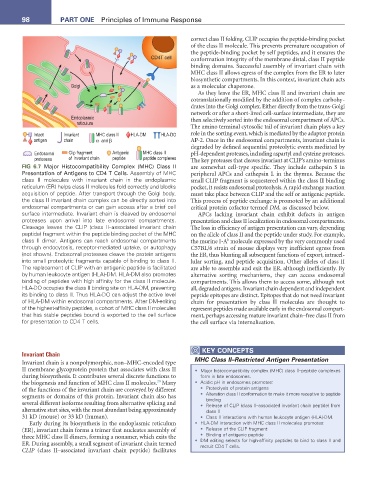
        FIG 6.7  Major Histocompatibility Complex (MHC) Class II   are somewhat cell-type specific. They include cathepsin S in
        Presentation of Antigens to CD4 T Cells. Assembly of MHC   peripheral APCs and cathepsin L in the thymus. Because the
        class II molecules with invariant chain in the endoplasmic   small CLIP fragment is sequestered within the class II binding
        reticulum (ER) helps class II molecules fold correctly and blocks   pocket, it resists endosomal proteolysis. A rapid exchange reaction
        acquisition of peptide. After transport through the Golgi body,   must take place between CLIP and the self or antigenic peptide.
        the class II invariant chain complex can be directly sorted into   This process of peptide exchange is promoted by an additional
        endosomal compartments or can gain access after a brief cell   critical protein cofactor termed DM, as discussed below.
        surface intermediate. Invariant chain is cleaved by endosomal   APCs lacking invariant chain exhibit defects in antigen
        proteases upon arrival into late endosomal compartments.   presentation and class II localization in endosomal compartments.
        Cleavage leaves  the CLIP (class II–associated  invariant chain   The loss in efficiency of antigen presentation can vary, depending
        peptide) fragment within the peptide binding pocket of the MHC   on the allele of class II and the peptide under study. For example,
        class II dimer.  Antigens can reach  endosomal compartments   the murine I-A  molecule expressed by the very commonly used
                                                                           b
        through endocytosis, receptor-mediated uptake, or autophagy   C57BL/6 strain of mouse displays very inefficient egress from
        (not shown). Endosomal proteases cleave the protein antigens   the ER, thus blunting all subsequent functions of export, intracel-
        into small proteolytic fragments capable of binding to class II.   lular sorting, and peptide acquisition. Other alleles of class II
        The replacement of CLIP with an antigenic peptide is facilitated   are able to assemble and exit the ER, although inefficiently. By
        by human leukocyte antigen (HLA)-DM. HLA-DM also promotes   alternative sorting mechanisms, they can access endosomal
        binding of peptides with high affinity for the class II molecule.   compartments. This allows them to access some, although not
        HLA-DO occupies the class II binding site on HLA-DM, preventing   all, degraded antigens. Invariant chain dependent and independent
        its binding to class II. Thus HLA-DO can adjust the active level   peptide epitopes are distinct. Epitopes that do not need invariant
        of HLA-DM within endosomal compartments. After DM-editing   chain for presentation by class II molecules are thought to
        of the highest-affinity peptides, a cohort of MHC class II molecules   represent peptides made available early in the endosomal compart-
        that has stable peptides bound is exported to the cell surface   ment, perhaps accessing mature invariant chain–free class II from
        for presentation to CD4 T cells.                       the cell surface via internalization.


                                                                   KeY ConCePtS
        Invariant Chain
        Invariant chain is a nonpolymorphic, non–MHC-encoded type   MHC Class II–Restricted Antigen Presentation
        II membrane glycoprotein protein that associates with class II   •  Major histocompatibility complex (MHC) class II–peptide complexes
        during biosynthesis. It contributes several discrete functions to   form in late endosomes.
                                                    20
        the biogenesis and function of MHC class II molecules.  Many   •  Acidic pH in endosomes promotes:
        of the functions of the invariant chain are conveyed by different   •  Proteolysis of protein antigens
        segments or domains of this protein. Invariant chain also has   •  Alteration class II conformation to make it more receptive to peptide
                                                                    binding
        several different isoforms resulting from alternative splicing and   •  Release of CLIP (class II–associated invariant chain peptide) from
        alternative start sites, with the most abundant being approximately   class II
        31 kD (mouse) or 33 kD (human).                            •  Class II interactions with human leukocyte antigen (HLA)-DM.
           Early during its biosynthesis in the endoplasmic reticulum   •  HLA-DM interaction with MHC class II molecules promotes:
        (ER), invariant chain forms a trimer that nucleates assembly of   •  Release of the CLIP fragment
        three MHC class II dimers, forming a nonamer, which exits the   •  Binding of antigenic peptide
        ER. During assembly, a small segment of invariant chain termed   •  DM editing selects for high-affinity peptides to bind to class II and
                                                                   recruit CD4 T cells.
        CLIP (class II–associated invariant chain peptide) facilitates

