


Page 1200 - Clinical Immunology_ Principles and Practice ( PDFDrive )
P. 1200
CHaPTEr 85  Gene Therapy for Primary Immune Deficiency Diseases              1164.e1


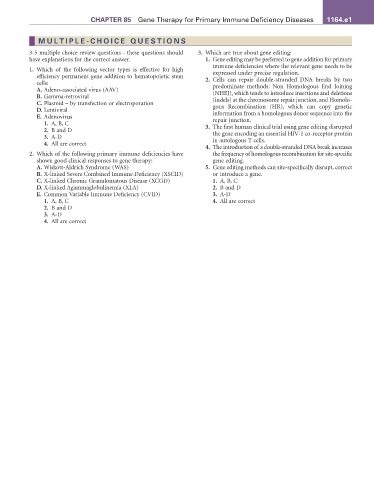
              MULTIPLE-CHOICE QUESTIONS

           3-5 multiple choice review questions - these questions should   3.  Which are true about gene editing:
           have explanations for the correct answer.                1.  Gene editing may be preferred to gene addition for primary
                                                                       immune deficiencies where the relevant gene needs to be
           1.  Which of the following vector types is effective for high
             efficiency permanent gene addition to hematopoietic stem   expressed under precise regulation.
             cells:                                                 2.  Cells can repair double-stranded DNA breaks by two
              A. Adeno-associated virus (AAV)                          predominate methods: Non Homologous End Joining
              B. Gamma-retroviral                                      (NHEJ), which tends to introduce insertions and deletions
              C. Plasmid – by transfection or electroporation          (indels) at the chromosome repair junction, and Homolo-
              D. Lentiviral                                            gous Recombination (HR), which can copy genetic
              E.  Adenovirus                                           information from a homologous donor sequence into the
               1.  A, B, C                                             repair junction.
               2.  B and D                                          3.  The first human clinical trial using gene editing disrupted
               3.  A-D                                                 the gene encoding an essential HIV-1 co-receptor protein
               4.  All are correct                                     in autologous T cells.
                                                                    4.  The introduction of a double-stranded DNA break increases
           2.  Which of the following primary immune deficiencies have   the frequency of homologous recombination for site-specific
             shown good clinical responses to gene therapy:            gene editing.
              A. Wiskott-Aldrich Syndrome (WAS)                     5.  Gene editing methods can site-specifically disrupt, correct
              B. X-linked Severe Combined Immune Deficiency (XSCID)    or introduce a gene.
              C. X-linked Chronic Granulomatous Disease (XCGD)         1.  A, B, C
              D. X-linked Agammaglobulinemia (XLA)                     2.  B and D
              E.  Common Variable Immune Deficiency (CVID)             3.  A-D
               1.  A, B, C                                             4.  All are correct
               2.  B and D
               3.  A-D
               4.  All are correct

