


Page 1204 - Clinical Immunology_ Principles and Practice ( PDFDrive )
P. 1204
1168         ParT TEN  Prevention and Therapy of Immunological Diseases


                                                               For example, pulsed intravenous (IV) methylprednisolone is
        Glucocorticoid Receptor Resistance                     effective in the treatment of systemic lupus erythematosus
        Several mechanisms may explain the clinical finding of GCR   (SLE) and causes rapid immunosuppression in patients with
        resistance, including alterations in the number, binding affinity, or   organ- and/or life-threatening manifestations of SLE. However,
        phosphorylation status of GCR. Other possible explanations are   the standard regime (1 g/day for 3 consecutive days) is associated
        polymorphic changes and/or overexpression of (co)chaperones,   with significant risks of infection, and lower doses may be just
        increased expression of inflammatory transcription factors,   as effective. 15
        overexpression of the GCRβ isoform, the multidrug resistance   High-dose GCs are also often used in immune thrombo-
        pump, and altered membrane-bound (mGCR) expression. 11  cytopenia associated with SLE, although comparative studies
                                                                         16
                                                               are  lacking.   It  has  been  calculated  that  in  such  situations,
        Nongenomic Actions of Glucocorticoids                  the concentrations achieved in vivo are high enough (around
        Some regulatory effects of GCs occur within seconds or minutes.   10–5 mol/L) to cause immediate nonspecific nongenomic effects
                                                                              1
        These are too rapid to result from genomic actions and must,   on immune cells.  Intraarticular injections also bring high
        therefore, be caused by nongenomic mechanisms of action.   concentrations of GCs into contact with inflammatory cells,
        Three different rapid nongenomic actions of GCs have been   although it is difficult to assess locally achieved concentrations
        described. 1,12,13                                     because crystal suspensions are most often used.
        cGCR-Mediated Nongenomic Actions                       Specific Nongenomic Actions
        Dexamethasone can rapidly inhibit epidermal growth factor-  GCs can also induce specific nongenomic actions, mediated
        stimulated cPLA2 (cytosolic PLA2) activation with subsequent   through membrane-bound glucocorticoid receptors (mGCRs).
                           12
        arachidonic acid release.  This effect is thought to be mediated by   The existence and function of membrane-bound receptors
        occupation of cGCR, rather than changes in gene transcription,   have been demonstrated for various steroids (including min-
        as the observed effect is RU486 sensitive (i.e., GCR dependent)   eralocorticoids, gonadal hormones, vitamin D, and thyroid
        but  actinomycin  insensitive  (i.e.,  transcription  independent).   hormones). 1,17  Small numbers of mGCRs can be demonstrated
        Chaperones or (co)chaperones of the multiprotein complex may   by immunofluorescence on human peripheral blood mononuclear
        act as signaling components to mediate this effect. Following   cells (PBMCs; monocytes and B cells) obtained from healthy
                                                                      17
        GC binding, the cGCR is released from this complex to mediate   controls.  The monoclonal antibody (mAb) used to detect mGCRs
        classic genomic actions. However, there is also a rapid release   also recognizes cGCRs, suggesting that mGCRs are probably
        of Src and other (co)chaperones of the multiprotein complex,   variants of cGCRs produced by differential splicing or promoter
        which may cause rapid inhibition of arachidonic acid release.   switching. Immunostimulation with lipopolysaccharide increases
                                                                                   +
        Similarly, dexamethasone has been reported to have cardiovas-  the percentage of mGCR  monocytes, and this can be prevented
        cular protective effects, which are neither genomic (because   by inhibiting the secretory pathway with brefeldin A. This suggests
        they occurred too quickly and were actinomycin insensitive)   that mGCRs are actively upregulated and transported through the
        nor nonspecific–nongenomic effects (because they occurred at   cell after immunostimulation. These in vitro findings are consistent
                                                                                                      +
                                    13
        a very low concentration [100 nM]).  These may involve binding   with observations that the frequency of mGCR  monocytes is
        of GCs to cGCRs, leading to nontranscriptional activation of   increased in patients with rheumatic disorders and is positively
                                                                                                17
        phosphatidylinositol 3-kinase, protein kinase Akt, and endothelial   correlated with disease activity in RA.  It remains unclear
        NO synthase.                                           whether mGCRs are involved in pathogenesis.  Alternatively,
                                                               and  perhaps  more  likely,  they  may  cause  negative  feedback
        Nonspecific Nongenomic Actions                         regulation.
        GCs are sometimes administered at very high doses. Systemic
        daily dosages >100 mg prednisone equivalent are regarded as
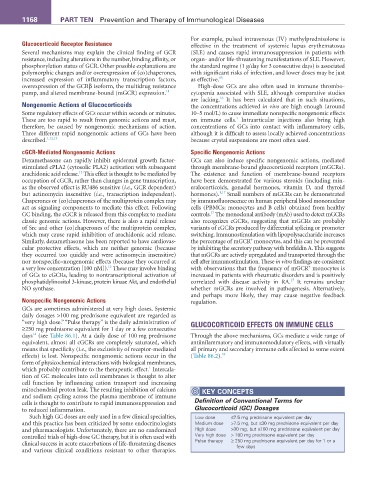
        “very high dose.” “Pulse therapy” is the daily administration of   GLUCOCORTICOID EFFECTS ON IMMUNE CELLS
        ≥250 mg prednisone equivalent for 1 day or a few consecutive
            14
        days  (see Table 86.1). At a daily dose of 100 mg prednisone   Through the above mechanisms, GCs mediate a wide range of
        equivalent, almost all cGCRs are completely saturated, which   antiinflammatory and immunomodulatory effects, with virtually
        means that specificity (i.e., the exclusivity of receptor-mediated   all primary and secondary immune cells affected to some extent
        effects) is lost. Nonspecific nongenomic actions occur in the   (Table 86.2). 18
        form of physicochemical interactions with biological membranes,
                                                  1
        which probably contribute to the therapeutic effect.  Intercala-
        tion of GC molecules into cell membranes is thought to alter
        cell function by influencing cation transport and increasing
        mitochondrial proton leak. The resulting inhibition of calcium    KEY CONCEPTS
        and sodium cycling across the plasma membrane of immune
        cells is thought to contribute to rapid immunosuppression and   Definition of Conventional Terms for
        to reduced inflammation.                                 Glucocorticoid (GC) Dosages
           Such high GC doses are only used in a few clinical specialties,   Low dose  ≤7.5 mg prednisone equivalent per day
        and this practice has been criticized by some endocrinologists   Medium dose  >7.5 mg, but ≤30 mg prednisone equivalent per day
        and pharmacologists. Unfortunately, there are no randomized   High dose  >30 mg, but ≤100 mg prednisone equivalent per day
        controlled trials of high-dose GC therapy, but it is often used with   Very high dose  > 100 mg prednisone equivalent per day
        clinical success in acute exacerbations of life-threatening diseases   Pulse therapy  ≥ 250 mg prednisone equivalent per day for 1 or a
                                                                              few days
        and various clinical conditions resistant to other therapies.

