


Page 1227 - Clinical Immunology_ Principles and Practice ( PDFDrive )
P. 1227
1190         PART TEN  Prevention and Therapy of Immunological Diseases


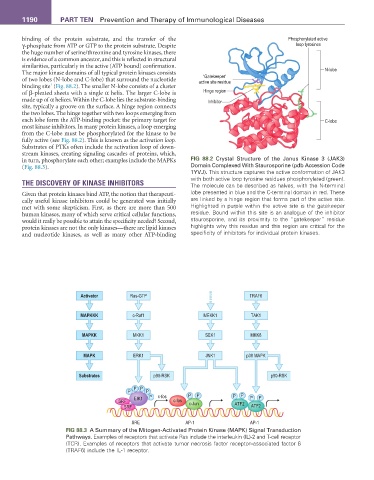
        binding of the protein substrate, and the transfer of the                              Phosphorylated active
        γ-phosphate from ATP or GTP to the protein substrate. Despite                             loop tyrosines
        the huge number of serine/threonine and tyrosine kinases, there
        is evidence of a common ancestor, and this is reflected in structural
        similarities, particularly in the active (ATP bound) confirmation.
        The major kinase domains of all typical protein kinases consists                                   N-lobe
                                                                    ‘Gatekeeper’
        of two lobes (N-lobe and C-lobe) that surround the nucleotide   active site residue
                 1
        binding site  (Fig. 88.2). The smaller N-lobe consists of a cluster
        of β-pleated sheets with a single α helix. The larger C-lobe is   Hinge region
        made up of α helices. Within the C-lobe lies the substrate-binding   Inhibitor
        site, typically a groove on the surface. A hinge region connects
        the two lobes. The hinge together with two loops emerging from
        each lobe form the ATP-binding pocket: the primary target for                                      C-lobe
        most kinase inhibitors. In many protein kinases, a loop emerging
        from the C-lobe must be phosphorylated for the kinase to be
        fully active (see Fig. 88.2). This is known as the activation loop.
        Substrates of PTKs often include the activation loop of down-
        stream kinases, creating signaling cascades of proteins, which,
        in turn, phosphorylate each other; examples include the MAPKs   FIG 88.2  Crystal Structure of the Janus Kinase 3 (JAK3)
        (Fig. 88.3).                                           Domain Complexed With Staurosporine (pdb Accession Code
                                                               1YVJ). This structure captures the active conformation of JAK3
                                                               with both active loop tyrosine residues phosphorylated (green).
        THE DISCOVERY OF KINASE INHIBITORS                     The molecule can be described as halves, with the N-terminal
        Given that protein kinases bind ATP, the notion that therapeuti-  lobe presented in blue and the C-terminal domain in red. These
        cally useful kinase inhibitors could be generated was initially   are linked by a hinge region that forms part of the active site.
        met with some skepticism. First, as there are more than 500   Highlighted in purple within the active site is the gatekeeper
        human kinases, many of which serve critical cellular functions,   residue. Bound within this site is an analogue of the inhibitor
        would it really be possible to attain the specificity needed? Second,   staurosporine, and its proximity to the “gatekeeper” residue
        protein kinases are not the only kinases—there are lipid kinases   highlights why this residue and this region are critical for the
        and nucleotide kinases, as well as many other  ATP-binding   specificity of inhibitors for individual protein kinases.


                           Activator        Ras-GTP                                TRAF6


                           MAPKKK           c-Raf1                  MEKK1          TAK1


                            MAPKK            MKK1                   SEK1           MKK6


                            MAPK             ERK1                   JNK1          p38 MAPK


                           Substrates              p90-RSK                                p90-RSK

                                             P P
                                           P     P
                                             EIK1  P  c-fos    P  P          P  P  P  P
                                        SRF               c-fos  c-Jun        ATF2
                                          SRF                                      ATF2

                                            SRE               AP-1                 AP-1
                       FIG 88.3  A Summary of the Mitogen-Activated Protein Kinase (MAPK) Signal Transduction
                       Pathways. Examples of receptors that activate Ras include the interleukin (IL)-2 and T-cell receptor
                       (TCR). Examples of receptors that activate tumor necrosis factor receptor–associated factor 6
                       (TRAF6) include the IL-1 receptor.

