


Page 1229 - Clinical Immunology_ Principles and Practice ( PDFDrive )
P. 1229
1192         PART TEN  Prevention and Therapy of Immunological Diseases


        kinases. These  mAbs  include  and  target  the  designated  RTK:   identifying mutations in patients with immunodeficiencies.
        bevacizumab  (vascular  endothelial  growth  factor  receptor   Specifically, mutation of  JAK3 results in a severe combined
        [VEGFR]), ranibizumab (VEGFR), cetuximab (epidermal growth   immune deficiency (SCID), characterized by an almost complete
        factor receptor [EGFR]), pertuzumab (human epidermal growth   absence of T cells and NK cells with defective B cells. This
        factor receptor [HER]), and trastuzumab (HER2/neu).    phenocopies deficiency of the cognate receptor that associates
                                                               with JAK3, the IL-2 receptor common γ chain, cγc (encoded by
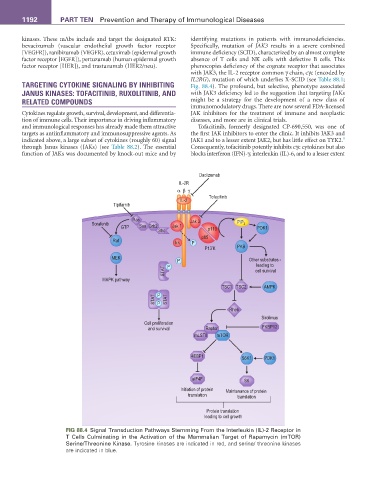
                                                               IL2RG), mutation of which underlies X-SCID (see Table 88.1;
        TARGETING CYTOKINE SIGNALING BY INHIBITING             Fig. 88.4). The profound, but selective, phenotype associated
        JANUS KINASES: TOFACITINIB, RUXOLITINIB, AND           with JAK3 deficiency led to the suggestion that targeting JAKs
        RELATED COMPOUNDS                                      might be a strategy for the development of a new class of
                                                               immunomodulatory drugs. There are now several FDA-licensed
        Cytokines regulate growth, survival, development, and differentia-  JAK inhibitors for the treatment of immune and neoplastic
        tion of immune cells. Their importance in driving inflammatory   diseases, and more are in clinical trials.
        and immunological responses has already made them attractive   Tofacitinib, formerly designated CP-690,550, was  one  of
        targets as antiinflammatory and immunosuppressive agents. As   the first JAK inhibitors to enter the clinic. It inhibits JAK3 and
                                                                                                                 9
        indicated above, a large subset of cytokines (roughly 60) signal   JAK1 and to a lesser extent JAK2, but has little effect on TYK2.
        through Janus kinases (JAKs) (see  Table 88.2). The essential   Consequently, tofacitinib potently inhibits cγc cytokines but also
        function of JAKs was documented by knock-out mice and by   blocks interferon (IFN)-γ, interleukin (IL)-6, and to a lesser extent


                                                                  Daclizumab
                                                            IL-2R
                                                           αβ γ
                                                                     Tofacitinib
                                                            IL-2
                                      Tipifarnib
                                            Ras                Jak 3
                               Sorafenib                                       PIP 3
                                         GTP   Sos  Grb2  Jak 1                      PDK1
                                                     Shc             p110
                                                                   p85
                                      Raf                 Ick   P
                                                                    P13’K      PKB
                                      MEK
                                                           P                      Other substrates -
                                                                                     leading to
                                                       STAT  P                       cell survival
                                   MAPK pathway
                                                                          TSC1  TSC2   AMPK
                                                   STAT  P P  STAT
                                                                            Rheb
                                                                                       Sirolimus
                                                Cell proliferation
                                                 and survival       Raptor             FKBP12
                                                                 mLST8  mTOR


                                                                4EBP1           S6K1    PDK1


                                                                eIF4F            S6
                                                            Initiation of protein   Maintenance of protein
                                                               translation     translation

                                                                     Protein translation
                                                                    leading to cell growth

                       FIG 88.4  Signal Transduction Pathways Stemming From the Interleukin (IL)-2 Receptor in
                       T Cells Culminating in the Activation of the Mammalian Target of Rapamycin (mTOR)
                       Serine/Threonine Kinase. Tyrosine kinases are indicated in red, and serine/ threonine kinases
                       are indicated in blue.

