


Page 1257 - Clinical Immunology_ Principles and Practice ( PDFDrive )
P. 1257
1218         Part ten  Prevention and Therapy of Immunological Diseases


        many European countries publish their own country-specific   computation, and science will result in improvements in human
        immunization schedules, and vaccination guidelines that are   health remains to be seen. At present there is some (healthy)
        published by the WHO are utilized by many developing countries.   skepticism about the big data systems biology approach. The
        The schedules are generally similar but with some region-specific   field must show that the massive data can be analyzed
        differences. For example, the 2016 US  ACIP immunization   and integrated and that the approach is more than a fishing
        schedule for children recommends vaccinations against 10 viral   expedition but, rather, is an exploratory engine that is hypothesis
        diseases: hepatitis B, rotavirus infection, polio, influenza, measles,   generating and also leads to models that will be tested and will
                                                         58
        mumps, rubella, varicella, hepatitis  A, and HPV infection.    produce new knowledge, resulting in improved vaccines that
        Preventive viral vaccines in the WHO-recommended routine   benefit human health.
        immunization schedule for children include the same 10 viral   For outstanding scientists to be attracted to and retained in
        vaccines (although four of those, mumps, influenza, varicella,   the field of vaccinology, it is essential that science funding agencies
        and hepatitis A vaccines, are recommended only for country-  provide and maintain robust support for critical discovery research
        specific immunization programs with certain characteristics).   projects (investigator-initiated research projects) that form the
        The WHO schedule also recommends some additional vaccines   engine of innovation that drives all of science. At the same time,
        (e.g., rabies, yellow fever, Japanese encephalitis, and tick-borne   targeted big science vaccine program projects and networks have
        encephalitis vaccines are recommended for certain high-risk   the potential to synergistically pool their approaches in an intense
        populations). 59                                       focused effort to tackle major vaccine needs and challenges (e.g.,
                                                               development of HIV and TB vaccines). To translate basic advances
        SOME PRESENT AND FUTURE CHALLENGES                     and laboratory science into improved health care for patients,
                                                               having  well-trained  translational  physician-scientists lead
        The science of vaccinology is exciting and strong, having entered   clinical–translational human research programs is an additional
        a new era with the high-throughput analytical and data approaches   component of essential infrastructure. There is a need for
        being applied today.  Whether these advances in technology,   postdoctoral training programs that focus on vaccinology, but


                       Vaccine       19–21 years    22–26 years     27–59 years    60–64 years    ≥ 65 years

                   Influenza 1                                    1 dose annually
                   Td/Tdap 2                          Substitute Tdap for Td once, then Td booster every 10 yrs
                   MMR 3                            1 or 2 doses depending on indication

                   VAR 4                                            2 doses
                   HZV 5                                                                    1 dose

                   HPV–Female 6               3 doses
                   HPV–Male 6                 3 doses
                   PCV13 7                                                                  1 dose

                   PPSV23 7                                 1 or 2 doses depending on indication   1 dose
                   HepA 8                                   2 or 3 doses depending on vaccine
                   HepB 9                                           3 doses
                   MenACWY or
                   MPSV4 10                                1 or more doses depending on indication
                   MenB 10                                  2 or 3 doses depending on vaccine
                   Hib 11                                   1 or 3 doses depending on indication

                              Recommended for adults who meet the  Recommended for adults with additional
                              age requirement, lack documentation of  medical conditions or other indications  No recommendation
                              vaccination, or lack evidence of past infection
             A
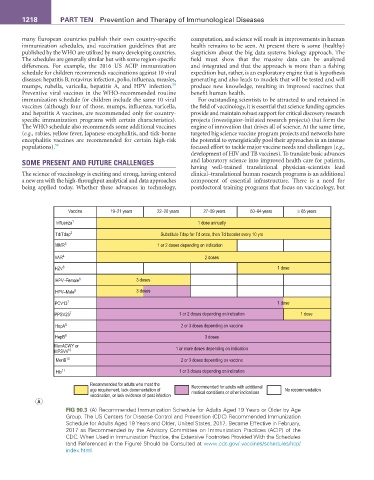
                       FIG 90.3  (A) Recommended Immunization Schedule for Adults Aged 19 Years or Older by Age
                       Group. The US Centers for Disease Control and Prevention (CDC) Recommended Immunization
                       Schedule for Adults Aged 19 Years and Older, United States, 2017, Became Effective in February,
                       2017 as Recommended by the Advisory Committee on Immunization Practices (ACIP) of the
                       CDC. When Used in Immunization Practice, the Extensive Footnotes Provided With the Schedules
                       (and Referenced in the Figure) Should be Consulted at www.cdc.gov/ vaccines/schedules/hcp/
                       index.html.

