


Page 1258 - Clinical Immunology_ Principles and Practice ( PDFDrive )
P. 1258
CHaPter 90  Vaccines            1219


                                      Immuno-  HIV infection  Asplenia,  Kidney failure,  Heart or
                                     compromised  CD4+count  persistent  end-stage renal lung disease,      Men who
                                    (excluding HIV (xells/µL) 3–7,9–11  complement  disease,on  chronic  Chronic liver  Healthcare  have sex
                  Vaccine  Pregnancy 1–6,9 infection) 3–7,11  < 200  ≥ 200  deficiencies  7,10,11  hemodialysis 7,9  alcoholism 7  disease 7–9  Diabetes 7,9  personnel 3,4,9  with men 6,8,9
              Influenza 1                                          1 dose annually
                             1 dose
              Td/Tdap 2     Tdap each                  Substitute Tdap for Td once,then Td booster every 10 yrs
                            pregnancy
              MMR 3              contraindicated             1 or 2 doses depending on indication

              VAR 4              contraindicated                       2 doses
              HZV 5              contraindicated                       1 doses

              HPV–Female 6                                       3 doses through age 26 yrs
                                                                                                             3 doses
              HPV–Male 6             3 doses through age 26 yrs  3 doses through age 21 yrs                through age
                                                                                                             26 yrs
              PCV13 7                                                   1 dose

              PPSV23 7                                                      1, 2, or 3 doses depending on indication

              HepA 8                                                          2 or 3 doses depending on vaccine
              HepB 9                                                            3 doses
              MenACWY or
              MPSV4 10                                 1 or more doses depending on indication

              MenB 10                                    2 or 3 doses depending on vaccine
                                      3 doses
              Hib 11                 post-HSCT                 1 dose
                                    recipients only
                    Recommended for adults who meet the  Recommended for adults with additional
                    age requirement, lack documentation of  medical conditions or other indications  Contraindicated  No recommendation
                    vaccination, or lack evidence of past infection
             B
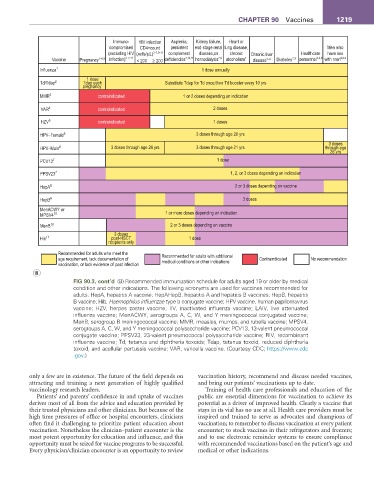
                         FIG 90.3, cont’d  (B) Recommended immunization schedule for adults aged 19 or older by medical
                         condition and other indications. The following acronyms are used for vaccines recommended for
                         adults: HepA, hepatitis A vaccine; HepAHepB, hepatitis A and hepatitis B vaccines; HepB, hepatitis
                         B vaccine; Hib, Haemophilus influenzae type b conjugate vaccine; HPV vaccine, human papillomavirus
                         vaccine; HZV, herpes zoster vaccine; IIV, inactivated influenza vaccine; LAIV, live attenuated
                         influenza vaccine; MenACWY, serogroups A, C, W, and Y meningococcal conjugated vaccine;
                         MenB, serogroup B meningococcal vaccine; MMR, measles, mumps, and rubella vaccine; MPSV4,
                         serogroups A, C, W, and Y meningococcal polysaccharide vaccine; PCV13, 13-valent pneumococcal
                         conjugate vaccine; PPSV23, 23-valent pneumococcal polysaccharide vaccine; RIV, recombinant
                         influenza vaccine; Td, tetanus and diphtheria toxoids; Tdap, tetanus toxoid, reduced diphtheria
                         toxoid, and acellular pertussis vaccine; VAR, varicella vaccine. (Courtesy CDC; https://www.cdc
                         .gov.)


           only a few are in existence. The future of the field depends on   vaccination history, recommend and discuss needed vaccines,
           attracting and training a next generation of highly qualified   and bring our patients’ vaccinations up to date.
           vaccinology research leaders.                            Training of health care professionals and education of the
             Patients’ and parents’ confidence in and uptake of vaccines   public are essential dimensions for vaccination to achieve its
           derives most of all from the advice and education provided by   potential as a driver of improved health. Clearly a vaccine that
           their trusted physicians and other clinicians. But because of the   stays in its vial has no use at all. Health care providers must be
           high time pressures of office or hospital encounters, clinicians   inspired and trained to serve as advocates and champions of
           often find it challenging to prioritize patient education about   vaccination; to remember to discuss vaccination at every patient
           vaccination. Nonetheless the clinician–patient encounter is the   encounter; to stock vaccines in their refrigerators and freezers;
           most potent opportunity for education and influence, and this   and to use electronic reminder systems to ensure compliance
           opportunity must be seized for vaccine programs to be successful.   with recommended vaccinations based on the patient’s age and
           Every physician/clinician encounter is an opportunity to review   medical or other indications.

