


Page 127 - Clinical Immunology_ Principles and Practice ( PDFDrive )
P. 127
110          ParT ONE  Principles of Immune Response


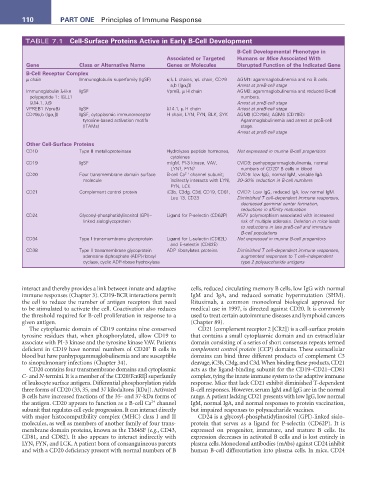
         TABLE 7.1  Cell-Surface Proteins active in Early B-Cell Development
                                                                               B-Cell Developmental Phenotype in
                                                        associated or Targeted   Humans or Mice associated With
          Gene             Class or alternative Name    Genes or Molecules     Disrupted Function of the Indicated Gene
          B-Cell receptor Complex
          µ chain          Immunoglobulin superfamily (IgSF)  κ,λ L chains, ψL chain, CD79   AGM1: agammaglobulinemia and no B cells.
                                                         a,b (Igα,β)           Arrest at preB-cell stage
          Immunoglobulin λ-like   IgSF                  VpreB, µ H chain       AGM2: agammaglobulinemia and reduced B-cell
           polypeptide 1; IGLL1                                                 numbers.
           (λ14.1, λ5)                                                         Arrest at preB-cell stage
          VPREB1 (VpreB)   IgSF                         λ14.1, µ H chain       Arrest at preB-cell stage
          CD79a,b (Igα,β)  IgSF, cytoplasmic immunoreceptor   H chain, LYN, FYN, BLK, SYK  AGM3 (CD79A); AGM6 (CD79B):
                            tyrosine-based activation motifs                    Agammaglobulinemia and arrest at proB-cell
                            (ITAMs)                                             stage.
                                                                               Arrest at proB-cell stage

          Other Cell-Surface Proteins
          CD10             Type II metalloproteinase    Hydrolyzes peptide hormones,   Not expressed in murine B-cell progenitors
                                                         cytokines
          CD19             IgSF                         mIgM, PI-3 kinase, VAV,   CVID3: panhypogammaglobulinemia, normal
                                                                                            +
                                                         LYN?, FYN?             numbers of CD20  B cells in blood
                                                              2 +
          CD20             Four transmembrane domain surface   B-cell Ca  channel subunit;   CVID5: low IgG, normal IgM, variable IgA
                            molecule                     indirectly interacts with LYN,   20–30% reduction in B-cell numbers
                                                         FYN, LCK
          CD21             Complement control protein   iC3b, C3dg, C3d, CD19, CD81,   CVID7: Low IgG, reduced IgA, low normal IgM.
                                                         Leu 13, CD23          Diminished T cell–dependent immune responses,
                                                                                decreased germinal center formation,
                                                                                reductions in affinity maturation
          CD24             Glycosyl-phosphatidylinositol (GPI)–  Ligand for P-selectin (CD62P)  A57V polymorphism associated with increased
                            linked sialoglycoprotein                            risk of multiple sclerosis. Deletion in mice leads
                                                                                to reductions in late preB-cell and immature
                                                                                B-cell populations
          CD34             Type I transmembrane glycoprotein  Ligand for L-selectin (CD62L)   Not expressed in murine B-cell progenitors
                                                         and E-selectin (CD62E)
          CD38             Type II transmembrane glycoprotein   ADP ribosylates proteins  Diminished T cell–dependent immune responses,
                            adenosine diphosphate (ADP)-ribosyl                 augmented responses to T cell–independent
                            cyclase, cyclic ADP-ribose hydroxylase              type 2 polysaccharide antigens


        interact and thereby provides a link between innate and adaptive   cells, reduced circulating memory B cells, low IgG with normal
        immune responses (Chapter 3). CD19-BCR interactions permit   IgM and IgA, and reduced somatic hypermutation (SHM).
        the cell to reduce the number of antigen receptors that need   Rituximab, a common monoclonal biological approved for
        to be stimulated to activate the cell. Coactivation also reduces   medical use in 1997, is directed against CD20. It is commonly
        the threshold required for B-cell proliferation in response to a   used to treat certain autoimmune diseases and lymphoid cancers
        given antigen.                                         (Chapter 89).
           The cytoplasmic domain of CD19 contains nine conserved   CD21 (complement receptor 2 [CR2]) is a cell-surface protein
        tyrosine residues that, when phosphorylated, allow CD19 to   that contains a small cytoplasmic domain and an extracellular
        associate with PI-3 kinase and the tyrosine kinase VAV. Patients   domain consisting of a series of short consensus repeats termed
                                                  +
        deficient in CD19 have normal numbers of CD20  B cells in   complement control protein (CCP) domains. These extracellular
        blood but have panhypogammaglobulinemia and are susceptible   domains can bind three different products of complement C3
        to sinopulmonary infections (Chapter 34).              cleavage, iC3b, C3dg, and C3d. When binding these products, CD21
           CD20 contains four transmembrane domains and cytoplasmic   acts as the ligand-binding subunit for the CD19–CD21–CD81
        C- and N-termini. It is a member of the CD20/FcεRIβ superfamily   complex, tying the innate immune system to the adaptive immune
        of leukocyte surface antigens. Differential phosphorylation yields   response. Mice that lack CD21 exhibit diminished T-dependent
        three forms of CD20 (33, 35, and 37 kilodaltons [kDa]). Activated   B-cell responses. However, serum IgM and IgG are in the normal
        B cells have increased fractions of the 35- and 37-kDa forms of   range. A patient lacking CD21 presents with low IgG, low normal
                                                   2+
        the antigen. CD20 appears to function as a B-cell Ca  channel   IgM, normal IgA, and normal responses to protein vaccination,
        subunit that regulates cell cycle progression. It can interact directly   but impaired responses to polysaccharide vaccines.
        with major histocompatibility complex (MHC) class I and II   CD24 is a glycosyl-phosphatidylinositol (GPI)-linked sialo-
        molecules, as well as members of another family of four trans-  protein that serves as a ligand for P-selectin (CD62P). It is
        membrane domain proteins, known as the TM4SF (e.g., CD43,   expressed on progenitor, immature, and mature B cells. Its
        CD81, and CD82). It also appears to interact indirectly with   expression decreases in activated B cells and is lost entirely in
        LYN, FYN, and LCK. A patient born of consanguineous parents   plasma cells. Monoclonal antibodies (mAbs) against CD24 inhibit
        and with a CD20 deficiency present with normal numbers of B   human B-cell differentiation into plasma cells. In mice, CD24

