


Page 129 - Clinical Immunology_ Principles and Practice ( PDFDrive )
P. 129
112          ParT ONE  Principles of Immune Response


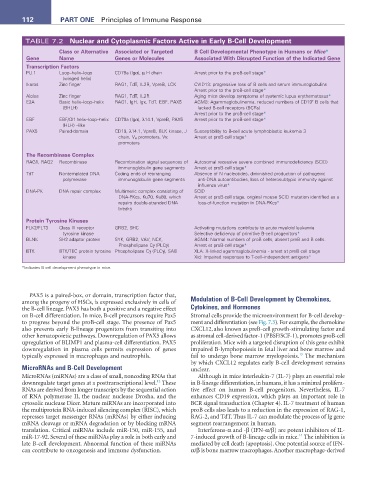
         TABLE 7.2  Nuclear and Cytoplasmic Factors active in Early B-Cell Development
                    Class or alternative  associated or Targeted   B Cell Developmental Phenotype in Humans or Mice*
          Gene      Name               Genes or Molecules        associated With Disrupted Function of the Indicated Gene
          Transcription Factors
          PU.1      Loop–helix–loop    CD79a (Igα), µ H chain    Arrest prior to the proB-cell stage*
                      (winged helix)
          Ikaros    Zinc finger        RAG1, TdT, IL2R, VpreB, LCK  CVID13: progressive loss of B cells and serum immunoglobulins
                                                                 Arrest prior to the proB-cell stage*
          Aiolos    Zinc finger        RAG1, TdT, IL2R           Aging mice develop symptoms of systemic lupus erythematosus*
                                                                                                       +
          E2A       Basic helix–loop–helix   RAG1, IgH, Igκ, TdT, EBF, PAX5  AGM8: Agammaglobulinemia, reduced numbers of CD19  B cells that
                      (BHLH)                                      lacked B-cell receptors (BCRs)
                                                                 Arrest prior to the proB-cell stage*
          EBF       EBF/Olf helix–loop–helix   CD79a (Igα), λ14.1, VpreB, PAX5  Arrest prior to the proB-cell stage*
                      (HLH) –like
          PAX5      Paired-domain      CD19, λ14.1, VpreB, BLK kinase, J   Susceptibility to B-cell acute lymphoblastic leukemia 3
                                        chain, V H  promoters, Vκ   Arrest at proB-cell stage*
                                        promoters

          The recombinase Complex
          RAG1, RAG2  Recombinase      Recombination signal sequences of   Autosomal recessive severe combined immunodeficiency (SCID)
                                        immunoglobulin gene segments  Arrest at proB-cell stage*
          TdT       Nontemplated DNA   Coding ends of rearranging   Absence of N nucleotides, diminished production of pathogenic
                      polymerase        immunoglobulin gene segments  anti-DNA autoantibodies, loss of heterosubtypic immunity against
                                                                  influenza virus*
          DNA-PK    DNA repair complex  Multimeric complex consisting of   SCID
                                        DNA-PKcs, Ku70, Ku80, which   Arrest at proB-cell stage, original mouse SCID mutation identified as a
                                        repairs double-stranded DNA   loss-of-function mutation in DNA-PKcs*
                                        breaks
          Protein Tyrosine Kinases
          FLK2/FLT3  Class III receptor   GRB2, SHC              Activating mutations contribute to acute myeloid leukemia
                      tyrosine kinase                            Selective deficiency of primitive B-cell progenitors*
          BLNK      SH2 adaptor protein  SYK, GRB2, VAV, NCK,    AGM4: Normal numbers of proB cells, absent preB and B cells.
                                        Phospholipase Cγ (PLCγ)  Arrest at proB-cell stage*
          BTK       BTK/TEC protein tyrosine  Phospholipase Cγ (PLCγ), SAB  XLA: X-linked agammaglobulinemia - arrest at preB cell stage
                      kinase                                     Xid: Impaired responses to T-cell–independent antigens*
        *Indicates B cell development phenotype in mice.


           PAX5 is a paired-box, or domain, transcription factor that,
        among the progeny of HSCs, is expressed exclusively in cells of   Modulation of B-Cell Development by Chemokines,
        the B-cell lineage. PAX5 has both a positive and a negative effect   Cytokines, and Hormones
        on B-cell differentiation. In mice, B-cell precursors require Pax5   Stromal cells provide the microenvironment for B-cell develop-
        to progress beyond the proB-cell stage. The presence of Pax5   ment and differentiation (see Fig. 7.3). For example, the chemokine
        also prevents early B-lineage progenitors from transiting into   CXCL12, also known as preB-cell growth-stimulating factor and
        other hematopoietic pathways. Downregulation of PAX5 allows   as stromal cell-derived factor-1 (PBSF/SCF-1), promotes proB-cell
        upregulation of BLIMP1 and plasma-cell differentiation. PAX5   proliferation. Mice with a targeted disruption of this gene exhibit
        downregulation in plasma cells permits expression of genes   impaired B-lymphopoiesis in fetal liver and bone marrow and
                                                                                                   13
        typically expressed in macrophages and neutrophils.    fail to undergo bone marrow myelopoiesis.  The mechanism
                                                               by which CXCL12 regulates early B-cell development remains
        MicroRNAs and B-Cell Development                       unclear.
        MicroRNAs (miRNAs) are a class of small, noncoding RNAs that   Although in mice interleukin-7 (IL-7) plays an essential role
                                                    12
        downregulate target genes at a posttranscriptional level.  These   in B-lineage differentiation, in humans, it has a minimal prolifera-
        RNAs are derived from longer transcripts by the sequential action   tive effect on human B-cell progenitors. Nevertheless, IL-7
        of RNA polymerase II, the nuclear nuclease Drosha, and the   enhances CD19 expression, which plays an important role in
        cytosolic nuclease Dicer. Mature miRNAs are incorporated into   BCR signal transduction (Chapter 4). IL-7 treatment of human
        the multiprotein RNA-induced silencing complex (RISC), which   proB cells also leads to a reduction in the expression of RAG-1,
        represses target messenger RNAs (mRNAs) by either inducing   RAG-2, and TdT. Thus IL-7 can modulate the process of Ig gene
        mRNA cleavage or mRNA degradation or by blocking mRNA   segment rearrangement in human.
        translation. Critical miRNAs include miR-150, miR-155, and   Interferons-α and -β (IFN-α/β) are potent inhibitors of IL-
                                                                                                   14
        miR-17-92. Several of these miRNAs play a role in both early and   7-induced growth of B-lineage cells in mice.  The inhibition is
        late B-cell development. Abnormal function of these miRNAs   mediated by cell death (apoptosis). One potential source of IFN-
        can contribute to oncogenesis and immune dysfunction.  α/β is bone marrow macrophages. Another macrophage-derived

