


Page 131 - Clinical Immunology_ Principles and Practice ( PDFDrive )
P. 131
114          ParT ONE  Principles of Immune Response


                                       B-cell follicle
                            Mantle zone             T cell–dependent activation of B cells
                                                       Germinal center formation
                            Network
                            of FDC
                                                    Light zone – affinity selected differentiation into  Memory cells
                                                    Dark zone – B-cell proliferation and diversification  Plasma cells

                                                     T-cell zone


                                                      Ti antigen activation of marginal zone B cells
                                                         Extrafollicular differentiation into short-lived plasma cells
                              Marginal zone                 Macrophages bring the antigen to the marginal zone
                                                            Dendritic cells bring antigen to the T-cell zone
                                                            Marginal zone B cells bring antigen to the follicle
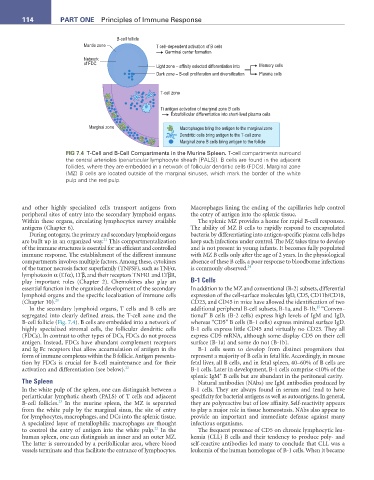
                       FIG 7.4  T-Cell and B-Cell Compartments in the Murine Spleen. T-cell compartments surround
                       the central arterioles (periarticular lymphocyte sheath [PALS]). B cells are found in the adjacent
                       follicles, where they are embedded in a network of follicular dendritic cells (FDCs). Marginal zone
                       (MZ) B cells are located outside of the marginal sinuses, which mark the border of the white
                       pulp and the red pulp.


        and other highly specialized cells transport antigens from   Macrophages lining the ending of the capillaries help control
        peripheral sites of entry into the secondary lymphoid organs.   the entry of antigen into the splenic tissue.
        Within these organs, circulating lymphocytes survey available   The splenic MZ provides a home for rapid B-cell responses.
        antigens (Chapter 6).                                  The ability of MZ B cells to rapidly respond to encapsulated
           During ontogeny, the primary and secondary lymphoid organs   bacteria by differentiating into antigen-specific plasma cells helps
                                   21
        are built up in an organized way.  This compartmentalization   keep such infections under control. The MZ takes time to develop
        of the immune structures is essential for an efficient and controlled   and is not present in young infants. It becomes fully populated
        immune response. The establishment of the different immune   with MZ B cells only after the age of 2 years. In the physiological
        compartments involves multiple factors. Among these, cytokines   absence of these B cells, a poor response to bloodborne infections
        of the tumor necrosis factor superfamily (TNFSF), such as TNFα,   is commonly observed. 24
        lymphotoxin α (LTα), LTβ, and their receptors TNFR1 and LTβR,
        play important roles (Chapter 2). Chemokines also play an   B-1 Cells
        essential function in the organized development of the secondary   In addition to the MZ and conventional (B-2) subsets, differential
        lymphoid organs and the specific localization of immune cells   expression of the cell-surface molecules IgD, CD5, CD11b/CD18,
        (Chapter 10). 20                                       CD23, and CD45 in mice have allowed the identification of two
                                                                                                         25
           In the secondary lymphoid organs, T cells and B cells are   additional peripheral B-cell subsets, B-1a, and B-1b.  “Conven-
        segregated into clearly defined areas, the T-cell zone and the   tional” B cells (B-2 cells) express high levels of IgM and IgD,
        B-cell follicle (Fig. 7.4). B cells are embedded into a network of   whereas “CD5” B cells (B-1 cells) express minimal surface IgD.
        highly specialized stromal cells, the follicular dendritic cells   B-1 cells express little CD45 and virtually no CD23. They all
        (FDCs). In contrast to other types of DCs, FDCs do not process   express CD5 mRNA, although some display CD5 on their cell
        antigen. Instead, FDCs have abundant complement receptors   surface (B-1a) and some do not (B-1b).
        and Ig Fc receptors that allow accumulation of antigen in the   B-1 cells seem to develop from distinct progenitors that
        form of immune complexes within the B follicle. Antigen presenta-  represent a majority of B cells in fetal life. Accordingly, in mouse
        tion by FDCs is crucial for B-cell maintenance and for their   fetal liver, all B cells, and in fetal spleen, 40–60% of B cells are
        activation and differentiation (see below). 22         B-1 cells. Later in development, B-1 cells comprise <10% of the
                                                                         +
                                                               splenic IgM  B cells but are abundant in the peritoneal cavity.
        The Spleen                                                Natural antibodies (NAbs) are IgM antibodies produced by
        In the white pulp of the spleen, one can distinguish between a   B-1 cells. They are always found in serum and tend to have
        periarticular lymphatic sheath (PALS) of T cells and adjacent   specificity for bacterial antigens as well as autoantigens. In general,
                    23
        B-cell follicles.  In the murine spleen, the MZ is separated   they are polyreactive but of low affinity. Self-reactivity appears
        from the white pulp by the marginal sinus, the site of entry   to play a major role in tissue homeostasis. NAbs also appear to
        for lymphocytes, macrophages, and DCs into the splenic tissue.   provide an important  and immediate defense against  many
        A specialized layer of metallophilic macrophages are thought   infectious organisms.
                                                    22
        to control the entry of antigen into the white pulp.  In the   The frequent presence of CD5 on chronic lymphocytic leu-
        human spleen, one can distinguish an inner and an outer MZ.   kemia (CLL) B cells and their tendency to produce poly- and
        The latter is surrounded by a perifollicular area, where blood   self-reactive antibodies led many to conclude that CLL was a
        vessels terminate and thus facilitate the entrance of lymphocytes.   leukemia of the human homologue of B-1 cells. When it became

