


Page 128 - Clinical Immunology_ Principles and Practice ( PDFDrive )
P. 128
CHaPTEr 7  B-Cell Development and Differentiation              111


           is also known as heat-stable antigen (HSA). Mice made deficient   PIP-deficient mice lack GCs in peripheral lymphoid organs and
           in CD24 show a leaky block in B-cell development with a reduc-  exhibit defects in B-cell activation.
           tion in late preB-cell and immature B-cell populations. However,   Ikaros and Aiolos belong to the same zinc finger transcription
           peripheral B-cell numbers are normal, and no impairment of   factor family.  Although both are expressed during lymphoid
           immune function has been demonstrated.                 development,  Ikaros  is  expressed  in  stem  cells  and  mature
             CD38 is a bifunctional enzyme that can synthesize cyclic   lymphocytes, whereas Aiolos is only expressed after commit-
           adenosine diphosphate–ribose (cADPR) from nicotinamide   ment to the  B-cell lineage. Ikaros transcripts are subject  to
                                  +
           adenine dinucleotide (NAD ) and also hydrolyze cADPR to   alternate splicing. It can generate several isoforms, each of which
           ADP-ribose. It is presumed that the enzyme exists to  ADP-  differs in its DNA-binding pattern, tendency to dimerize, and
           ribosylate target molecules. CD38 is expressed on preB cells,   nuclear localization.  Among the genes bound by Ikaros are
           activated B cells, and early plasma cells, but not on immature   TdT,  λ14.1 (λ5), VpreB, and LCK. Ikaros-deficient mice lack
           or mature B cells or on mature plasma cells. Antibodies to CD38   B cells. Aiolos-deficient mice exhibit elevated levels of IgG and
           can inhibit B lymphopoiesis, induce B-cell proliferation, and   IgE. As they age, these mice tend to develop autoantibodies and
           protect B cells from apoptosis. CD38 knock-out mice exhibit   B-cell lymphomas.
           marked deficiencies in antibody responses to T cell–dependent   The E2A locus encodes two basic helix–loop–helix transcrip-
           protein antigens and augmented antibody responses to T-cell–  tion factors that represent two alternately spliced products, E12
           independent type 2 polysaccharide antigens.            and E47. Targets for E2A include RAG-1 and TdT. Although the
                                                                  functions of E12 and E47 overlap, E47 appears to play the greater
           Transcription Factors Controlling B-Cell Differentiation  role in driving TdT and RAG-1, whereas E12 is a better activator
           Ultimately, B-cell development is a function of differential gene   of EBF and PAX5 and thus helps commit developing cells to the
           expression. Deficiencies in the function of the transcription   B-cell lineage. In mice, disruptions in the E2A gene are marked
           factors that regulate lymphoid-specific gene expression can thus   by an arrest of B-cell development prior to the first transcription
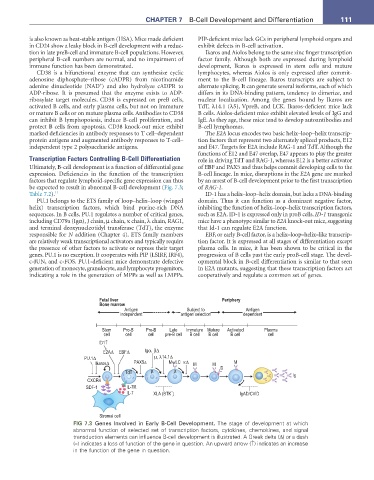
           be expected to result in abnormal B-cell development (Fig. 7.3;   of RAG-1.
           Table 7.2). 11                                           ID-1 has a helix–loop–helix domain, but lacks a DNA-binding
             PU.1 belongs to the ETS family of loop–helix–loop (winged   domain.  Thus  it  can  function  as  a  dominant  negative  factor,
           helix) transcription factors, which bind purine-rich DNA   inhibiting the function of helix–loop–helix transcription factors,
           sequences. In B cells, PU.1 regulates a number of critical genes,   such as E2A. ID-1 is expressed only in proB cells. ID-1 transgenic
           including CD79a (Igα), J chain, µ chain, κ chain, λ chain, RAG1,   mice have a phenotype similar to E2A knock-out mice, suggesting
           and terminal deoxynucleotidyl transferase (TdT), the enzyme   that Id-1 can regulate E2A function.
           responsible for N addition (Chapter 4). ETS family members   EBF, or early B-cell factor, is a helix–loop–helix–like transcrip-
           are relatively weak transcriptional activators and typically require   tion factor. It is expressed at all stages of differentiation except
           the presence of other factors to activate or repress their target   plasma cells. In mice, it has been shown to be critical in the
           genes. PU.1 is no exception. It cooperates with PIP (LSIRF, IRF4),   progression of B cells past the early proB-cell stage. The devel-
           c-JUN, and c-FOS. PU.1-deficient mice demonstrate defective   opmental block in B-cell differentiation is similar to that seen
           generation of monocyte, granulocyte, and lymphocyte progenitors,   in E2A mutants, suggesting that these transcription factors act
           indicating a role in the generation of MPPs as well as LMPPs.   cooperatively and regulate a common set of genes.


                                  Fetal liver                             Periphery
                                  Bone marrow
                                          Antigen             Subject to         Antigen
                                        independent         antigen selection    dependent

                                  Stem   Pro-B   Pre-B   Late  Immature Mature  Activated  Plasma
                                   cell   cell   cell  pre-B cell  B cell  B cell  B cell  cell
                                 ID1↑
                                   E2A∆  EBF∆   Igα, β∆
                             PU.1∆                 µ, λ14.1∆
                                Ikaros∆      PAX5∆      MψLC κ∆   M    M  D   M
                                          TdT     µ       µ
                                                                                                 Ig
                              CXCR4
                             SDF-1        IL-7R
                                          IL-7     XLA (BTK ) -                IgAD/CVID


                                  Stromal cell
                         FIG 7.3  Genes Involved in Early B-Cell Development. The stage of development at which
                         abnormal function of selected set of transcription factors, cytokines, chemokines, and signal
                         transduction elements can influence B-cell development is illustrated. A Greek delta (Δ) or a dash
                         (–) indicates a loss of function of the gene in question. An upward arrow (↑) indicates an increase
                         in the function of the gene in question.

