


Page 130 - Clinical Immunology_ Principles and Practice ( PDFDrive )
P. 130
CHaPTEr 7  B-Cell Development and Differentiation              113


           cytokine, IL-1, can also act as a dose-dependent positive or   cell–activating factor (BAFF) of the tumor necrosis factor (TNF)
           negative modulator of B lymphopoiesis.                 family, with its receptor, BAFF-R, which is expressed primarily
                                                  15
                                                                          17
             Systemic hormones also regulate lymphopoiesis.  A role for sex   on B cells.  Death signals triggered through interaction of the
           steroids is suggested by the reduction in preB cells during pregnancy.   BCR with self antigen can be counterbalanced by stimulation
           Estradiol can also alter later stages of B-cell development, promoting   of BAFF-R, which enhances expression of survival factors, such
           expansion of the marginal zone (MZ) compartment. Prolactin   as Bcl-2, and at the same time downregulates proapoptotic factors.
           appears to enhance production of both MZ and follicular B cells.   BAFF and a second TNF family member APRIL (a proliferation-
           Mice with a LOF mutation in the Pit-1 transcription factor gene   inducing ligand) are essential factors for B-cell development and
                                                                                                18
           do not produce growth hormone, prolactin, or thyroid-stimulating   also for their long-term maintenance.  With the development
           hormone. These dwarf mice exhibit a defect in B-cell development   of plasma cells, BAFF-R is downregulated while the receptors
           that is correctable by the thyroid hormone thyroxine. 16  transmembrane activator and calcium-modulator and cyclophilin
                                                                  ligand (CAML) interactor (TACI) and B-cell maturation antigen
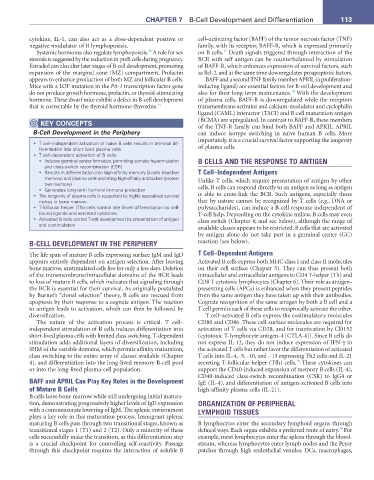
               KEY CONCEPTS                                       (BCMA) are upregulated. In contrast to BAFF-R, these members
                                                                  of the TNF-R family can bind both BAFF and APRIL. APRIL
            B-Cell Development in the Periphery                   can induce isotype switching in naïve human B cells. More
                                                                  importantly, it is a crucial survival factor supporting the longevity
            •  T cell–independent activation of naïve B cells results in terminal dif-
              ferentiation into short-lived plasma cells.         of plasma cells.
            •  T cell–dependent activation of B cells:
              •  Induces germinal center formation, permitting somatic hypermutation   B CELLS AND THE RESPONSE TO ANTIGEN
                and class-switch recombination (CSR)
              •  Results in differentiation into high-affinity memory B cells (reactive   T Cell–Independent Antigens
                memory) and plasma cells secreting high-affinity antibodies (protec-  Unlike T cells, which require presentation of antigen by other
                tive memory)
              •  Generates long-term humoral immune protection    cells, B cells can respond directly to an antigen as long as antigen
            •  The longevity of plasma cells is supported by highly specialized survival   is able to cross-link the  BCR. Such antigens, especially  those
              niches in bone marrow.                              that by nature cannot be recognized by T cells (e.g., DNA or
            •  T-follicular helper (Tfh) cells control late B-cell differentiation by cell-  polysaccharides), can induce a B-cell response independent of
              bound ligands and secreted cytokines.               T-cell help. Depending on the cytokine milieu, B cells may even
            •  Activated B cells control T-cell development by presentation of antigen   class switch (Chapter 4; and see below), although the range of
              and costimulation.
                                                                  available classes appears to be restricted. B cells that are activated
                                                                  by antigen alone do not take part in a germinal center (GC)
           B-CELL DEVELOPMENT IN THE PERIPHERY                    reaction (see below).
           The life span of mature B cells expressing surface IgM and IgD   T Cell–Dependent Antigens
           appears entirely dependent on antigen selection. After leaving   Activated B cells express both MHC class I and class II molecules
           bone marrow, unstimulated cells live for only a few days. Deletion   on their cell surface (Chapter 5). They can thus present both
           of the transmembrane/intracellular domains of the BCR leads   intracellular and extracellular antigens to CD4 T-helper (Th) and
           to loss of mature B cells, which indicates that signaling through   CD8 T cytotoxic lymphocytes (Chapter 6). Their role as antigen-
           the BCR is essential for their survival. As originally postulated   presenting cells (APCs) is enhanced when they present peptides
           by Burnet’s “clonal selection” theory, B cells are rescued from   from the same antigen they have taken up with their antibodies.
           apoptosis by their response to a cognate antigen. The reaction   Cognate recognition of the same antigen by both a B cell and a
           to antigen leads to activation, which can then be followed by   T cell permits each of these cells to reciprocally activate the other.
           diversification.                                         T cell–activated B cells express the costimulatory molecules
             The nature of the activation process is critical. T cell–  CD80 and CD86. These cell-surface molecules are required for
           independent stimulation of B cells induces differentiation into   activation of T cells via CD28, and for inactivation by CD152
           short-lived plasma cells with limited class switching. T-dependent   (cytotoxic T-lymphocyte antigen-4 [CTLA-4]). Since B cells do
           stimulation adds additional layers of diversification, including   not express IL-12, they do not induce expression of IFN-γ in
           SHM of the variable domains, which permits affinity maturation,   the activated T cells but rather favor the differentiation of activated
           class switching to the entire array of classes available (Chapter   T cells into IL-4, -5, -10, and - 13 expressing Th2 cells and IL-21
                                                                                                  19
           4), and differentiation into the long-lived memory B-cell pool   secreting T-follicular helper (Tfh) cells.  These cytokines can
           or into the long-lived plasma-cell population.         support the CD40-induced expansion of memory B cells (IL-4),
                                                                  CD40-induced class-switch recombination (CSR) to IgG4 or
           BAFF and APRIL Can Play Key Roles in the Development   IgE (IL-4), and differentiation of antigen-activated B cells into
           of Mature B Cells                                      high-affinity plasma cells (IL-21).
           B cells leave bone marrow while still undergoing initial matura-
           tion, demonstrating progressively higher levels of IgD expression   ORGANIZATION OF PERIPHERAL
           with a commensurate lowering of IgM. The splenic environment   LYMPHOID TISSUES
           plays a key role in this maturation process. Immigrant splenic
           maturing B cells pass through two transitional stages, known as   B lymphocytes enter the secondary lymphoid organs through
                                                                                                                20
           transitional stages 1 (T1) and 2 (T2). Only a minority of these   defined ways. Each organ exhibits a preferred route of entry.  For
           cells successfully make the transition, as this differentiation step   example, most lymphocytes enter the spleen through the blood-
           is a crucial checkpoint for controlling self-reactivity. Passage   stream, whereas lymphocytes enter lymph nodes and the Peyer
           through this checkpoint requires the interaction of soluble B   patches through high endothelial venules. DCs, macrophages,

