


Page 1337 - Clinical Immunology_ Principles and Practice ( PDFDrive )
P. 1337
1298         ParT ElEvEN  Diagnostic Immunology


                Single Nucleotide Variant or Mutation             Short Tandem Repeat (STR)            Allele
                      10        20      30
               –ggattacctg   acccAccgct     taatcattga     Reference                                     2
                                                                      –ggattacctCAGCAGccgcttaatcattgatt
               –ggattacctg    acccGccgct    taatcattga     c.15A>G
                                                                                                         5
                                                                      –ggattacctCAGCAGCAGCAGCAGccgcttaatcattgatt
                Deletion
                      10        20      30
               –ggattacctg    acccACCgct     taatcattga
                                                                  Structural and Copy Number Variants (CNV)
               –ggattacctg    accc–––gct    taatcattga     c.15_17delACC
                                                                  Deletion

                Insertion
                      10        20      30
               –ggattacctg   accc-accgct    taatcattga
               –ggattacctg   acccGaccgct    taatcattga     c.14_15insG
                                                                  Duplication
                Insertion/Deletion
                      10        20      30
               –ggattacctg   acccACCgct    taatcattga
               –ggattacctg   acccGATgct    taatcattga     c.15_17delinsGAT
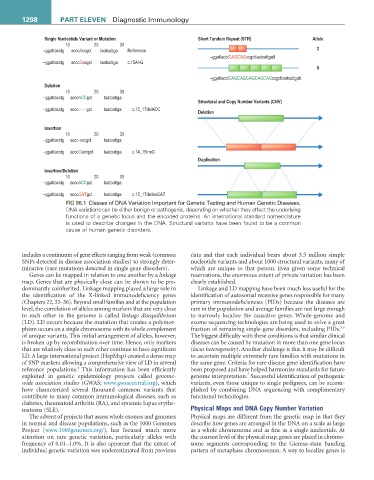
                       FIG 96.1  Classes of DNA Variation Important for Genetic Testing and Human Genetic Diseases.
                       DNA variations can be either benign or pathogenic, depending on whether they affect the underlying
                       functions of a genetic locus and the encoded proteins. An international standard nomenclature
                       is used to describe changes in the DNA. Structural variants have been found to be a common
                       cause of human genetic disorders.


        includes a continuum of gene effects ranging from weak (common   data and that each individual bears about 3.5 million simple
        SNPs detected in disease association studies) to strongly deter-  nucleotide variants and about 1000 structural variants, many of
        minative (rare mutations detected in single gene disorders).  which are unique to that person. Even given some technical
           Genes can be mapped in relation to one another by a linkage   reservations, the enormous extent of private variation has been
        map. Genes that are physically close can be shown to be pre-  clearly established.
        dominantly coinherited. Linkage mapping played a large role in   Linkage and LD mapping have been much less useful for the
        the  identification  of  the X-linked immunodeficiency  genes   identification of autosomal recessive genes responsible for many
        (Chapters 22, 33–36). Beyond small families and at the population   primary immunodeficiencies (PIDs) because the diseases are
        level, the correlation of alleles among markers that are very close   rare in the population and average families are not large enough
        to each other in the genome is called  linkage disequilibrium    to narrowly localize the causative genes.  Whole-genome and
        (LD). LD occurs because the mutation that creates a polymor-  exome sequencing technologies are being used to solve a great
                                                                                                                5,6
        phism occurs on a single chromosome with its whole complement   fraction of remaining single-gene disorders, including PIDs.
        of unique variants. This initial arrangement of alleles, however,   The biggest difficulty with these conditions is that similar clinical
        is broken up by recombination over time. Hence, only markers   diseases can be caused by mutation in more than one gene locus
        that are relatively close to each other continue to have significant   (locus heterogeneity). Another challenge is that it may be difficult
        LD. A large international project (HapMap) created a dense map   to ascertain multiple extremely rare families with mutations in
        of SNP markers allowing a comprehensive view of LD in several   the same gene. Criteria for rare disease gene identification have
                          4
        reference populations.  This information has been efficiently   been proposed and have helped harmonize standards for future
                                                                                  7
        exploited in genetic epidemiology projects called  genome-   genome interpretation.  Successful identification of pathogenic
        wide association studies (GWAS; www.gwascentral.org), which   variants, even those unique to single pedigrees, can be accom-
        have characterized several thousand common variants that   plished by combining DNA sequencing with complimentary
        contribute to many common immunological diseases, such as   functional technologies.
        diabetes, rheumatoid arthritis (RA), and systemic lupus erythe-
        matosus (SLE).                                         Physical Maps and DNA Copy Number Variation
           The advent of projects that assess whole exomes and genomes   Physical maps are different from the genetic map in that they
        in normal and disease populations, such as the 1000 Genomes   describe how genes are arranged in the DNA on a scale as large
        Project (www.1000genomes.org/), has focused much more   as a whole chromosome and as fine as a single nucleotide. At
        attention on rare genetic variation, particularly alleles with   the coarsest level of the physical map, genes are placed in chromo-
        frequency of 0.01–1.0%. It is also apparent that the extent of   some segments corresponding to the Giemsa-stain banding
        individual genetic variation was underestimated from previous   pattern of metaphase chromosomes. A way to localize genes is

