


Page 1342 - Clinical Immunology_ Principles and Practice ( PDFDrive )
P. 1342
CHaPTEr 96  Molecular Methods              1303


           expression analysis, cDNA “target” derived from the tissue or
           cell source is labeled with fluorophores and used to determine   Sanger Sequencing
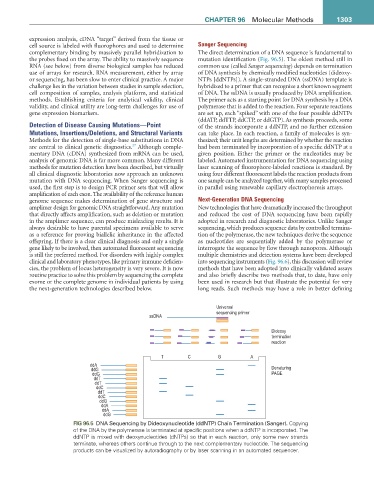
           complementary binding by massively parallel hybridization to   The direct determination of a DNA sequence is fundamental to
           the probes fixed on the array. The ability to massively sequence   mutation identification (Fig. 96.5). The oldest method still in
           RNA (see below) from diverse biological samples has reduced   common use (called Sanger sequencing) depends on termination
           use of arrays for research. RNA measurement, either by array   of DNA synthesis by chemically modified nucleotides (dideoxy-
           or sequencing, has been slow to enter clinical practice. A major   NTPs [ddNTPs]). A single-stranded DNA (ssDNA) template is
           challenge lies in the variation between studies in sample selection,   hybridized to a primer that can recognize a short known segment
           cell composition of samples, analysis platform, and statistical   of DNA. The ssDNA is usually produced by DNA amplification.
           methods. Establishing criteria for analytical validity, clinical   The primer acts as a starting point for DNA synthesis by a DNA
           validity, and clinical utility are long-term challenges for use of   polymerase that is added to the reaction. Four separate reactions
           gene expression biomarkers.                            are set up, each “spiked” with one of the four possible ddNTPs
                                                                  (ddATP, ddTTP, ddCTP, or ddGTP). As synthesis proceeds, some
           Detection of Disease Causing Mutations—Point           of the strands incorporate a ddNTP, and no further extension
           Mutations, Insertions/Deletions, and Structural Variants  can take place. In each reaction, a family of molecules is syn-
           Methods for the detection of single-base substitutions in DNA   thesized; their unit lengths are determined by whether the reaction
                                            27
           are central to clinical genetic diagnostics.  Although comple-  had been terminated by incorporation of a specific ddNTP at a
           mentary DNA (cDNA) synthesized from mRNA can be used,   given position. Either the primer or the nucleotides may be
           analysis of genomic DNA is far more common. Many different   labeled. Automated instrumentation for DNA sequencing using
           methods for mutation detection have been described, but virtually   laser scanning of fluorophore-labeled reactions is standard. By
           all clinical diagnostic laboratories now approach an unknown   using four different fluorescent labels the reaction products from
           mutation with DNA sequencing. When Sanger sequencing is   one sample can be analyzed together, with many samples processed
           used, the first step is to design PCR primer sets that will allow   in parallel using renewable capillary electrophoresis arrays.
           amplification of each exon. The availability of the reference human
           genome sequence makes determination of gene structure and   Next-Generation DNA Sequencing
           amplimer design for genomic DNA straightforward. Any mutation   New technologies that have dramatically increased the throughput
           that directly affects amplification, such as deletion or mutation   and reduced the cost of DNA sequencing have been rapidly
           in the amplimer sequence, can produce misleading results. It is   adopted in research and diagnostic laboratories. Unlike Sanger
           always desirable to have parental specimens available to serve   sequencing, which produces sequence data by controlled termina-
           as a reference for proving biallelic inheritance in the affected   tion of the polymerase, the new techniques derive the sequence
           offspring. If there is a clear clinical diagnosis and only a single   as nucleotides are sequentially added by the polymerase or
           gene likely to be involved, then automated fluorescent sequencing   interrogate the sequence by flow through nanopores. Although
           is still the preferred method. For disorders with highly complex   multiple chemistries and detection systems have been developed
           clinical and laboratory phenotypes, like primary immune deficien-  into sequencing instruments (Fig. 96.6), this discussion will review
           cies, the problem of locus heterogeneity is very severe. It is now   methods that have been adopted into clinically validated assays
           routine practice to solve this problem by sequencing the complete   and also briefly describe two methods that, to date, have only
           exome or the complete genome in individual patients by using   been used in research but that illustrate the potential for very
           the next-generation technologies described below.      long reads. Such methods may have a role in better defining


                                                                        Universal
                                                                        sequencing primer
                                                  ssDNA

                                                                                          Dideoxy
                                                                                          termination
                                                                                          reaction

                                                      T       C         G          A
                              ddA
                               ddG                                                        Denaturing
                               ddG                                                        PAGE
                                ddT
                                ddT
                                ddC
                                 ddT
                                 ddC
                                  ddG
                                  ddA
                                  ddA
                                   ddG
                         FIG 96.5  DNA Sequencing by Dideoxynucleotide (ddNTP) Chain Termination (Sanger). Copying
                         of the DNA by the polymerase is terminated at specific positions when a ddNTP is incorporated. The
                         ddNTP is mixed with deoxynucleotides (dNTPs) so that in each reaction, only some new strands
                         terminate, whereas others continue through to the next complementary nucleotide. The sequencing
                         products can be visualized by autoradiography or by laser scanning in an automated sequencer.

