


Page 1339 - Clinical Immunology_ Principles and Practice ( PDFDrive )
P. 1339
1300         ParT ElEvEN  Diagnostic Immunology


        DESCRIPTION AND PRINCIPLES OF DNA                                                        Fixed cells
        DIAGNOSTIC TECHNIQUES

        The overriding theme of all DNA diagnostic techniques is the
        detection of variants in the DNA molecule that are associated
        with disease. This has historically involved a targeted search in                    Denature DNA in situ
        one or a few specific genes or regions, but the field is evolving
        rapidly toward techniques that allow for simultaneous survey
        of the entire genome. DNA copy number analysis and DNA
        sequencing have come to dominate individual genetic diagnostic
        methods. Bioinformatics is  a necessary diagnostic  laboratory
        discipline that must be coupled to these methods, particularly         Hybridize
        when the whole genome is surveyed.
                                                                 DIG-dUTP labeled
        Detection of Disease-Causing Copy Number Variants:          DNA probe
        FISH and Microarrays
        Many genetic diseases are caused by deletions or duplications
        in human DNA. These conditions typically have copy number
        abnormalities ranging from 500 kilobases (Kb) to 5 megabases                         Fluorescent-tagged
        (Mb) and are sometimes referred to as “genomic disorders.” The                        anti-DIG antibody
        most common genomic disorder with a clinically important
        effect on the immune system is 22q11 deletion syndrome. This
        disorder affects about 1 per 4000 live-born infants and accounts
        for about 90% of DGS cases. The karyotype, in which a metaphase
        chromosome spread was stained and visualized under the                      Fluorescence Microscopy
        microscope, was for many decades the only clinically useful test
        for the detection of copy number changes. The karyotype offered
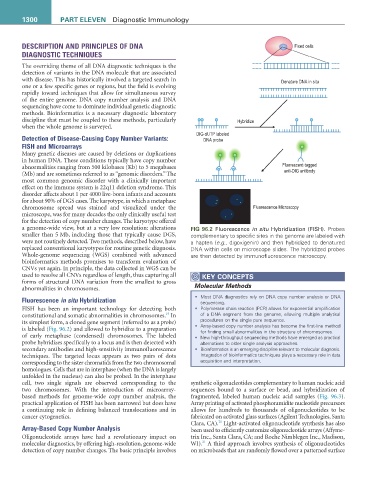
        a genome-wide view, but at a very low resolution: alterations   FIG 96.2  Fluorescence in situ Hybridization (FISH). Probes
        smaller than 5 Mb, including those that typically cause DGS,   complementary to specific sites in the genome are labeled with
        were not routinely detected. Two methods, described below, have   a hapten (e.g., digoxigenin) and then hybridized to denatured
        replaced conventional karyotypes for routine genetic diagnosis.   DNA within cells on microscope slides. The hybridized probes
        Whole-genome sequencing (WGS) combined with advanced   are then detected by immunofluorescence microscopy.
        bioinformatics methods promises to transform evaluation of
        CNVs yet again. In principle, the data collected in WGS can be
        used to resolve all CNVs regardless of length, thus capturing all    KEY CONCEPTS
        forms of structural DNA variation from the smallest to gross
        abnormalities in chromosomes.                            Molecular Methods
        Fluorescence in situ Hybridization                       •  Most DNA diagnostics rely on DNA copy number analysis or DNA
                                                                   sequencing.
        FISH has been an important technology for detecting both   •  Polymerase chain reaction (PCR) allows for exponential amplification
                                                       19
        constitutional and somatic abnormalities in chromosomes.  In   of  a  DNA  segment  from  the genome,  allowing  multiple  analytical
        its simplest form, a cloned gene segment (referred to as a probe)   procedures on the single pure sequence.
        is labeled (Fig. 96.2) and allowed to hybridize to a preparation   •  Array-based copy number analysis has become the first-line method
                                                                   for finding small abnormalities in the structure of chromosomes.
        of early metaphase (condensed) chromosomes. The labeled    •  New high-throughput sequencing methods have emerged as practical
        probe hybridizes specifically to a locus and is then detected with   alternatives to older single analysis approaches.
        secondary antibodies and high-sensitivity immunofluorescence   •  Bioinformatics is an emerging discipline relevant to molecular diagnosis.
        techniques. The targeted locus appears as two pairs of dots   Integration of bioinformatics techniques plays a necessary role in data
        corresponding to the sister chromatids from the two chromosomal   acquisition and interpretation.
        homologues. Cells that are in interphase (when the DNA is largely
        unfolded in the nucleus) can also be probed. In the interphase
        cell, two single signals are observed corresponding to the    synthetic oligonucleotides complementary to human nucleic acid
        two chromosomes.  With the introduction of microarray-   sequences bound to a surface or bead, and hybridization of
        based methods for genome-wide copy number analysis, the   fragmented, labeled human nucleic acid samples (Fig. 96.3).
        practical application of FISH has been narrowed but does have   Array printing of activated phosphoramidite nucleotide precursors
        a continuing role in defining balanced translocations and in   allows for hundreds to thousands of oligonucleotides to be
        cancer cytogenetics.                                   fabricated on activated glass surfaces (Agilent Technologies, Santa
                                                                         20
                                                               Clara, CA).  Light-activated oligonucleotide synthesis has also
        Array-Based Copy Number Analysis                       been used to efficiently customize oligonucleotide arrays (Affyme-
        Oligonucleotide arrays have had a revolutionary impact on   trix Inc., Santa Clara, CA; and Roche Nimblegen Inc., Madison,
                                                                   21
        molecular diagnostics, by offering high-resolution, genome-wide   WI).  A third approach involves synthesis of oligonucleotides
        detection of copy number changes. The basic principle involves   on microbeads that are randomly flowed over a patterned surface

