


Page 1341 - Clinical Immunology_ Principles and Practice ( PDFDrive )
P. 1341
1302         ParT ElEvEN  Diagnostic Immunology


        (Illumina Inc., San Diego, CA). 22,23  These processes are very   resulting hybridization intensities can be used to derive the
        similar, in principle, to the fabrication of microelectronics devices,   genotypes. These assays are fixed in the sense that the investigator
        and so have given these arrays the nickname “gene chips.”  uses the information from a standardized array but cannot add
           Microarrays have been used in very-large-scale studies to   SNPs for particular purposes. An alternative approach, incor-
        genotype common polymorphisms. Robust chemistries that can   porated in the Infinium assays (Illumina Inc., San Diego, CA),
        analyze standard sets of up to 5 000 000 SNPs in a single assay   involves the detection of allele-specific primer extension or single
        are now routine (see Fig. 96.3). Nonamplified genomic DNA is   base extension products on a self-assembling high-density
                                                                             26
        too complex (i.e., the concentration of any particular sequence   microbead array.  In the Infinium assays, genomic DNA is first
        is too low) to be analyzed directly. High-throughput genotyping   subjected to whole genome amplification (WGA), and those
        assays require an array-based readout and scalable, multiplex   products are hybridized to an array of locus-specific 50-mer
        assay chemistry. This is extremely challenging because of the   capture probes. Either primer extension or ligation reactions on
        complexity of the human genome (i.e., any particular unique   the array surface are used to accomplish allele discrimination.
        sequence in the mixture has a low molar concentration and   Signal amplification with methods familiar to users of enzyme-
        because of the need for exquisite specificity at the single base   linked immunosorbent assay (ELISA) is used to enhance the
        level). An important general principle for achieving single-base   sensitivity. A distinct advantage of this class of assays is that the
                                                      24
        specificity is the detection of physically coincident events.  This   “assay conversion” (percent SNPs that actually allow inference
        is exactly the route taken by the polymerase chain reaction (PCR),   of the genotype in the final assay mixture) is very high and thus
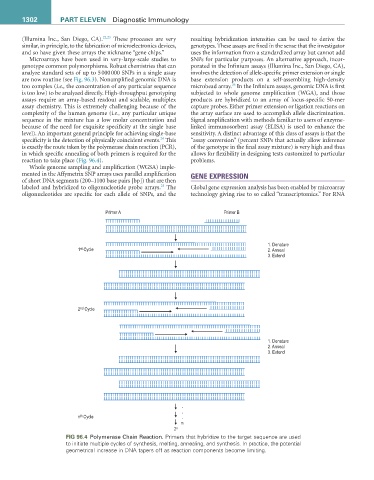
        in which specific annealing of both primers is required for the   allows for flexibility in designing tests customized to particular
        reaction to take place (Fig. 96.4).                    problems.
           Whole genome sampling and amplification (WGSA) imple-
        mented in the Affymetrix SNP arrays uses parallel amplification   GENE EXPRESSION
        of short DNA segments (200–1100 base pairs [bp]) that are then
                                                      25
        labeled and hybridized to oligonucleotide probe arrays.  The   Global gene expression analysis has been enabled by microarray
        oligonucleotides are specific for each allele of SNPs, and the   technology giving rise to so called “transcriptomics.” For RNA
                                    Primer A                              Primer B


                                                                                         1. Denature
                           1 st  Cycle                                                   2. Anneal
                                                                                         3. Extend


                           2  Cycle
                           nd


                                                                                         1. Denature
                                                                                         2. Anneal
                                                                                         3. Extend


                                                            .
                                                            .
                           th
                           n Cycle                          .
                                                            n
                                                          2 n
                       FIG 96.4  Polymerase Chain Reaction. Primers that hybridize to the target sequence are used
                       to initiate multiple cycles of synthesis, melting, annealing, and synthesis. In practice, the potential
                       geometrical increase in DNA tapers off as reaction components become limiting.

