


Page 1340 - Clinical Immunology_ Principles and Practice ( PDFDrive )
P. 1340
CHaPTEr 96  Molecular Methods              1301


                 Label test DNA with Cy3     Label standard control DNA           gDNA
                                                   with Cy5

                                                                    WGA

                                                                                   Fragment and
                                                                                     Denature

                                                                                                      Scan
                                                                     Anneal

                                                                       A      G                * TA  * CG

                                                                                                A      B
                                             Hybridize
                                                                C  Identical probes per bead type  Single base extension


                                               Scan


                           Cy3/Cy5 ratio >1  Cy3/Cy5 ratio <1
                 A          Duplication  Deletion
                          Restriction digest
                                                                  PM-Sense A
                                                                  MM-Sense A
                   Xbal    Xbal   Xbal     gDNA
                                                                  PM-Antisense A
                                                                  MM-Antisense A
                         Adaptor ligation

                                                                  PM-Sense B
                                                                  MM-Sense B
                            PCR           End label               PM-Antisense B
                                                                  MM-Antisense B
                                                 b
                                                   b          Hybridize and wash
                                                    b
                                                      b

                 B
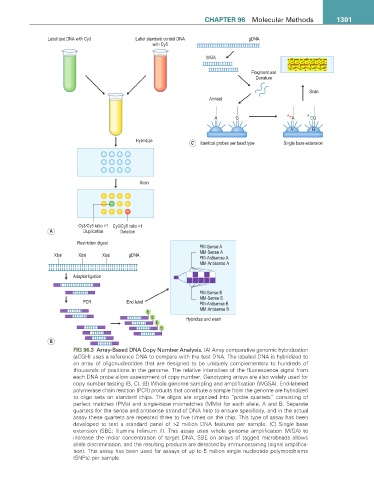
                         FIG 96.3  Array-Based DNA Copy Number Analysis. (A) Array comparative genomic hybridization
                         (aCGH) uses a reference DNA to compare with the test DNA. The labeled DNA is hybridized to
                         an array of oligonucleotides that are designed to be uniquely complementary to hundreds of
                         thousands of positions in the genome. The relative intensities of the fluorescence signal from
                         each DNA probe allow assessment of copy number. Genotyping arrays are also widely used for
                         copy number testing (B, C). (B) Whole genome sampling and amplification (WGSA). End-labeled
                         polymerase chain reaction (PCR) products that constitute a sample from the genome are hybridized
                         to oligo sets on standard chips. The oligos are organized into “probe quartets” consisting of
                         perfect matches (PMs) and single-base mismatches (MMs) for each allele, A and B. Separate
                         quartets for the sense and antisense strand of DNA help to ensure specificity, and in the actual
                         assay these quartets are repeated three to five times on the chip. This type of assay has been
                         developed to test a standard panel of  >2 million DNA features per sample. (C) Single base
                         extension (SBE; Illumina Infinium II). This assay uses whole genome amplification (WGA) to
                         increase the molar concentration of target DNA. SBE on arrays of tagged microbeads allows
                         allele discrimination, and the resulting products are detected by immunostaining (signal amplifica-
                         tion). This assay has been used for assays of up to 5 million single nucleotide polymorphisms
                         (SNPs) per sample.

