


Page 1343 - Clinical Immunology_ Principles and Practice ( PDFDrive )
P. 1343
1304         ParT ElEvEN  Diagnostic Immunology


                        Solid phase       Anchor primer
                                                                           G G C A G T

             Incorporation  4-color fluorescent-labeled dNTPs

                                                           Nucleotide incorporates
                                                               into DNA            H+
                                                                                   Hydrogen ion released


               Imaging                                 Ion sensitive layer                    Sensor layer
                                                                         Electrochemical signal

                                                                  T   G   A    C      GG
                                                       B                   Sequence call
             Deprotection
         A

                      ZMW array

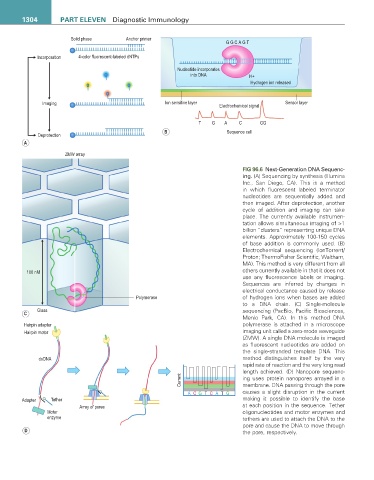
                                                                                FIG 96.6  Next-Generation DNA Sequenc-
                                                                                ing. (A) Sequencing by synthesis (Illumina
                                                                                Inc.,  San  Diego,  CA).  This  is  a  method
                                                                                in which  fluorescent labeled terminator
                                                                                nucleotides are sequentially added and
                                                                                then imaged. After deprotection, another
                                                                                cycle of addition and imaging can take
                                                                                place. The currently  available instrumen-
                                                                                tation allows simultaneous imaging of >1
                                                                                billion “clusters” representing unique DNA
                                                                                elements. Approximately 100-150 cycles
                                                                                of base addition is commonly used. (B)
                                                                                Electrochemical sequencing (IonTorrent/
                                                                                Proton; ThermoFisher Scientific, Waltham,
                                                                                MA). This method is very different from all
          100 nM                                                                others currently available in that it does not
                                                                                use any fluorescence labels or imaging.
                                                                                Sequences are inferred by changes in
                                                                                electrical conductance caused by release
                                              Polymerase                        of hydrogen ions when bases are added
                                                                                to  a  DNA  chain.  (C)  Single-molecule
             Glass                                                              sequencing (PacBio, Pacific Biosciences,
         C
                                                                                Menlo Park, CA). In this method DNA
         Hairpin adapter                                                        polymerase is attached in a microscope
         Hairpin motor                                                          imaging unit called a zero-mode waveguide
                                                                                (ZMW). A single DNA molecule is imaged
                                                                                as fluorescent nucleotides are added on
                                                                                the single-stranded template DNA. This
              dsDNA                                                             method distinguishes itself by the very
                                                                                rapid rate of reaction and the very long read
                                                                                length  achieved. (D) Nanopore  sequenc-
                                                            Current             ing uses protein nanopores arrayed in a
                                                                                membrane. DNA passing through the pore
                                                              A C G T  C  A T G  causes a  slight disruption  in  the current
        Adapter   Tether                                                        making it possible to identify the base
                           Array of pores                                       at each position in the sequence. Tether
                Motor                                                           oligonucleotides and motor enzymes and
                enzyme                                                          tethers are used to attach the DNA to the
                                                                                pore and cause the DNA to move through
         D                                                                      the pore, respectively.

