


Page 205 - Clinical Immunology_ Principles and Practice ( PDFDrive )
P. 205
CHAPTER 12  T-Cell Activation and Tolerance             185


                                                                    Peptide/MHC complex


                                                     CD4             TCR
                                          CD45                        β
                                                                            CD3
                                                            α     ξξ  γε  δε


                                                                      YY  YY
                                 Phosphatase           Lck        Y  Y  P
                                   domains                        Y  Y  P
                                                                             ITAMs
                                                        Y
                                                             2
                                                                                     SH2
                                                  1     P                            domains
                                                                      3
                                                                               ZAP-70


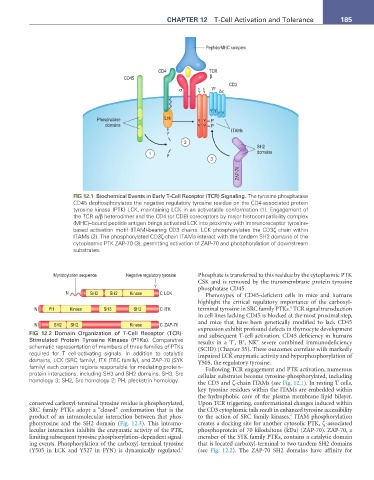
                         FIG 12.1  Biochemical Events in Early T-Cell Receptor (TCR) Signaling. The tyrosine phosphatase
                         CD45 dephosphorylates the negative regulatory tyrosine residue on the CD4-associated protein
                         tyrosine kinase (PTK) LCK, maintaining LCK in an activatable conformation (1). Engagement of
                         the TCR α/β heterodimer and the CD4 (or CD8) coreceptors by major histocompatibility complex
                         (MHC)–bound peptide antigen brings activated LCK into proximity with immunoreceptor tyrosine-
                         based activation motif (ITAM)-bearing CD3 chains. LCK phosphorylates the CD3ζ chain within
                         ITAMs (2). The phosphorylated CD3ζ-chain ITAMs interact with the tandem SH2 domains of the
                         cytoplasmic PTK ZAP-70 (3), permitting activation of ZAP-70 and phosphorylation of downstream
                         substrates.


                   Myristoylation sequence  Negative regulatory tyrosine  Phosphate is transferred to this residue by the cytoplasmic PTK
                                                                  CSK and is removed by the transmembrane protein tyrosine
                                                   Y              phosphatase CD45.
                       N       SH3   SH2   Kinase    C LCK          Phenotypes  of  CD45-deficient  cells  in  mice  and  humans
                                                                  highlight the critical regulatory importance of the carboxyl-
                                                                                                4
            N    PH     Kinase     SH3       SH2     C ITK        terminal tyrosine in SRC family PTKs.  TCR signal transduction
                                                                  in cell lines lacking CD45 is blocked at the most proximal step,
            N      SH2  SH2                Kinase    C ZAP-70     and  mice  that  have  been  genetically  modified  to  lack  CD45
           FIG 12.2  Domain Organization of T-Cell Receptor (TCR)-  expression exhibit profound defects in thymocyte development
                                                                  and subsequent T-cell activation. CD45 deficiency in humans
           Stimulated Protein Tyrosine Kinases (PTKs). Comparative   results in a T , B , NK  severe combined immunodeficiency
                                                                             −
                                                                                     +
                                                                                +
           schematic representation of members of three families of PTKs   (SCID) (Chapter 35). These outcomes correlate with markedly
           required for T cell-activating signals. In addition to catalytic   impaired LCK enzymatic activity and hyperphosphorylation of
           domains, LCK (SRC family), ITK (TEC family), and ZAP-70 (SYK   Y505, the regulatory tyrosine.
           family) each contain regions responsible for mediating protein–  Following TCR engagement and PTK activation, numerous
           protein interactions, including SH3 and SH2 domains. SH3, Src   cellular substrates become tyrosine-phosphorylated, including
           homology 3; SH2, Src homology 2; PH, pleckstrin homology.   the CD3 and ζ-chain ITAMs (see Fig. 12.1). In resting T cells,
                                                                  key tyrosine residues within the ITAMs are embedded within
                                                                  the hydrophobic core of the plasma membrane lipid bilayer.
           conserved carboxyl-terminal tyrosine residue is phosphorylated,   Upon TCR triggering, conformational changes induced within
           SRC  family  PTKs  adopt  a “closed”  conformation  that  is  the   the CD3 cytoplasmic tails result in enhanced tyrosine accessibility
                                                                                                2
           product of an intramolecular interaction between that phos-  to the action of SRC family kinases.  ITAM phosphorylation
           photyrosine and the SH2 domain (Fig. 12.3). This intramo-  creates a docking site for another cytosolic PTK, ζ-associated
           lecular interaction inhibits the enzymatic activity of the PTK,   phosphoprotein of 70 kilodaltons (kDa) (ZAP-70). ZAP-70, a
           limiting subsequent tyrosine phosphorylation–dependent signal-  member of the SYK family PTKs, contains a catalytic domain
           ing events. Phosphorylation of the carboxyl-terminal tyrosine   that is located carboxyl-terminal to two tandem SH2 domains
                                                            3
           (Y505 in LCK and  Y527 in FYN) is dynamically regulated.    (see  Fig. 12.2). The ZAP-70 SH2 domains have affinity for

