


Page 209 - Clinical Immunology_ Principles and Practice ( PDFDrive )
P. 209
CHAPTER 12  T-Cell Activation and Tolerance             189


                                   1                 233
                              LAT    TM      P-Y sites

                                   1                       322
                              GADS   SH3    SH2           SH3

                                   1                                      533
                           A  SLP-76     P-Y sites     Prorich        SH2
                                        TCR/CD3


                                                                                      PIP2

                                         LCK        P PLCγ1    P  VAV RAC
                                        ZAP-70  P           SLP-76  P  NCK PAK
                                              GRB2  P GADs    P  ITK   WASP      DAG    IP3
                                          SOS
                                                      HPK1  ADAP
                                         RAS

                                         ERK                Integrin   Cytoskeletal
                                                           activation  rearrangements


                                 Nucleus
                                                             Transcription
                           B
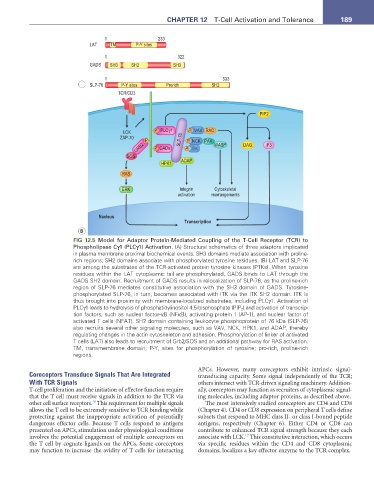
                         FIG 12.5  Model for Adaptor Protein-Mediated Coupling of the T-Cell Receptor (TCR) to
                         Phospholipase Cγ1 (PLCγ1) Activation. (A) Structural schematics of three adaptors implicated
                         in plasma membrane proximal biochemical events. SH3 domains mediate association with proline-
                         rich regions; SH2 domains associate with phosphorylated tyrosine residues. (B) LAT and SLP-76
                         are among the substrates of the TCR-activated protein tyrosine kinases (PTKs). When tyrosine
                         residues within the LAT cytoplasmic tail are phosphorylated, GADS binds to LAT through the
                         GADS SH2 domain. Recruitment of GADS results in relocalization of SLP-76, as the proline-rich
                         region of SLP-76 mediates constitutive association with the SH3 domain of GADS. Tyrosine-
                         phosphorylated SLP-76, in turn, becomes associated with ITK via the ITK SH2 domain. ITK is
                         thus brought into proximity with membrane-localized substrates, including PLCγ1. Activation of
                         PLCγ1 leads to hydrolysis of phosphatidylinositol 4,5-bisphosphate (PIP 2 ) and activation of transcrip-
                         tion factors, such as nuclear factor-κB (NFκB), activating protein 1 (AP-1), and nuclear factor of
                         activated T cells (NFAT). SH2 domain containing leukocyte phosphoprotein of 76 kDa (SLP-76)
                         also recruits several other signaling molecules, such as VAV, NCK, HPK1, and ADAP, thereby
                         regulating changes in the actin cytoskeleton and adhesion. Phosphorylation of linker of activated
                         T cells (LAT) also leads to recruitment of Grb2/SOS and an additional pathway for RAS activation.
                         TM, transmembrane domain; P-Y, sites for phosphorylation of tyrosine; pro-rich, proline-rich
                         regions.

                                                                  APCs. However, many coreceptors exhibit intrinsic signal-
           Coreceptors Transduce Signals That Are Integrated      transducing capacity. Some signal independently of the TCR;
           With TCR Signals                                       others intersect with TCR-driven signaling machinery. Addition-
           T-cell proliferation and the initiation of effector function require   ally, coreceptors may function as recruiters of cytoplasmic signal-
           that the T cell must receive signals in addition to the TCR via   ing molecules, including adaptor proteins, as described above.
                               18
           other cell surface receptors.  This requirement for multiple signals   The most intensively studied coreceptors are CD4 and CD8
           allows the T cell to be extremely sensitive to TCR binding while   (Chapter 4). CD4 or CD8 expression on peripheral T cells define
           protecting  against  the inappropriate activation  of potentially   subsets that respond to MHC class II- or class I-bound peptide
           dangerous effector cells. Because T cells respond to antigens   antigens, respectively (Chapter 6). Either CD4 or CD8 can
           presented on APCs, stimulation under physiological conditions   contribute to enhanced TCR signal strength because they each
                                                                                 19
           involves the potential engagement of multiple coreceptors on   associate with LCK.  This constitutive interaction, which occurs
           the T cell by cognate ligands on the APCs. Some coreceptors   via specific residues within the CD4 and CD8 cytoplasmic
           may function to increase the avidity of T cells for interacting   domains, localizes a key effector enzyme to the TCR complex.

