


Page 27 - Clinical Immunology_ Principles and Practice ( PDFDrive )
P. 27
CHaPter 1  The Human Immune Response                     13


           of additional proinflammatory molecules. The protective role   that this positive response be tightly regulated by mechanisms
           of IgE is in host defenses against parasitical infestation, particularly   that operate to turn off the response and to eliminate cells no
           with helminths (Chapter 31).                           longer required. 50,51  Under physiological circumstances, once an
                                                                  immune response fades, commonly as a consequence of antigen
           Complement and Immune Complexes                        depletion, two pathways to terminal lymphocyte differentiation
           As noted, the biological functions of IgG and IgM are importantly   become available: apoptosis or differentiation into memory cells.
           reflections of their capacities to activate the complement system.   Memory cells are, of course, a key to the effectiveness of the
           Through a cascade of sequential substrate–enzyme interactions,   adaptive immune system, since a second activating encounter
           the 11 principal components of the antibody-dependent comple-  with  antigen  (e.g.,  pathogen)  is  both  more  rapid  and  more
           ment cascade (C1q, C1r, C1s, and C2–C9) cause many of the   productive. Isotype-switched high-affinity antibodies are rapidly
           principal  consequences  of  an  antigen-antibody  interaction   produced, and/or clones of CTL effector cells proliferate. But
           (Chapter 21). These include the establishment of pores in a   the majority of lymphocytes in an active response are not required
           target cell membrane by the terminal  components (C5–C9)   for maintenance of immunological memory, and the necessity
           leading to osmotic lysis; the production of factors (principally   for homeostasis leads to apoptosis of cells no longer required.
           C5a)  with  chemotactic  activity  for  phagocytic  myeloid  cells;   Apoptosis (or Regulated Cell Death; RCD) is a unique process
           opsonization by C3b, promoting phagocytosis; and the ability   of cellular death, widely conserved phylogenetically, and distin-
           to induce degranulation of mast cells (C3a, C4a, and C5a). There   guished from death by necrosis by cellular shrinking, DNA
                                                        49
           are three distinct pathways to complement activation.  The   fragmentation, and breakdown of cells into “apoptotic bodies”
           pathway mediated by the binding of the first component (specifi-  containing nuclear fragments and intact organelles that can be
           cally C1q) to IgG or IgM has been termed the “classical” pathway   eliminated by phagocytosis without release into the extracellular
           (CP). The lectin pathway is similar to the CP but is activated    space of the majority of intracellular, especially nuclear, compo-
           by selected carbohydrate-binding proteins, the mannose (or   nents. Necrosis can be genetically determined (Regulated Necrosis;
           mannan)-binding lectin (MBL), and ficolins, which recognize   RN) or unregulated, reflecting some accidental or otherwise
           certain carbohydrate repeating structures on microorganisms.   inevitable  process  (Chapter  13).  Apoptosis  depends  on  the
           MBL and ficolins are plasma proteins that are homologous to   activation of cysteinyl proteases, termed caspases, which cleave
           C1q and contribute to innate immunity through their capacity   proteins that regulate DNA repair and the establishment/
           to induce antibody- and C1q-independent activation of the CP.   maintenance of cellular architecture. In the absence of these
           Finally, a large number of substances, including certain bacterial,   apoptotic mechanisms, massive proliferation of cells in lymphoid
           fungal, and viral products, can directly activate the cascade   tissues results and is seen clinically as autoimmune lympho-
           through a distinct series of proteins also leading to activation   proliferative syndrome (ALPS), which is characterized by lym-
           of the central C3 component. Although bypassing C1, C4, and   phocytosis with lymphadenopathy and splenomegaly as well as
           C2, this distinct pathway can achieve all the biological conse-  autoimmunity and hypergammaglobulinemia. 52
           quences of C3–C9 activation. Non–antibody-induced activation
           of C3 is referred to as the “alternative” pathway (AP) or “pro-  MECHANISMS OF IMMUNOLOGICAL DISEASES
           perdin” pathway. Additionally, the central components of the
           cascade (e.g., C5a) can be directly produced by the action of   Immunological diseases can be classified on the basis of our
                                              49
           serine proteases of the coagulation system.  Reflecting these   understanding of normal immune physiology and its perturba-
           separate pathways to activation and the fact that many types of   tions in disease states (Table 1.2). One type of immunological
           leukocytes express receptors for activated complement compo-  disease results from failure or deficiency of a component of the
           nents, the complement system is a major contributor to the   immune system leading to failure of normal immune function
           efferent limbs of both innate and acquired immune systems.  (Chapters 32–40). Such disorders are usually identified by
             In addition to their roles in pathogen/antigen elimination,   increased susceptibility to infection (Chapter 37). Failure of host
           constituents of the complement system, together with antigen–  defense can be congenital (e.g., X-linked agammaglobulinemia;
           antibody (immune) complexes, act at leukocyte surfaces to   Chapter 34) or acquired (e.g., acquired immunodeficiency
           regulate immune functions. For example, interaction of immune   syndrome [AIDS]; Chapter 39). It can be global (e.g., severe
           complexes via FcγR on B cells decreases their responsiveness   combined immunodeficiency [SCID]; Chapter 35) or, quite
           to stimulation. In contrast, complement activation on B-cell   specific, involving only a single component of the immune system
           surfaces coligates their receptors with B-cell receptors for antigen,   (e.g., selective IgA deficiency; Chapter 34).
           rendering the cells more readily activated and resistant to    A second type of immunological disease is malignant trans-
           apoptosis.                                             formation of immunological cells (Chapters 77–80). Manifesta-
             Essential for the proper function of the complement system   tions of leukocyte malignancies are protean, most commonly
           is a series of downregulatory mechanisms that prevent unwanted
           activation of the system and that extinguish its activity when
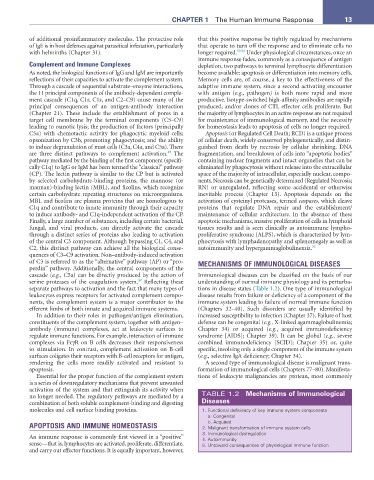
           no longer needed. The regulatory pathways are mediated by a   TABLE 1.2  Mechanisms of Immunological
           combination of both soluble complement-binding and digesting   Diseases
           molecules and cell surface binding proteins.            1. Functional deficiency of key immune system components
                                                                       a. Congenital
                                                                       b. Acquired
           APOPTOSIS AND IMMUNE HOMEOSTASIS                        2. Malignant transformation of immune system cells
                                                                   3. Immunological dysregulation
           An immune response is commonly first viewed in a “positive”   4. Autoimmunity
           sense—that is, lymphocytes are activated, proliferate, differentiate,   5. Untoward consequences of physiological immune function
           and carry out effector functions. It is equally important, however,

