


Page 232 - Clinical Immunology_ Principles and Practice ( PDFDrive )
P. 232
CHaPter 14  The Microbiota in Immunity and Inflammation                 211


                             Small intestine                                              Large intestine

             Lumen


                                                              Outer
                                                            mucous layer


                  SlgA

                           AMPs                               Inner
                                                            mucous layer

                                                        Apical
                                                              IECs
             Entero-           Paneth      Goblet       Basolateral
              cyte              cell        cell
                                                                             IL-22R
                        plgR                                                              Tight junctions
                                                                                   IL-22
             Lamina propria              SlgA-producing
                                          plasma cell
                                                                          LTi cell     NK-22
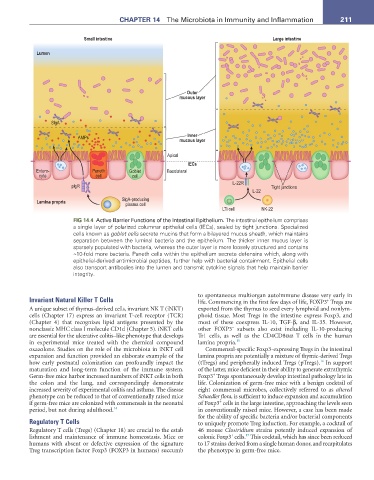
                         FIG 14.4  Active Barrier Functions of the Intestinal Epithelium. The intestinal epithelium comprises
                         a single layer of polarized columnar epithelial cells (IECs), sealed by tight junctions. Specialized
                         cells known as goblet cells secrete mucins that form a bilayered mucus sheath, which maintains
                         separation between the luminal bacteria and the epithelium. The thicker inner mucus layer is
                         sparsely populated with bacteria, whereas the outer layer is more loosely structured and contains
                         ≈10-fold more bacteria. Paneth cells within the epithelium secrete defensins which, along with
                         epithelial-derived antimicrobial peptides, further help with bacterial containment. Epithelial cells
                         also transport antibodies into the lumen and transmit cytokine signals that help maintain barrier
                         integrity.


                                                                  to spontaneous multiorgan autoimmune disease very early in
           Invariant Natural Killer T Cells                       life. Commencing in the first few days of life, FOXP3  Tregs are
                                                                                                            +
           A unique subset of thymus-derived cells, invariant NK T (iNKT)   exported from the thymus to seed every lymphoid and nonlym-
           cells (Chapter 17) express an invariant T-cell receptor (TCR)   phoid  tissue.  Most  Tregs  in  the  intestine  express  Foxp3,  and
           (Chapter 4) that recognizes lipid antigens presented by the   most of these coexpress IL-10, TGF-β, and IL-35. However,
                                                                             −
           nonclassic MHC class I molecule CD1d (Chapter 5). iNKT cells   other FOXP3  subsets also exist including IL-10-producing
           are essential for the ulcerative colitis–like phenotype that develops   Tr1 cells, as well as the CD4CD8αα T cells in the human
           in experimental mice treated with the chemical  compound   lamina propria. 15
           oxazolone. Studies on the role of the microbiota in iNKT cell   Commensal-specific Foxp3-expressing Tregs in the intestinal
           expansion and function provided an elaborate example of the   lamina propria are potentially a mixture of thymic-derived Tregs
                                                                                                          16
           how early postnatal colonization can profoundly impact the   (tTregs) and peripherally induced Tregs (pTregs).  In support
           maturation and long-term function of the immune system.   of the latter, mice deficient in their ability to generate extrathymic
                                                                       +
           Germ-free mice harbor increased numbers of iNKT cells in both   Foxp3  Tregs spontaneously develop intestinal pathology late in
           the colon and the lung, and correspondingly demonstrate   life. Colonization of germ-free mice with a benign cocktail of
           increased severity of experimental colitis and asthma. The disease   eight commensal microbes, collectively referred to as  altered
           phenotype can be reduced to that of conventionally raised mice   Schaedler flora, is sufficient to induce expansion and accumulation
                                                                         +
           if germ-free mice are colonized with commensals in the neonatal   of Foxp3  cells in the large intestine, approaching the levels seen
           period, but not during adulthood. 14                   in conventionally raised mice. However, a case has been made
                                                                  for the ability of specific bacteria and/or bacterial components
           Regulatory T Cells                                     to uniquely promote Treg induction. For example, a cocktail of
           Regulatory T cells (Tregs) (Chapter 18) are crucial to the estab   46 mouse  Clostridium strains potently induced expansion of
                                                                             +
                                                                                 17
           lishment  and  maintenance  of  immune  homeostasis.  Mice  or   colonic Foxp3  cells.  This cocktail, which has since been reduced
           humans with absent or defective expression of the signature   to 17 strains derived from a single human donor, and recapitulates
           Treg transcription factor Foxp3 (FOXP3 in humans) succumb   the phenotype in germ-free mice.

