


Page 281 - Clinical Immunology_ Principles and Practice ( PDFDrive )
P. 281
262          ParT TwO  Host Defense Mechanisms and Inflammation


                                                                    +
                                                                                       −
         TABLE 18.1  Subsets of Thymic and Peripheral Foxp3  Tregs and Foxp3  Tregs
                                             Double        Qa-1–restricted
                                                                                 −
                                                                             +
                                                               +
                     FOXP3 Treg  Tr1 and Th3  Negative Tregs  CD8 Treg    CD8 CD28 Treg  NKT Cell   γδ T Cell
                          +
          Site of    Thymus/     Periphery   Periphery     Periphery      Periphery    Periphery    Periphery
           generation  periphery
          Marker     Foxp3, CD25,   IL-10    TCR αβ CD4 CD8  Nonclassic MHC   Not specified  Invariant TCR   Various subsets
                                                  +
                                                      −
                      CTLA-4, GITR  TGF-β     − NK1.1 −     Ib Qa-1                     chain Va14   Vg5  (mouse)
                                                                                                      +
                                                                                        (mouse), Va24  Vg1  (human)
                                                                                                      +
                                                                                        (human)
          Specificity  Peptide plus   Peptide plus   Peptide plus MHC  Peptide plus MHC   Peptide plus   Glycolipids plus   Glycolipids plus
                      MHC class II  MHC class II  class I   class Ib       MHC class I  CD1d         CD1, Peptide
                                                                                                     plus MHC class
                                                                                                     Ib
          Target cell  T cells, B cells,   T cell  T cell  T cell         DCs/APCs     T cells, APCs  T cells, APCs,
                      APCs, NK                                                                       epithelial cells
                      cells NKT cells
          Suppressive   Cell-contact  IL-10  Perforin,     Perforin       Induction of   IL-10, Th2   Lysis, CD95-CD95
           mechanisms  Costimulation   TGF-β  trogocytosis,                ILT3/ILT4 in   cytokines  ligand pathway,
                      modification            Fas                          DCs                       thymosin-b4
                     Cytokine
                      production
          Reported   Autoimmunity  Autoimmunity  Autoimmunity  Autoimmunity  Autoimmunity  Autoimmunity  Autoimmunity
           suppressive  Transplantation  Transplantation  Transplantation  Transplantation  Transplantation  Allergy (dermatitis)
           function  Allergy     Allergy                                               Cancer       Infection
                     Infection
                     Cancer
        APC, antigen-presenting cell; DC, dendritic cell; ILT, immunoglobulin transcript; Tr1, regulatory type 1 cell; Th3, T-helper 3 cell; Treg, regulatory T cell; MHC, major histocompatibility
        complex.


                                                               the treatment and prevention of a variety of immunological
                                                               diseases. 2
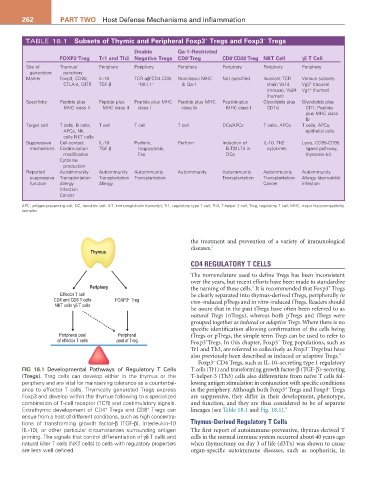
                               Thymus
                                                               CD4 REGULATORY T CELLS

                                                               The nomenclature used to define Tregs has been inconsistent
                                                               over the years, but recent efforts have been made to standardize
                              Periphery                        the naming of these cells.  It is recommended that Foxp3  Tregs
                                                                                                            +
                                                                                   3
                     Effector T cell                           be clearly separated into thymus-derived tTregs, peripherally in
                                           +
                   CD4 and CD8 T cells  FOXP3  Treg            vivo–induced pTregs and in vitro–induced iTregs. Readers should
                   NKT cells γδ T cells
                                                               be aware that in the past tTregs have often been referred to as
                                                               natural Tregs (nTregs), whereas both pTregs and iTregs were
                                                               grouped together as induced or adaptive Tregs. Where there is no
                                                               specific identification allowing confirmation of the cells being
                    Peripheral pool     Peripheral             tTregs or pTregs, the simple term Tregs can be used to refer to
                    of effector T cells  pool of Treg          Foxp3 Tregs. In this chapter, Foxp3  Treg populations, such as
                                                                                            −
                                                                    +
                                                                                                      −
                                                               Tr1 and Th3, are referred to collectively as Foxp3  Tregs but have
                                                               also previously been described as induced or adaptive Tregs. 4
                                                                       −
                                                                  Foxp3  CD4 Tregs, such as IL-10–secreting type 1 regulatory
        FIG 18.1  Developmental Pathways of Regulatory T Cells   T cells (Tr1) and transforming growth factor-β (TGF-β)–secreting
        (Tregs). Treg cells can develop either in the thymus or the   T-helper-3 (Th3) cells also differentiate from naïve T cells fol-
        periphery and are vital for maintaining tolerance as a counterbal-  lowing antigen stimulation in conjunction with specific conditions
                                                                                              +
                                                                                                            −
        ance to effector T cells. Thymically generated Tregs express   in the periphery. Although both Foxp3  Tregs and Foxp3  Tregs
        Foxp3 and develop within the thymus following to a specialized   are suppressive, they differ in their development, phenotype,
        combination of T-cell receptor (TCR) and costimulatory signals.   and function, and they are thus considered to be of separate
        Extrathymic development of CD4  Tregs and CD8  Tregs can   lineages (see Table 18.1 and Fig. 18.1). 4
                                                 +
                                    +
        ensue from a host of different conditions, such as high concentra-
        tions  of  transforming  growth  factor-β  (TGF-β),  interleukin-10   Thymus-Derived Regulatory T Cells
        (IL-10), or other particular circumstances surrounding antigen   The first report of autoimmune-preventive, thymus-derived T
        priming. The signals that control differentiation of γδ T cells and   cells in the normal immune system occurred about 40 years ago
        natural killer T cells (NKT cells) to cells with regulatory properties   when thymectomy on day 3 of life (d3Tx) was shown to cause
        are less well defined.                                 organ-specific autoimmune diseases, such as oophoritis, in

