


Page 285 - Clinical Immunology_ Principles and Practice ( PDFDrive )
P. 285
266          ParT TwO  Host Defense Mechanisms and Inflammation


                                           13
        in multiple organs, resulting in early death.  Moreover, genetic
        deficiencies of CD25 in humans generate a comparable clinical and
        pathological pattern. It is now known that IL-2–deficient animals   Cell contact–dependent  Effector
                                                                   mechanisms :
        have substantially reduced, although not completely depleted,   -Membrane TGF-β        T cell
                       +
        numbers of Foxp3  T cells and that disease can be prevented   -Consumption of IL-2
                                      +
        by adoptive transfer of normal Foxp3  Tregs (see Table 18.2).  -Granzyme/perforin
                                                     +
           In addition to antigen recognition and cytokines, Foxp3  Tregs   -cAMP
        require appropriate interactions with antigen-presenting cells                             Release of
        (APCs) for their function and survival. Several molecules of cell                          immunosuppressive
        adhesion and costimulation are important for function and     FOXP3 +       IL-10          substances
        homeostasis of Tregs, including CD18/CD11a, GITR, CD28, and    Treg         TGF-β          (IL-10, tryptophan
        CTLA-4.                                                                     IL-35          catabolites)
                                                                                                   -low CD80/CD86
           Effector CD4 T cells differentiate into various subpopulations,                         expression
        such as Th1, Th2, Th17, and Tfh, in response to specific stimula-  Cell contact–dependent
                                                                     mechanisms :
        tion and cytokine milieus (Chapter 16). It has become clear that   -CTLA-4 dependent CD80/86
        Tregs mirror this process to some extent and can also differentiate   downmodulation
        in response to the same stimuli into a subpopulation specialized   -Granzyme/perforin
        to control the matching effector population. As a result, Tregs
        express transcription factors linked to these fates, such as T-bet                     APC
        (Th1), RORγt (Th17), and BCL6 (Tfh), and this allows Tregs to
        gain expression of relevant chemokine receptors, such as CXCR5,
        in the case of T-follicular regulatory (Tfr) cells, enabling these                                       +
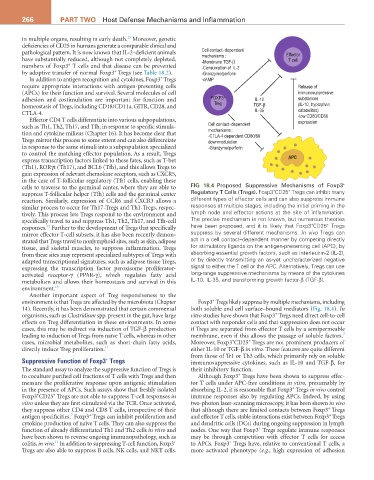
        cells to traverse to the germinal center, where they are able to   FIG 18.4  Proposed Suppressive Mechanisms of Foxp3
                                                                                               +
                                                                                          +
        suppress T-follicular helper (Tfh) cells and the germinal center   Regulatory T Cells (Tregs). Foxp3 CD25  Tregs can inhibit many
        reaction. Similarly, expression of CCR6 and CXCR3 allows a   different types of effector cells and can also suppress immune
        similar process to occur for Th17-Tregs and Th1-Tregs, respec-  responses at multiple stages, including the initial priming in the
        tively. This process lets Tregs respond to the environment and   lymph node and effector actions at the site of inflammation.
        specifically travel to and suppress Th1, Th2, Th17, and Tfh-cell   The precise mechanism is not known, but numerous theories
                                                                                                       +
                                                                                                            +
                14
        responses.  Further to the development of Tregs that specifically   have been proposed, and it is likely that Foxp3 CD25  Tregs
        mirror effector T-cell subsets, it has also been recently demon-  suppress by several different mechanisms. In vivo Tregs can
        strated that Tregs travel to nonlymphoid sites, such as skin, adipose   act in a cell contact–dependent manner by competing directly
        tissue, and skeletal muscles, to suppress inflammation. Tregs   for stimulatory ligands on the antigen-presenting cell (APC), by
        from these sites may represent specialized subtypes of Tregs with   absorbing essential growth factors, such as interleukin-2 (IL-2),
        adapted transcriptional signatures, such as adipose tissue Tregs,   or by directly transmitting an as-yet uncharacterized negative
        expressing  the  transcription  factor  peroxisome  proliferator-  signal to either the T cell or the APC. Alternatively, Tregs can use
        activated receptor-γ (PPAR-γ), which regulates fatty acid   long-range suppressive mechanisms by means of the cytokines
        metabolism and allows their homeostasis and survival in this   IL-10, IL-35, and transforming growth factor-β (TGF-β).
        environment. 15
           Another important aspect of Treg responsiveness to the
                                                                       +
        environment is that Tregs are affected by the microbiota (Chapter   Foxp3  Tregs likely suppress by multiple mechanisms, including
        14). Recently, it has been demonstrated that certain commensal   both soluble and cell surface–bound mediators (Fig. 18.4). In
                                                                                           +
        organisms, such as Clostridium spp. present in the gut, have large   vitro studies have shown that Foxp3  Tregs need direct cell-to-cell
        effects on Treg differentiation in these environments. In some   contact with responder cells and that suppression does not occur
        cases, this may be indirect via induction of TGF-β production   if Tregs are separated from effector T cells by a semipermeable
                                                                                                                 7
        leading to induction of Tregs from naïve T cells, whereas in other   membrane, even if this allows the passage of soluble factors.
                                                                             +
                                                                                  +
        cases, microbial metabolites, such as short-chain fatty acids,   Moreover, Foxp3 CD25  Tregs are not prominent producers of
        directly induce Treg proliferation. 11                 either IL-10 or TGF-β in vitro. These features are quite different
                                                               from those of Tr1 or Th3 cells, which primarily rely on soluble
                                    +
        Suppressive Function of Foxp3  Tregs                   immunosuppressive  cytokines,  such  as  IL-10  and  TGF-β,  for
        The standard assay to analyze the suppressive function of Tregs is   their inhibitory function.
                                                                               +
        to coculture purified cell fractions of T cells with Tregs and then   Although Foxp3  Tregs have been shown to suppress effec-
        measure the proliferative response upon antigenic stimulation   tor T cells under APC-free conditions in vitro, presumably by
                                                                                                 +
        in the presence of APCs. Such assays show that freshly isolated   absorbing IL-2, it is reasonable that Foxp3  Tregs in vivo control
             +
                  +
        Foxp3 CD25  Tregs are not able to suppress T-cell responses in   immune responses also by regulating APCs. Indeed, by using
        vitro unless they are first stimulated via the TCR. Once activated,   two-photon laser-scanning microscopy, it has been shown in vivo
                                                                                                            +
        they suppress other CD4 and CD8 T cells, irrespective of their   that although there are limited contacts between Foxp3  Tregs
                                                                                                             +
                              +
                        7
        antigen specificities.  Foxp3  Tregs can inhibit proliferation and   and effector T cells, stable interactions exist between Foxp3  Tregs
        cytokine production of naïve T cells. They can also suppress the   and dendritic cells (DCs) during ongoing suppression in lymph
                                                                                      +
        function of already differentiated Th1 and Th2 cells in vitro and   nodes. One way that Foxp3  Tregs regulate immune responses
        have been shown to reverse ongoing immunopathology, such as   may be through competition with effector T cells for access
                                                          +
                                                                            +
                   11
        colitis, in vivo.  In addition to suppressing T-cell function, Foxp3    to APCs. Foxp3  Tregs have, relative to conventional T cells, a
        Tregs are also able to suppress B cells, NK cells, and NKT cells.  more activated phenotype (e.g., high expression of adhesion

