


Page 283 - Clinical Immunology_ Principles and Practice ( PDFDrive )
P. 283
Human CD4+ T cells


                      CD25                                     CD45RA


                                       FOXP3                                    FOXP3
                                                                                Thymus


                                                                                 nTregs
                      Ki-67                                    CD45RA                           CD25 high

                                                                                                CTLA-4 +


                                                                               Non-Tregs    eTregs


                                       FOXP3
                                                                                 FOXP3


                      CD25


                                       FOXP3
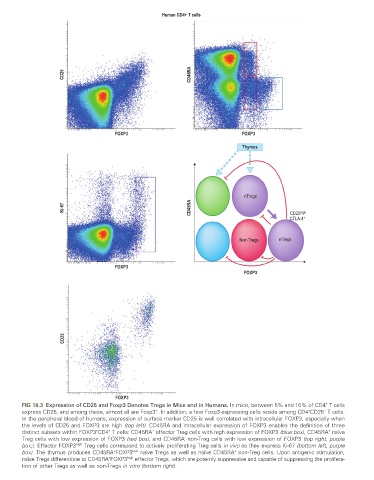
        FIG 18.3  Expression of CD25 and Foxp3 Denotes Tregs in Mice and in Humans. In mice, between 5% and 10% of CD4  T cells
                                                                                                            +
        express CD25, and among these, almost all are Foxp3 . In addition, a few Foxp3-expressing cells reside among CD4 CD25  T cells.
                                                    +
                                                                                                           −
                                                                                                      +
        In the peripheral blood of humans, expression of surface marker CD25 is well correlated with intracellular FOXP3, especially when
        the levels of CD25 and FOXP3 are high (top left). CD45RA and intracellular expression of FOXP3 enables the definition of three
                                                                                                            +
        distinct subsets within FOXP3 CD4  T cells: CD45RA  effector Treg cells with high expression of FOXP3 (blue box), CD45RA  naïve
                                     +
                                +
                                                   −
        Treg cells with low expression of FOXP3 (red box), and CD45RA  non-Treg cells with low expression of FOXP3 (top right, purple
                                                             -
        box;). Effector FOXP3 high  Treg cells correspond to actively proliferating Treg cells in vivo as they express Ki-67 (bottom left, purple
                                      +
                                                                              +
                                            low
        box). The thymus produces CD45RA FOXP3  naïve Tregs as well as naïve CD45RA  non-Treg cells. Upon antigenic stimulation,
        naïve Tregs differentiate to CD45RA FOXP3 high  effector Tregs, which are potently suppressive and capable of suppressing the prolifera-
                                     +
        tion of other Tregs as well as non-Tregs in vitro (bottom right).

