


Page 284 - Clinical Immunology_ Principles and Practice ( PDFDrive )
P. 284
CHaPTEr 18  Regulatory Immune Cells               265


                   +
                                  +
               +
                                                                                       +
                                          −
                                      +
                                                                                              low
           CD25 CD4  T cells and CD25 CD4 CD8  thymocytes specifically   into two subsets: CD45RA FOXP3  naïve Tregs (nTregs) and
                                                                         −
           express Foxp3 mRNA in contrast to the cell surface markers used   CD45RA FOXP3 high  effector Tregs (eTregs) (see Fig. 18.3).
           until now. In addition, other thymocytes/T cells, Th1, or Th2   In addition to tTregs, there is abundant evidence from mouse
                                                  9
           cells scarcely express Foxp3 even after stimulation.  Intranuclear   studies supporting the peripheral development of T cells with
                                                                                                               +
                                                                                                                    +
           staining of the Foxp3 protein shows that although the majority   suppressive properties. For example, Foxp3-expressing CD25 CD4
                                         +
                 +
                                              +
           of Foxp3  cells in mice reside in the CD4 CD25  T-cell population,   Tregs, functionally and phenotypically similar to tTregs, can be
                                       +
                                            −
           some can also be found in the CD4 CD25  population (see Fig.   induced from naïve T cells by in vitro or in vivo antigenic stimula-
                                                                                           11
           18.3). Importantly, retroviral transduction of  Foxp3 in naïve   tion in the presence of TGF-β.  However, it should be noted
               −
           CD25  T cells can convert them to regulatory cells with at least   that in vitro–induced Tregs lack the Treg-type epigenetic pattern
           some of the suppressive functions of true Tregs. However, although   and so may not be stable Tregs, making it important to differenti-
           it is essential, it has also become clear that Foxp3 alone is not   ate between in vivo peripherally induced pTregs and in vitro-
                                                                              10
           sufficient to stably maintain the full Treg identity. Another critical   induced iTregs.  Recent findings indicate that both murine and
           factor is the presence of a Treg-type epigenetic pattern in which   human thymus-derived Treg cells express Helios, an Ikaros family
           genes, such as Foxp3, CTLA-4, and GITR, have stably demethylated   transcription factor, and Neuropilin-1, whereas most induced
           CpG residues and a permissive chromatin structure allowing   Foxp3-expressing CD4 T cells do not. However, some highly
                                                                                        −
           them to be constitutively expressed by Tregs. These epigenetic   activated pTregs and Foxp3  T cells express these markers to
           modifications  occur  independently  of  Foxp3  expression  and   some extent, making them useful, but not of themselves conclusive,
                                                                                                     12
           maintain a significant proportion of the Treg gene expression   to differentiate between tTregs and pTregs.  Recent work has
                                      10
           even in the absence of Foxp3 itself.  However, at the same time,   demonstrated  that  tTregs  are  sufficient  for  the  prevention  of
           Foxp3 expression is still essential, as shown by the severe diseases   widespread autoimmunity but that pTregs have a more specialized
           seen in  humans or  mice lacking  functional  Foxp3. A similar   function in the prevention of type-2 immune responses in mucosal
           pattern of FOXP3 expression can be observed in humans, with   sites, such as the gastrointestinal tract and the lungs. 11
                     +
                                   +
           most FOXP3  cells among CD4 CD25 high  T cells, and a few being            +
               −
                       low
           CD25  or CD25  (see Fig. 18.3). However, in humans, but not   Maintenance of Foxp3  Tregs
           in mice, low levels of FOXP3 can be transiently induced by TCR   In addition to TCR interaction, it seems that accessory signals,
           stimulation in conventional T cells. These T cells can be detected   such as costimulation through CD28-B7 or CD40-CD40L, play
                              +
                                                                                                    +
           directly in blood as CD4  T cells with a memory phenotype and   an important role in the production of Foxp3  Tregs in the thymus,
                                                            8
           a weak expression of FOXP3, but with no suppressive function.    since animals that lack CD28 or CD40 expression generate only
                       +
                                                                                       +
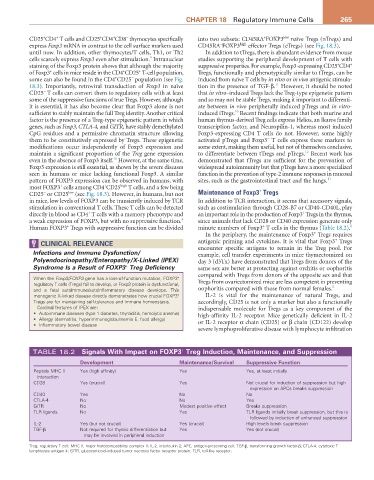
           Human FOXP3  Tregs with suppressive function can be divided   minute numbers of Foxp3  T cells in the thymus (Table 18.2). 6
                                                                                                        +
                                                                    In the periphery, the maintenance of Foxp3  Tregs requires
                                                                                                               +
               CLINICaL rELEVaNCE                                 antigenic priming and cytokines. It is vital that Foxp3  Tregs
            Infections and Immune Dysfunction/                    encounter specific antigens to remain in the Treg pool. For
                                                                  example, cell transfer experiments in mice thymectomized on
            Polyendocrinopathy/Enteropathy/X-Linked (IPEX)        day 3 (d3Tx) have demonstrated that Tregs from donors of the
            Syndrome Is a Result of FOXP3  Treg Deficiency        same sex are better at protecting against orchitis or oophoritis
                                          +
                                                                  compared with Tregs from donors of the opposite sex and that
            When the Foxp3/FOXP3 gene has a loss-of-function mutation, FOXP3   +
            regulatory T cells (Tregs) fail to develop, or Foxp3 protein is dysfunctional,   Tregs from ovariectomized mice are less competent in preventing
                                                                                                              5
            and a fatal autoimmune/autoinflammatory disease develops. This   oophoritis compared with those from normal females.
            monogenic X-linked disease directly demonstrates how crucial FOXP3   +  IL-2 is vital for the maintenance of natural Tregs, and
            Tregs are for maintaining self-tolerance and immune homeostasis.  accordingly, CD25 is not only a marker but also a functionally
             Cardinal features of IPEX are:                       indispensable molecule for Tregs as a key component of the
            •  Autoimmune diseases (type 1 diabetes, thyroiditis, hemolytic anemia)  high-affinity IL-2 receptor. Mice genetically deficient in IL-2
            •  Allergy (dermatitis, hyperimmunoglobulinemia E, food allergy)  or IL-2 receptor α chain (CD25) or β chain (CD122) develop
            •  Inflammatory bowel disease
                                                                  severe lymphoproliferative disease with lymphocyte infiltration
                                                            +
            TABLE 18.2  Signals with Impact on FOXP3  Treg Induction, Maintenance, and Suppression
                           Development                      Maintenance/Survival  Suppressive Function
            Peptide MHC II   Yes (high affinity)            Yes                   Yes, at least initially
             interaction
            CD28           Yes (crucial)                    Yes                   Not crucial for induction of suppression but high
                                                                                   expression on APCs breaks suppression
            CD40           Yes                              No                    No
            CTLA-4         No                               No                    Yes
            GITR           No                               Modest positive effect  Breaks suppression
            TLR ligands    No                               Yes                   TLR ligands initially break suppression, but this is
                                                                                   followed by induction of enhanced suppression
            IL-2           Yes (but not crucial)            Yes (crucial)         High levels break suppression
            TGF-β          Not required for thymic differentiation but   Yes      Yes (not crucial)
                            may be involved in peripheral induction
           Treg, regulatory T cell; MHC II, major histocompatibility complex II; IL-2, interleukin 2; APC, antigen-presenting cell; TGF-β, transforming growth factor-β; CTLA-4, cytotoxic T
           lymphocyte antigen 4; GITR, glucocorticoid-induced tumor necrosis factor receptor protein; TLR, toll-like receptor.

