


Page 282 - Clinical Immunology_ Principles and Practice ( PDFDrive )
P. 282
CHaPTEr 18  Regulatory Immune Cells               263


                                                                                                                    +
           otherwise healthy mice, a finding later attributed to the slightly   This dilemma is especially apparent when investigating Foxp3
                                                                                                              +
           delayed thymic emigration of tTregs in comparison with effector   Tregs in humans, where a significant proportion of CD4  T cells
                                                                                                                  +
                5
           T cells.  Subsequent studies showed that the development of   in peripheral blood express CD25, yet only 2%–4% of CD4  T
           autoimmune diseases could be inhibited if the thymectomized   cells, enriched among cells with the highest expression level of
                                        +
                                            −
                                                            +
                                                                                                                8
           animals were reconstituted with CD4 CD8  thymocytes or CD4    CD25 (CD25 high ), have suppressive properties (Fig. 18.3).  The
                                                                              +
           splenocytes from histocompatible immune-uncompromised   fact that CD25  Tregs are not a discrete population in humans
           animals. Athymic mice transferred with non-Tregs or thymocytes   poses a problem both when obtaining cells for experimental
           spontaneously develop organ-specific autoimmune diseases,   purposes and when evaluating their role in a clinical setting.
                                                                                                                    +
           which can be reversed by cotransfer of tTregs from normal adult   Therefore finding more specific cell surface markers of CD4
               6,7
           mice.  Tregs can suppress the proliferation and cytokine produc-  natural Tregs remains an important goal.
           tion of conventional CD4 or CD8 T cells in vitro. tTregs are
           thought to arise from T-cell clones with relatively high reactivity   Thymus-Derived Tregs Express the Transcription
           to self antigens presented in the thymus.              Factor Foxp3
             To pinpoint a specific phenotype for CD4 T cells with regula-  Specific expression of the transcription factor Foxp3 is closely
                                                                                                            9
           tory function, surface markers with more restricted expression   linked with the development and function of Tregs.  The first
           patterns have been explored. High and stable expression of the   hint as to the significance of Foxp3 was given by studies of the
           IL-2 receptor α chain, CD25 has been found to be a useful and   Scurfy mutant mouse. This mouse strain suffers from a spontane-
                                     +
           specific surface marker of Foxp3  Tregs. Between 5% and 10%   ous X-linked mutation of the Foxp3 gene, which leads to fatal
                 +
           of CD4  T cells express CD25 constitutively in the thymus and   lymphoproliferative disease associated with multiorgan infiltrates
           periphery of mice. Importantly, transfer of CD4 lymphocytes   and early death by 3–4 weeks of age in hemizygous males.
                         +
           depleted of CD25  cells induces autoimmunity in athymic nude   Similarly, mutations in the human orthologue FOXP3 are linked
                                     +
                                          +
           mice, whereas cotransfer of CD4 CD25  cells protects the mice   to immune dysregulation, polyendocrinopathy, enteropathy, IBD,
           from disease induction (Fig. 18.2). Other markers shown to be   allergic dermatitis, food allergy, hyperimmunoglobulinemia E,
                           +
           associated with Foxp3  Tregs are cytotoxic T lymphocyte antigen-4   hematological disorders, severe infections and X-linked (IPEX)
           (CTLA-4; CD152) and glucocorticoid-induced tumor necrosis   syndrome, which is an X-linked immunodeficiency syndrome
           factor receptor protein (GITR). However, these and CD25 are   associated with organ-specific autoimmune diseases, such as type
                                                                                      6
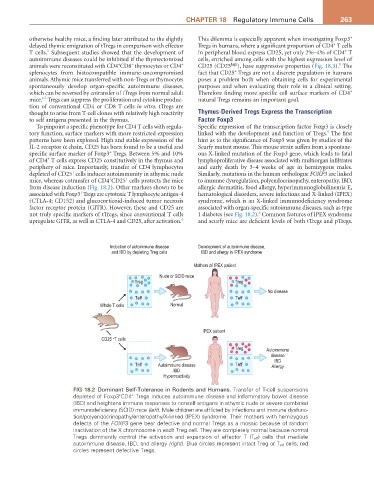
           not truly specific markers of tTregs, since conventional T cells   1 diabetes (see Fig. 18.2).  Common features of IPEX syndrome
                                                            6
           upregulate GITR, as well as CTLA-4 and CD25, after activation.    and scurfy mice are deficient levels of both tTregs and pTregs.
                                     Induction of autoimmune disease  Development of autoimmune disease,
                                      and IBD by depleting Treg cells  IBD and allergy in IPEX syndrome
                                                                Mothers of IPEX patient
                                                     Nude or SCID mice
                                             Treg                             Treg
                                                                                         No disease
                                             Teff                             Teff
                                  Whole T cells          Normal


                                                                   IPEX patient
                                      -
                                  CD25  T cells
                                                                              Treg      Autoimmune
                                                                                          disease
                                                                                           IBD
                                             Teff    Autoimmune disease       Teff        Allergy
                                                          IBD
                                                       Hyperreactivity

                         FIG 18.2  Dominant Self-Tolerance in Rodents and Humans. Transfer of T-cell suspensions
                         depleted of Foxp3 CD4  Tregs induces autoimmune disease and inflammatory bowel disease
                                            +
                                        +
                         (IBD) and heightens immune responses to nonself antigens in athymic nude or severe combined
                         immunodeficiency (SCID) mice (left). Male children are afflicted by infections and immune dysfunc-
                         tion/polyendocrinopathy/enteropathy/X-linked (IPEX) syndrome. Their mothers with hemizygous
                         defects of the FOXP3 gene bear defective and normal Tregs as a mosaic because of random
                         inactivation of the X chromosome in each Treg cell. They are completely normal because normal
                         Tregs dominantly control the activation and expansion of effector T (T eff ) cells that mediate
                         autoimmune disease, IBD, and allergy (right). Blue circles represent intact Treg or T eff  cells; red
                         circles represent defective Tregs.

