


Page 297 - Clinical Immunology_ Principles and Practice ( PDFDrive )
P. 297
278          ParT TwO  Host Defense Mechanisms and Inflammation


                   A                                                  B


                   C
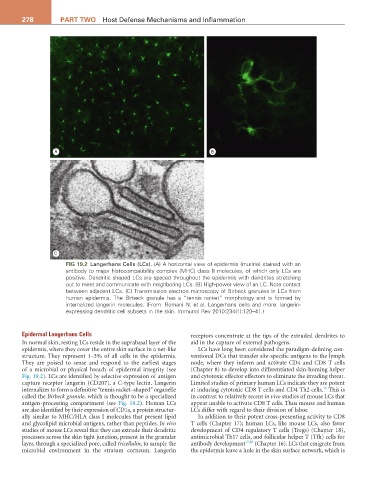
                       FIG 19.2  Langerhans Cells (LCs). (A) A horizontal view of epidermis (murine) stained with an
                       antibody to major histocompatibility complex (MHC) class II molecules, of which only LCs are
                       positive. Dendritic shaped LCs are spaced throughout the epidermis with dendrites stretching
                       out to meet and communicate with neighboring LCs. (B) High-power view of an LC. Note contact
                       between adjacent LCs. (C) Transmission electron microscopy of Birbeck granules in LCs from
                       human  epidermis.  The  Birbeck  granule  has  a  “tennis  racket”  morphology  and  is  formed  by
                       internalized langerin molecules. (From: Romani N. et al. Langerhans cells and more: langerin-
                       expressing dendritic cell subsets in the skin. Immunol Rev 2010:234(1):120–41.)


        Epidermal Langerhans Cells                             receptors concentrate at the tips of the extruded dendrites to
        In normal skin, resting LCs reside in the suprabasal layer of the   aid in the capture of external pathogens.
        epidermis, where they cover the entire skin surface in a net-like   LCs have long been considered the paradigm-defining con-
        structure. They represent 1–3% of all cells in the epidermis.   ventional DCs that transfer site-specific antigens to the lymph
        They are poised to sense and respond to the earliest stages    node, where they inform and activate CD4 and CD8 T cells
        of a microbial or physical breach of epidermal integrity (see    (Chapter 8) to develop into differentiated skin-homing helper
        Fig. 19.2). LCs are identified by selective expression of antigen   and cytotoxic effector effectors to eliminate the invading threat.
        capture receptor langerin (CD207), a C-type lectin. Langerin   Limited studies of primary human LCs indicate they are potent
                                                                                                           16
        internalizes to form a definitive “tennis racket–shaped” organelle   at inducing cytotoxic CD8 T cells and CD4 Th2 cells.  This is
        called the Birbeck granule, which is thought to be a specialized   in contrast to relatively recent in vivo studies of mouse LCs that
        antigen-processing compartment (see  Fig. 19.2). Human LCs   appear unable to activate CD8 T cells. Thus mouse and human
        are also identified by their expression of CD1a, a protein structur-  LCs differ with regard to their division of labor.
        ally similar to MHC/HLA class I molecules that present lipid   In addition to their potent cross-presenting activity to CD8
        and glycolipid microbial antigens, rather than peptides. In vivo   T cells (Chapter 17); human LCs, like mouse LCs, also favor
        studies of mouse LCs reveal that they can extrude their dendritic   development of CD4 regulatory T cells (Tregs) (Chapter 18),
        processes across the skin tight junction, present in the granular   antimicrobial Th17 cells, and follicular helper T (Tfh) cells for
        layer, through a specialized pore, called tricellulin, to sample the   antibody development 17,18  (Chapter 16). LCs that emigrate from
        microbial environment in the stratum corneum. Langerin   the epidermis leave a hole in the skin surface network, which is

