


Page 299 - Clinical Immunology_ Principles and Practice ( PDFDrive )
P. 299
280          ParT TwO  Host Defense Mechanisms and Inflammation


           Sensitization/immunization phase.  Epidermal LCs and dermal   during the sensitization phase, persist in the absence of antigens
        DCs are responsible for carrying antigens from the affected skin   and are readily capable of effector functions. They provide rapid
                                                                                                                 20
        site to draining lymph nodes, where they present those antigens   on-site immune protection to secondary antigen exposure.
        to activate and expand antigen-specific T cells. To emigrate from   Central memory T cells (T CM ) reside in lymph nodes and differ
        the epidermis, activated LCs downregulate E-cadherin to detach   from T RM , as they do not express high levels of skin-homing
        from their surrounding keratinocytes. During migration to the   receptors CLA and CCR4 or exhibit immediate robust responses
        draining lymph node, LCs and DCs undergo a maturation process   to antigen restimulation. T CM  in lymph nodes or spleen can be
        that stops antigen capture activity (by downregulation of antigen   activated by secondary presentation of Ag by skin-draining LCs
        capture receptors) and increases expression of T-cell interactive   or DCs. Activated T CM  enter the circulation, express skin-homing
        molecules: MHC class I and II molecules, costimulatory molecules   receptors, and extravasate into the affected skin site, where they
        CD80 and CD86, and ICAM-1 (CD54).                      can contribute to the elicitation response. CD4 and CD8 T RM
           Naïve  T  cells  in  the  lymph  nodes  that  express  TCRs  for   and recruited T CM  that interact with antigen-activated LCs and
        presented antigens form long-term APC–T cell conjugates (on   DCs in the dermis are further stimulated to proliferate in situ
        the order of 30 minutes) during which T cells are programmed   to amplify (i) effector cell numbers, (ii) cytokine and chemokine
        to differentiate into functionally distinct T-cell subsets. These   production, and  (iii) further recruitment  of  inflammatory
        new T cells leave the lymph node by downregulating their lymph   leukocytes, which act in concert to eradicate microorganisms,
        node–homing receptors, CCR7, and L-selectin (CD62L) and then   chemically modified, or neoplastic cells.
        upregulating the skin-specific homing receptor CLA and che-
        mokine receptors CCR4 and CCR10 to enter the affected skin   Skin Resident T-Cell Subpopulations
           20
        site.  Unless antigen is present in skin for an extended period,   In response to instructional cues from cutaneous DCs, antigen-
        the sensitization phase does not cause an inflammatory reaction   specific T cells differentiate into specialized subsets, each with
        and therefore often goes unnoticed.                    functions that focus on eliminating specific types of pathogens
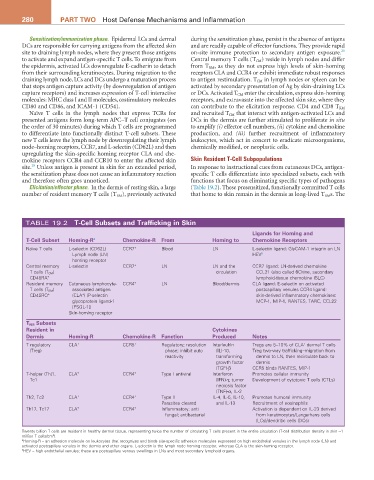
           Elicitation/effector phase.  In the dermis of resting skin, a large   (Table 19.2). These presensitized, functionally committed T cells
        number of resident memory T cells (T RM ), previously activated   that home to skin remain in the dermis as long-lived T RM s. The


         TABLE 19.2  T-Cell Subsets and Trafficking in Skin

                                                                                    Ligands for Homing and
          T-Cell Subset  Homing-r a      Chemokine-r  From             Homing to    Chemokine receptors
          Naïve T cells  L-selectin (CD62L)   CCR7 +  Blood            LN           L-selectin ligand: GlyCAM-1 integrin on LN
                         Lymph node (LN)                                            HEV b
                         homing receptor
          Central memory   L-selectin    CCR7 +       LN               LN and the   CCR7 ligand: LN-derived chemokine
           T cells (T CM )                                              circulation  CCL21 (also called 6Ckine, secondary
           CD45RA +                                                                  lymphoid-tissue chemokine (SLC)
          Resident memory  Cutaneous lymphocyte-  CCR4 +  LN           Blood/dermis  CLA ligand: E-selectin on activated
           T cells (T RM )   associated antigen                                      postcapillary venules CCR4 ligand:
                            +
           CD45RO +      (CLA ) (P-selectin                                          skin-derived inflammatory chemokines:
                         glycoprotein ligand-1                                       MCP-1, MIP-1, RANTES, TARC, CCL22
                         [PSGL-1])
                       Skin-homing receptor
          T rM  Subsets
          resident in                                                  Cytokines
          Dermis       Homing-r          Chemokine-r  Function         Produced     Notes
                                                                                                    +
          T regulatory   CLA +           CCR5 +       Regulatory; resolution   Interleukin   Tregs are 5–10% of CLA  dermal T cells
           (Treg)                                      phase; inhibit auto   (IL)-10,   Treg two-way trafficking–migration from
                                                       reactivity       transforming   dermis to LN, then recirculate back to
                                                                        growth factor   dermis
                                                                        (TGF)-β     CCR5 binds RANTES, MIP-1
          T-helper (Th)1,   CLA +        CCR4 +       Type I antiviral  Interferon   Promotes cellular immunity
           Tc1                                                          (IFN)-γ, tumor   Development of cytotoxic T cells (CTLs)
                                                                        necrosis factor
                                                                        (TNF)-α, IL-2
          Th2, Tc2     CLA +             CCR4 +       Type II          IL-4, IL-5, IL-10,   Promotes humoral immunity
                                                      Parasites cleared  and IL-13  Recruitment of eosinophils
          Th17, Tc17   CLA +             CCR4 +       Inflammatory; anti            Activation is dependent on IL-23 derived
                                                       fungal; antibacterial         from keratinocytes/Langerhans cells
                                                                                     (LCs)/dendritic cells (DCs)
        Twenty billion T cells are resident in healthy dermal tissue, representing twice the number of circulating T cells present in the entire circulation (T-cell distribution density in skin ≈1
        million T cells/cm ).
                  2
        a Homing-R – an adhesion molecule on leukocytes that recognizes and binds site-specific adhesion molecules expressed on high endothelial venules in the lymph node (LN) and
        activated postcapillary venules in the dermis and other organs. L-selectin is the lymph node homing receptor, whereas CLA is the skin-homing receptor.
        b HEV – high endothelial venules; these are postcapillary venous swellings in LNs and most secondary lymphoid organs.

