


Page 298 - Clinical Immunology_ Principles and Practice ( PDFDrive )
P. 298
CHaPTEr 19  Host Defenses in Skin             279


           subsequently replenished, under inflammatory conditions by   Thus they are able to forgo the canonical MHC class I–antigen
           iDCs for the short term and by resident LC-committed stem   processing  pathway,  which  requires  infection  for endogenous
           cells that seed the epidermis during fetal development for the   expression of the pathogen antigens. Mouse langerin positive
           long term. 17,19                                       dermal DCs are also critical for activating Tfh cells for IgG2a/c
                                                                  and IgG2b isotype antibody production. In the resting state,
           Dermal Dendritic Cells                                 all DCs are poor stimulators of T cells. Interaction with
           Dermal DCs efficiently present antigens that have reached the   so-called immature DCs can generate unresponsive antigen-
           dermis to T cells. In normal skin, multiple subpopulations of   specific T cells, a key mechanism for maintaining immune toler-
                                        19
           resident dermal DCs can be detected.  In mice, dermal langerin   ance, which is needed to prevent the immune system from
           positive and negative DCs are found, both of which are devel-  attacking self tissues.
           opmentally distinct from LCs. In humans, most dermal DCs are
           langerin negative; only a small number of langerin-dull dermal   T Cells and Immune Responses in Skin
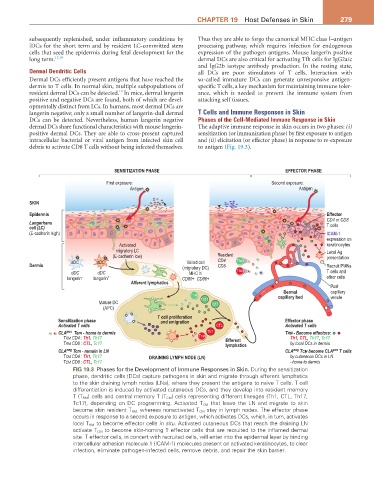
           DCs can be detected. Nevertheless, human langerin negative   Phases of the Cell-Mediated Immune Response in Skin
           dermal DCs share functional characteristics with mouse langerin-  The adaptive immune response in skin occurs in two phases: (i)
           positive dermal DCs. They are able to cross-present captured   sensitization (or immunization phase) by first exposure to antigen
           intracellular bacterial or viral antigen from infected skin cell   and (ii) elicitation (or effector phase) in response to re-exposure
           debris to activate CD8 T cells without being infected themselves.   to antigen (Fig. 19.3).


                                      SENSITIZATION PHASE                                     EFFECTOR PHASE

                                    First exposure:                                       Second exposure:
                                            Antigen                                                Antigen

           SKIN
           Epidermis                                                                                        Effector
                                                                                                            CD4 or CD8
           Langerhans                                                                                       T cells
           cell (LC)
           (E-cadherin high)                                                                                ICAM-1
                                                                                                            expression on
                                        Activated                                                           keratinocytes
                                       migratory LC                                                         Local Ag
                                      (E-cadherin low)                  Resident                            presentation
                        dDC      dDC                          Veiled cell  CD4  TRM
           Dermis                                            (migratory DC)  CD8                            Recruit PMNs
                        dDC      dDC                           MHC hi         TRM                           T cells and
                       langerin –  langerin +                CD80+  CD86+                                   other cells
                                            Afferent lymphatics
                                                                                                             Post
                                                                                              Dermal         capillary
                                                               TCM                          capillary bed    venule
                                                                   Th17
                                 Mature DC                            Tc17
                                   (APC)
                                                     T cell proliferation
                    Sensitization phase               and emigration                          Effector phase
                    Activated T cells                                   CTL                   Activated T cells
                    CLA pos   Tem - home to dermis                   Th1                      TRM - Become effectors:
                      TRM CD4 : Th1, Th17                         TCM      Efferent             Th1, CTL, Th17, Tc17
                      TRM CD8 : CTL, Tc17                                  lymphatics           by local DCs in dermis
                    CLA neg  Tcm - remain in LN                                               CLA neg  TCM become CLA pos  T cells
                      TCM CD4 : Th1, Th17         DRAINING LYMPH NODE (LN)                      by cutaneous DCs in LN
                      TCM CD8 : CTL, Tc17                                                       –home to dermis
                         FIG 19.3  Phases for the Development of Immune Responses in Skin. During the sensitization
                         phase, dendritic cells (DCs) capture pathogens in skin and migrate through afferent lymphatics
                         to the skin draining lymph nodes (LNs), where they present the antigens to naïve T cells. T cell
                         differentiation is induced by activated cutaneous DCs, and they develop into resident memory
                         T (T RM ) cells and central memory T (T CM ) cells representing different lineages (Th1, CTL, Th17,
                         Tc17), depending on DC programming. Activated T CM  that leave the LN and migrate to skin
                         become skin resident T RM,  whereas nonactivated T CM  stay in lymph nodes. The effector phase
                         occurs in response to a second exposure to antigen, which activates DCs, which, in turn, activates
                         local T RM  to become effector cells in situ. Activated cutaneous DCs that reach the draining LN
                         activate T CM  to become skin-homing T effector cells that are recruited to the inflamed dermal
                         site. T effector cells, in concert with recruited cells, will enter into the epidermal layer by binding
                         intercellular adhesion molecule 1 (ICAM-1) molecules present on activated keratinocytes, to clear
                         infection, eliminate pathogen-infected cells, remove debris, and repair the skin barrier.

