


Page 326 - Clinical Immunology_ Principles and Practice ( PDFDrive )
P. 326
306          Part two  Host Defense Mechanisms and Inflammation


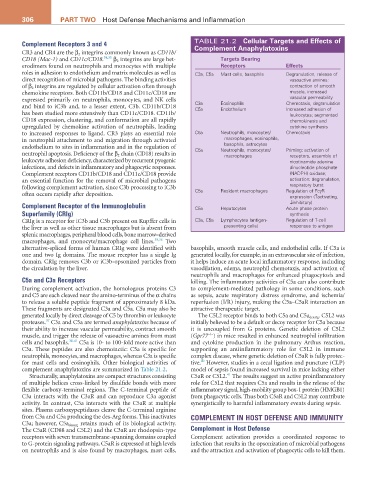
        Complement Receptors 3 and 4                             TABLE 21.2  Cellular targets and Effects of
                                                                 Complement anaphylatoxins
        CR3 and CR4 are the β 2  integrins commonly known as CD11b/
        CD18 (Mac-1) and CD11c/CD18. 34,35  β 2  integrins are large het-  targets Bearing
        erodimers found on neutrophils and monocytes with multiple       receptors             Effects
        roles in adhesion to endothelium and matrix molecules as well as   C3a, C5a  Mast cells, basophils  Degranulation, release of
        direct recognition of microbial pathogens. The binding activities                       vasoactive amines:
        of β 2  integrins are regulated by cellular activation often through                    contraction of smooth
        chemokine receptors. Both CD11b/CD18 and CD11c/CD18 are                                 muscle, increased
        expressed primarily on neutrophils, monocytes, and NK cells                             vascular permeability
        and bind to iC3b and, to a lesser extent, C3b. CD11b/CD18   C3a  Eosinophils           Chemotaxis, degranulation
                                                                 C5a
                                                                         Endothelium
                                                                                               Increased adhesion of
        has been studied more extensively than CD11c/CD18. CD11b/                               leukocytes; augmented
        CD18 expression, clustering, and conformation are all rapidly                           chemokinesis and
        upregulated by chemokine activation of neutrophils, leading                             cytokine synthesis
        to  increased  responses  to  ligand.  CR3  plays  an  essential  role   C5a  Neutrophils, monocytes/   Chemotaxis
        in neutrophil attachment to and migration through activated       macrophages, eosinophils,
                                                                          basophils, astrocytes
        endothelium to sites in inflammation and in the regulation of   C5a  Neutrophils, monocytes/  Priming: activation of
        neutrophil apoptosis. Deficiency of the β 2  chain (CD18) results in   macrophages      receptors, assembly of
        leukocyte adhesion deficiency, characterized by recurrent pyogenic                      nicotinamide adenine
        infections, and defects in inflammatory and phagocytic responses.                       dinucleotide phosphate
        Complement receptors CD11b/CD18 and CD11c/CD18 provide                                  (NADPH) oxidase;
        an essential function for the removal of microbial pathogens                            activation: degranulation,
        following complement activation, since C3b processing to iC3b                           respiratory burst
        often occurs rapidly after deposition.                   C5a     Resident macrophages  Regulation of FcγR
                                                                                                expression (↑activating,
                                                                                                ↓inhibitory)
        Complement Receptor of the Immunoglobulin                C5a     Hepatocytes           Acute phase protein
        Superfamily (CRIg)                                                                      synthesis
        CRIg is a receptor for iC3b and C3b present on Kupffer cells in   C3a, C5a  Lymphocytes (antigen-  Regulation of T-cell
        the liver as well as other tissue macrophages but is absent from   presenting cells)    responses to antigen
        splenic macrophages, peripheral blood cells, bone marrow–derived
        macrophages, and monocyte/macrophage cell lines. 35,36  Two
        alternative-spliced forms of human CRIg were identified with   basophils, smooth muscle cells, and endothelial cells. If C5a is
        one and two Ig domains. The mouse receptor has a single Ig   generated locally, for example, in an extravascular site of infection,
        domain. CRIg removes C3b or iC3b-opsonized particles from   it helps induce an acute local inflammatory response, including
        the circulation by the liver.                          vasodilation, edema, neutrophil chemotaxis, and activation of
                                                               neutrophils and macrophages for enhanced phagocytosis and
        C5a and C3a Receptors                                  killing. The inflammatory activities of C5a can also contribute
        During complement activation, the homologous proteins C3   to complement-mediated pathology in some conditions, such
        and C5 are each cleaved near the amino-terminus of the α chains   as sepsis, acute respiratory distress syndrome, and  ischemia/
        to release a soluble peptide fragment of approximately 8 kDa.   reperfusion (I/R) injury, making the C5a–C5aR interaction an
        These fragments are designated C3a and C5a. C5a may also be   attractive therapeutic target.
        generated locally by direct cleavage of C5 by thrombin or leukocyte   The C5L2 receptor binds to both C5a and C5a desarg . C5L2 was
                37
        proteases.  C3a and C5a are termed anaphylatoxins because of   initially believed to be a default or decoy receptor for C5a because
        their ability to increase vascular permeability, contract smooth   it  is  uncoupled  from  G  proteins.  Genetic  deletion  of  C5L2
                                                                     −/−
        muscle, and trigger the release of vasoactive amines from mast   (Gpr77 ) in mice resulted in enhanced neutrophil infiltration
        cells and basophils. 38-41  C5a is 10- to 100-fold more active than   and cytokine production in the pulmonary  Arthus reaction,
        C3a. These peptides are also chemotactic: C5a is specific for   supporting  an  antiinflammatory  role  for  C5L2  in  immune
        neutrophils, monocytes, and macrophages, whereas C3a is specific   complex disease, where genetic deletion of C5aR is fully protec-
                                                                   40
        for mast cells and eosinophils. Other biological activities of   tive.  However, studies in a cecal ligation and puncture (CLP)
        complement anaphylatoxins are summarized in Table 21.2.  model of sepsis found increased survival in mice lacking either
                                                                           41
           Structurally, anaphylatoxins are compact structures consisting   C5aR or C5L2.  The results suggest an active proinflammatory
        of multiple helices cross-linked by disulfide bonds with more   role for C5L2 that requires C5a and results in the release of the
        flexible  carboxy-terminal regions.  The C-terminal  peptide of   inflammatory signal, high-mobility group box-1 protein (HMGB1)
        C3a interacts with the C3aR and can reproduce C3a agonist   from phagocytic cells. Thus both C5aR and C5L2 may contribute
        activity. In contrast, C5a interacts with the C5aR at multiple   synergistically to harmful inflammatory events during sepsis.
        sites. Plasma carboxypeptidases cleave the C-terminal arginine
        from C3a and C5a producing the des-Arg forms. This inactivates   COMPLEMENT IN HOST DEFENSE AND IMMUNITY
        C3a; however, C5a desarg  retains much of its biological activity.
        The C5aR (CD88 and C5L2) and the C3aR are rhodopsin-type   Complement in Host Defense
        receptors with seven transmembrane-spanning domains coupled   Complement activation provides a coordinated response to
        to G-protein signaling pathways. C5aR is expressed at high levels   infection that results in the opsonization of microbial pathogens
        on neutrophils and is also found by macrophages, mast cells,   and the attraction and activation of phagocytic cells to kill them.

