


Page 327 - Clinical Immunology_ Principles and Practice ( PDFDrive )
P. 327
CHaPtEr 21  The Human Complement System: Basic Concepts and Clinical Relevance                     307


           Complement-dependent opsonization is of greatest importance
           in infections with encapsulated extracellular bacteria, and           Complement or protease activation
           individuals with deficiencies in Ab production, neutrophil func-
           tion, or C3 share increased susceptibility to these organisms,
           including Streptococcus pneumoniae and Haemophilus influenzae.          Limited local release of C5a
           MBL deficiency is also associated with recurrent pyogenic infec-
           tions in young children. In general, activation of complement
           by natural Ab or MBL results in C3b and iC3b deposition on    Neutrophil    Macrophage     Endothelial cell
           these pathogens, overcoming the antiphagocytic effects of the
           capsule. Phagocytic cells ingest and kill the organisms using   Priming     ↑ of activating   Expression of
           CD35, CD11b/CD18, and CD11c/CD18 receptors in conjunction                 ↓ of inhibitory FcγR  P-selectin
           with other innate and Fc receptors. C5aR signaling activates
                                                                                                     Chemokine (IL-8)
           these receptors, leading to increased phagocytosis. Gram-negative   Activation of C receptors   and cytokine (IL-6)
                                                                       Assembly of oxidase
           bacteria are susceptible to complement-dependent lysis. This is                              synthesis
           evident  in  the  increased  incidence  of  disseminated  neisserial
           infection in individuals deficient in C3, any of the MAC com-
           ponents, or P, as discussed below.                                     Effective control of infection
                                                                                transmigration, phagocytosis, killing
           Complement in Inflammation
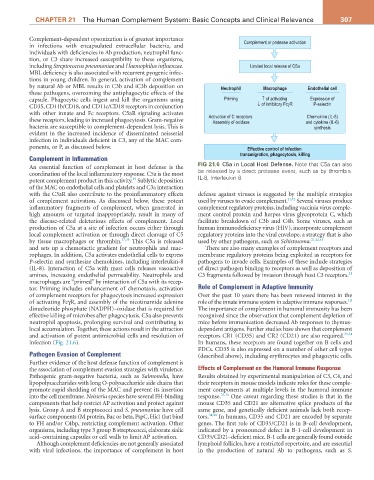
           An essential function of complement in host defense is the   FIG 21.6  C5a in Local Host Defense. Note that C5a can also
                                                                  be released by a direct protease event, such as by thrombin.
           coordination of the local inflammatory response. C5a is the most   IL-8, Interleukin 8.
                                            39
           potent complement product in this activity.  Sublytic deposition
           of the MAC on endothelial cells and platelets and C3a interaction
           with the C3aR also contribute to the proinflammatory effects   defense against viruses is suggested by the multiple strategies
           of complement activation.  As discussed below, these potent   used by viruses to evade complement. 21,42  Several viruses produce
           inflammatory  fragments  of complement, when  generated  in   complement regulatory proteins, including vaccinia virus comple-
           high amounts or targeted inappropriately, result in many of   ment control protein and herpes virus glycoprotein C, which
           the disease-related deleterious effects of complement. Local   facilitate breakdown of C3b and C4b. Some viruses, such as
           production of C5a at a site of infection occurs either through   human immunodeficiency virus (HIV), incorporate complement
           local complement activation or through direct cleavage of C5   regulatory proteins into the viral envelope, a strategy that is also
           by tissue macrophages or thrombin. 37,38  This C5a is released   used by other pathogens, such as Schistosoma. 21,42,43
           and sets up a chemotactic gradient for neutrophils and mac-  There are also many examples of complement receptors and
           rophages. In addition, C5a activates endothelial cells to express   membrane regulatory proteins being exploited as receptors for
           P-selectin and synthesize chemokines, including interleukin-8   pathogens to invade cells. Examples of these include strategies
           (IL-8). Interaction of C5a with mast cells releases vasoactive   of direct pathogen binding to receptors as well as deposition of
           amines, increasing endothelial permeability. Neutrophils and   C3 fragments followed by invasion through host C3 receptors. 21
           macrophages are “primed” by interaction of C5a with its recep-
           tor. Priming includes enhancement of chemotaxis, activation   Role of Complement in Adaptive Immunity
           of complement receptors for phagocytosis increased expression   Over the past 10 years there has been renewed interest in the
                                                                                                                   1,8
           of activating FcγR, and assembly of the nicotinamide adenine   role of the innate immune system in adaptive immune responses.
           dinucleotide phosphate (NADPH)–oxidase that is required for   The importance of complement in humoral immunity has been
           effective killing of microbes after phagocytosis. C5a also prevents   recognized since the observation that complement depletion of
           neutrophil apoptosis, prolonging survival and contributing to   mice before immunization decreased Ab responses to thymus-
           local accumulation. Together, these actions result in the attraction   dependent antigens. Further studies have shown that complement
           and activation of potent antimicrobial cells and resolution of   receptors CR1 (CD35) and CR2 (CD21) are also required. 33,34
           infection (Fig. 21.6).                                 In humans, these receptors are found together on B cells and
                                                                  FDCs. CD35 is also expressed on a number of other cell types
           Pathogen Evasion of Complement                         (described above), including erythrocytes and phagocytic cells.
           Further evidence of the host defense function of complement is
           the association of complement evasion strategies with virulence.   Effects of Complement on the Humoral Immune Response
           Pathogenic  gram-negative  bacteria,  such as  Salmonella,  have   Results obtained by experimental manipulation of C3, C4, and
           lipopolysaccharides with long O-polysaccharide side chains that   their receptors in mouse models indicate roles for these comple-
           promote rapid shedding of the MAC and prevent its insertion   ment components at multiple levels in the humoral immune
           into the cell membrane. Neisseria species have several FH-binding   response. 33,34  One caveat regarding these studies is that in the
           components that help restrict AP activation and protect against   mouse CD35 and CD21 are alternative splice products of the
           lysis. Group A and B streptococci and S. pneumoniae have cell   same gene, and genetically deficient animals lack both recep-
           surface components (M protein, Bac or beta, PspC, Hic) that bind   tors. 34,44  In humans, CD35 and CD21 are encoded by separate
           to FH and/or C4bp, restricting complement activation. Other   genes. The first role of CD35/CD21 is in B-cell development,
           organisms, including type 3 group B streptococci, elaborate sialic   indicated by a pronounced defect in B-1-cell development in
           acid–containing capsules or cell walls to limit AP activation.  CD35/CD21–deficient mice. B-1 cells are generally found outside
             Although complement deficiencies are not generally associated   lymphoid follicles, have a restricted repertoire, and are essential
           with  viral  infections,  the  importance  of complement  in  host   in the production of natural  Ab to pathogens, such as  S.

