


Page 363 - Clinical Immunology_ Principles and Practice ( PDFDrive )
P. 363
CHaPTEr 23  Mast Cells, Basophils, and Mastocytosis              343


           Mastocytosis can be limited to skin or have widespread systemic   Skin findings may be seen in both CM and SM, and the most
           effects. Mast cell disorders cause a broad range of symptoms   common skin-related symptom in patients with mastocytosis is
           that can mimic a variety of other conditions, often making   pruritus. Accumulations of mast cells in skin can present as a
           diagnosis a challenge.                                 variety of lesions. Urticaria pigmentosa (UP), also called macu-
                                                                  lopapular cutaneous mastocytosis (MPCM), is the most common
           Epidemiology                                           skin manifestation of mastocytosis in both adults and children.
           Mastocytosis can occur at any age, although it tends to have a   Lesions of UP appear as small, tan to reddish-brown macules
           more benign and transient course in children and often is limited   or slightly elevated papules (Fig. 23.5A–C). UP is present more
           to cutaneous manifestations. In a Polish case series of 100 children   commonly in the less aggressive forms of SM.
           with cutaneous mastocytosis (CM), 73% had onset of the disease   Diffuse cutaneous mastocytosis (DCM) is characterized by
                                                       45
           by age 6 months and 94% within the first year of life.  Most   edema and increased skin thickness, with or without a yellowish-
           cases of systemic mastocytosis (SM) are diagnosed in middle   brown coloration. DCM is rare, accounting for 1–3% of CM.
           age. The exact prevalence of mastocytosis is unknown, but    Cutaneous mastocytomas are well-demarcated flat or slightly
           an estimate from a recent Danish  population-based study is   elevated lesions that may have a yellow or red-brown coloration.
                              46
           approximately  1 : 10 000.   With rare exceptions, mastocytosis   Mastocytomas can be solitary or multiple and are typically 2–5 cm
           does not appear to be inherited.                       in size. The least frequent form of CM (<1% of cases) is telan-
                                                                  giectasia macularis eruptive perstans (TMEP). TMEP typically
           Pathogenesis                                           presents in adulthood and consists of tan/brown macules with
           The manifestations of mastocytosis can result from mast cell   telangiectasias.
           mediator release (both chronic and episodic) and from excessive   Lesions of UP, DCM, and cutaneous mastocytomas display
           accumulation of mast cells in one or more tissues. Although the   the Darier sign: localized urtication and redness of lesions fol-
           molecular pathogenesis is incompletely understood, mastocytosis   lowing rubbing, scratching, or stroking of skin. Mastocytomas
           is frequently associated with somatic gain-of-function mutations   can also precipitate severe systemic symptoms when rubbed. In
           in KIT (CD117). The most common of these mutations is   both CM and SM, mast cell mediator release can occur either
                            47
           Asp816Val, or D816V.  KIT-activating mutations lead to SCF-  chronically or episodically, resulting in a variety of symptoms,
           independent activation. Mast cells are thought to accumulate in   including flushing, pruritus, shortness of breath, nausea, vomiting,
           tissues because of clonal expansion and apoptotic defects of   abdominal pain, diarrhea, hypotension, syncope, fatigue, and
           KIT-mutated mast cells in mastocytosis. 6              headache. Anaphylaxis can be seen in both CM and SM. Interest-
                                                                  ingly, urticaria and angioedema are uncommon in mastocytosis.
           Clinical Features                                        Gastrointestinal (GI) symptoms are particularly common in
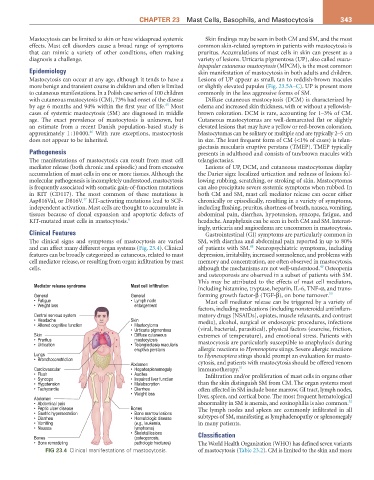
           The  clinical  signs  and symptoms of  mastocytosis  are  varied    SM, with diarrhea and abdominal pain reported in up to 80%
                                                                                   48
           and can affect many different organ systems (Fig. 23.4). Clinical   of patients with SM.  Neuropsychiatric symptoms, including
           features can be broadly categorized as cutaneous, related to mast   depression, irritability, increased somnolence, and problems with
           cell mediator release, or resulting from organ infiltration by mast   memory and concentration, are often observed in mastocytosis,
                                                                                                          49
           cells.                                                 although the mechanisms are not well-understood.  Osteopenia
                                                                  and osteoporosis are observed in a subset of patients with SM.
                                                                  This may be attributed to the effects of mast cell mediators,
            Mediator release syndrome       Mast cell infiltration
                                                                  including histamine, tryptase, heparin, IL-6, TNF-α, and trans-
            General                         General               forming growth factor-β (TGF-β), on bone turnover. 50
            •  Fatigue                      •  Lymph node           Mast cell mediator release can be triggered by a variety of
            •  Weight loss                    enlargement
                                                                  factors, including medications (including nonsteroidal antiinflam-
            Central nervous system                                matory drugs [NSAIDs], opiates, muscle relaxants, and contrast
            •  Headache                     Skin                  media), alcohol, surgical or endoscopic procedures, infections
            •  Altered cognitive function   •  Mastocytoma
                                            •  Urticaria pigmentosa  (viral, bacterial, parasitical), physical factors (exercise, friction,
            Skin                            •  Diffuse cutaneous  extremes of temperature), and emotional stress. Patients with
            •  Pruritus                       mastocytosis        mastocytosis are particularly susceptible to anaphylaxis during
            •  Urtication                   •  Telangiectasia macularis
                                              eruptiva perstans   allergic reactions to Hymenoptera stings. Severe allergic reactions
            Lungs                                                 to Hymenoptera stings should prompt an evaluation for masto-
            •  Bronchoconstriction
                                            Abdomen               cytosis, and patients with mastocytosis should be offered venom
            Cardiovascular                  •  Hepatosplenomegaly  immunotherapy. 51
            •  Flush                        •  Ascites              Infiltration and/or proliferation of mast cells in organs other
            •  Syncope                      •  Impaired liver function
            •  Hypotension                  •  Malabsorption      than the skin distinguish SM from CM. The organ systems most
            •  Tachycardia                  •  Diarrhea           often affected in SM include bone marrow, GI tract, lymph nodes,
                                            •  Weight loss
            Abdomen                                               liver, spleen, and cortical bone. The most frequent hematological
                                                                                                                   52
            •  Abdominal pain                                     abnormality in SM is anemia, and eosinophilia is also common.
            •  Peptic ulcer disease         Bones                 The lymph nodes and spleen are commonly infiltrated in all
            •  Gastric hypersecretion       •  Bone marrow lesions
            •  Diarrhea                     •  Hematologic disease  subtypes of SM, manifesting as lymphadenopathy or splenomegaly
            •  Vomiting                       (e.g., leukemia,    in many patients.
            •  Nausea                         lymphoma)
                                            •  Skeletal lesions   Classification
            Bones                             (osteoporosis,
            •  Bone remodeling                pathologic fractures)  The World Health Organization (WHO) has defined seven variants
                FIG 23.4  Clinical manifestations of mastocytosis.   of mastocytosis (Table 23.2). CM is limited to the skin and more

