


Page 42 - Clinical Immunology_ Principles and Practice ( PDFDrive )
P. 42
28           Part one  Principles of Immune Response


        and TNFα and are the most heterogeneous. They also express                                   Area of
        CCR6 and CD117 and can be divided on the basis of expression                                 stem cells
        of the NCR Nkp44. The role of these cells in normal host function            Erythropoiesis
                                                                                     island
        and responses to chronic inflammatory stimuli and cancer is
        under intensive study.
                                                                                                     Bone
            KeY ConCePtS
         Tissues of the Immune System
          •  Stem cells proliferate and mature into effector cells in the primary
           lymphoid organs, which include bone marrow and the thymus.                  Fat cells
          •  Mature immune cells reside in secondary lymphoid organs, where   Lymphoid
           additional maturation occurs and immune responses are generated.  aggregate
          •  The spleen and lymph nodes comprise the systemic immune system,
           which functions to protect the body from antigens in the lymphatic          Megakaryocyte
           drainage and the bloodstream.
          •  The mucosal immune system (respiratory, gastrointestinal, and genital)
           and the skin and adipose tissue have distinguishing features that
           differentiate the immune system at these sites from those of the   A
           systemic immune system.
           •  Mucosal sites include the mucosa-associated lymphoreticular tissue
             (MALT).
           •  Commensal  organisms  at  mucosal  surfaces  are  an  important
             component of the immune response at these sites.

        MAJOR LYMPHOID ORGANS

        The  primary  lymphoid  organs  are  sites  where  lymphocytes
        differentiate from stem cells and then proliferate and mature
        into effector cells. In humans, from birth to old age, these func-
        tions are carried out only in bone marrow and the thymus.
        Bone Marrow
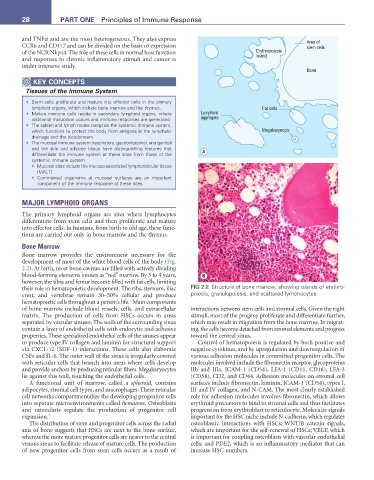
        Bone marrow provides the environment  necessary for the
        development of most of the white blood cells of the body (Fig.
        2.2). At birth, most bone cavities are filled with actively dividing
        blood-forming elements known as “red” marrow. By 3 to 4 years,   B
        however, the tibia and femur become filled with fat cells, limiting
        their role in hematopoietic development. The ribs, sternum, iliac   FIG 2.2  Structure of bone marrow, showing islands of erythro-
        crest, and vertebrae remain 30–50% cellular and produce   poiesis, granulopoiesis, and scattered lymphocytes.
                                           1
        hematopoietic cells throughout a person’s life.  Main components
        of bone marrow include blood vessels, cells, and extracellular   interactions between stem cells and stromal cells. Given the right
        matrix.  The  production  of  cells  from  HSCs  occurs  in  areas   stimuli, most of the progeny proliferate and differentiate further,
        separated by vascular sinuses. The walls of the surrounding sinus   which may result in migration from the bone marrow. In migrat-
        contain a layer of endothelial cells with endocytic and adhesive   ing, the cells become detached from stromal elements and progress
        properties. These specialized endothelial cells of the sinuses appear   toward the central sinus.
        to produce type IV collagen and laminin for structural support   Control of hematopoiesis is regulated by both positive and
        via CXCL-12 (SDF-1) interactions. These cells also elaborate   negative cytokines, and by upregulation and downregulation of
        CSFs and IL-6. The outer wall of the sinus is irregularly covered   various adhesion molecules in committed progenitor cells. The
        with reticular cells that branch into areas where cells develop   molecules involved include the fibronectin receptor, glycoproteins
        and provide anchors by producing reticular fibers. Megakaryocytes   IIb and IIIa, ICAM-1 (CD54), LFA-1 (CD11, CD18), LFA-3
        lie against this wall, touching the endothelial cells.  (CD58), CD2, and CD44. Adhesion molecules on stromal cell
           A functional unit of marrow, called a  spheroid, contains   surfaces include fibronectin, laminin, ICAM-1 (CD54), types I,
        adipocytes, stromal cell types, and macrophages. These reticular   III and IV collagen, and N-CAM. The most clearly established
        cell networks compartmentalize the developing progenitor cells   role for adhesion molecules involves fibronectin, which allows
        into separate microenvironments called hematons. Osteoblasts   erythroid precursors to bind to stromal cells and thus facilitates
        and osteoclasts regulate the production of progenitor cell   progression from erythroblast to reticulocyte. Molecular signals
        expansion. 3                                           important for the HSC niche include N-cadherin, which regulates
           The distribution of stem and progenitor cells across the radial   osteoblastic interactions with HSCs;  WNT/B catenin signals,
        axis of bone suggests that HSCs are next to the bone surface,   which are important for the self-renewal of HSCs; VEGF, which
        whereas the more mature progenitor cells are nearer to the central   is important for coupling osteoblasts with vascular endothelial
        venous sinus to facilitate release of mature cells. The production   cells; and PDE2, which is an inflammatory mediator that can
        of  new  progenitor  cells  from  stem  cells  occurs  as  a  result  of   increase HSC numbers.

