


Page 403 - Clinical Immunology_ Principles and Practice ( PDFDrive )
P. 403
384          PARt tHREE  Host Defenses to Infectious Agents


        mechanism of evasion is determined by the receptor that is used   are Rab3, -4, -5, -9, -7, -11, and -14. These proteins are associ-
        for pathogen entry into the host cell. Internalization via CRs   ated with different maturation stages of the phagosome and
        inhibits the production of IL-12, a cytokine critical in facilitating   chiefly orchestrate membrane fusion events to allow delivery of
        macrophage activation. Engulfment by this receptor also bypasses   vesicular protein cargo to the phagosomal compartment. The
        activation of the oxidative burst, thereby avoiding ROI production.   mycobacteria-containing phagosome acquires Rab5a but not the
        Similarly, engaging mismatch repair (MMR) and DC-specific   late endosomal marker Rab7a, which ultimately mediates fusion of
        intercellular adhesion (DC-SIGN) molecules for uptake triggers   the bacterial-containing phagosome with lysosomes that contain
        secretion of the suppressive cytokines IL-10 and TGF-β. Several   proteolytic enzymes active at low pH. By enabling arrest of this
        intracellular bacteria also produce ROI detoxifiers, including   maturation,  M. tuberculosis maintains its compartment at an
        superoxide dismutase and catalase, which nullify oxygen (O 2 )   early endosomal stage. This compartment does not acidify, partly
                                                                                            +
        and hydrogen peroxide (H 2 O 2 ), respectively. Finally, a number   because of a paucity of vacuolar H  adenosine triphosphatase
        of small bacterial products, such as the phenolic glycolipid and   (ATPase); at the same time, it exchanges molecules with the
        LAM of mycobacteria, scavenge ROIs. Many of the strategies   plasma membrane, such as the transferrin receptor, to access
        used to counteract the effects of ROIs also overlap in their effects   iron. Activation of macrophages with IFN-γ restores the normal
        on RNIs. A modification of lipid A renders gram-negative bacteria,   maturation of the mycobacterial phagosome, resulting in a drop
        including salmonellae, resistant to the effects of host antimicrobial   in mycobacterial viability. Francisellae and brucellae are engulfed
        peptides.                                              by phagosomes that acquire the early endosomal markers EEA1
                                                                         31
                                                               and Rab5a.  The Francisella-containing vacuole acquires late
        Intraphagosomal Survival                               endosomal markers, but the pathogen escapes into the cytosol
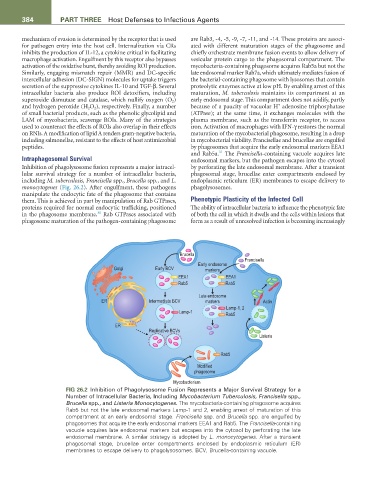
        Inhibition of phagolysosome fusion represents a major intracel-  by perforating the late endosomal membrane. After a transient
        lular survival strategy for a number of intracellular bacteria,   phagosomal stage, brucellae enter compartments enclosed by
        including M. tuberculosis, Francisella spp., Brucella spp., and L.   endoplasmic reticulum (ER) membranes to escape delivery to
        monocytogenes (Fig. 26.2). After engulfment, these pathogens   phagolysosomes.
        manipulate the endocytic fate of the phagosome that contains
        them. This is achieved in part by manipulation of Rab GTPases,   Phenotypic Plasticity of the Infected Cell
        proteins required for normal endocytic trafficking, positioned   The ability of intracellular bacteria to influence the phenotypic fate
                                 30
        in the phagosome membrane.  Rab GTPases associated with   of both the cell in which it dwells and the cells within lesions that
        phagosome maturation of the pathogen-containing phagosome   form as a result of unresolved infection is becoming increasingly


                                                            Brucella
                                                                                 Francisella
                                                                  Early endosome
                                      Golgi         Early BCV       markers
                                                           EEA1            EEA1
                                                           Rab5            Rab5

                                                                  Late endosome
                                  ER              Intermediate BCV  markers            Actin
                                                                           Lamp-1, 2
                                                            Lamp-1         Rab5

                                       ER
                                                  Replicative BCVs
                                                                                      Listeria


                                                                         Rab5
                                                                  Modified
                                                                 phagosome
                                                          Mycobacterium
                       FIG 26.2  Inhibition of Phagolysosome Fusion Represents a Major Survival Strategy for a
                       Number of Intracellular Bacteria, Including Mycobacterium Tuberculosis, Francisella spp.,
                       Brucella spp., and Listeria Monocytogenes. The mycobacteria-containing phagosome acquires
                       Rab5 but not the late endosomal markers Lamp-1 and 2, enabling arrest of maturation of this
                       compartment at an early endosomal stage. Francisella spp. and Brucella spp. are engulfed by
                       phagosomes that acquire the early endosomal markers EEA1 and Rab5. The Francisella-containing
                       vacuole acquires late endosomal markers but escapes into the cytosol by perforating the late
                       endosomal membrane. A similar strategy is adopted by  L. monocytogenes. After a transient
                       phagosomal  stage, brucellae  enter  compartments  enclosed  by  endoplasmic  reticulum  (ER)
                       membranes to escape delivery to phagolysosomes. BCV, Brucella-containing vacuole.

