


Page 398 - Clinical Immunology_ Principles and Practice ( PDFDrive )
P. 398
CHAPtER 26  Host Defenses to Intracellular Bacteria            379


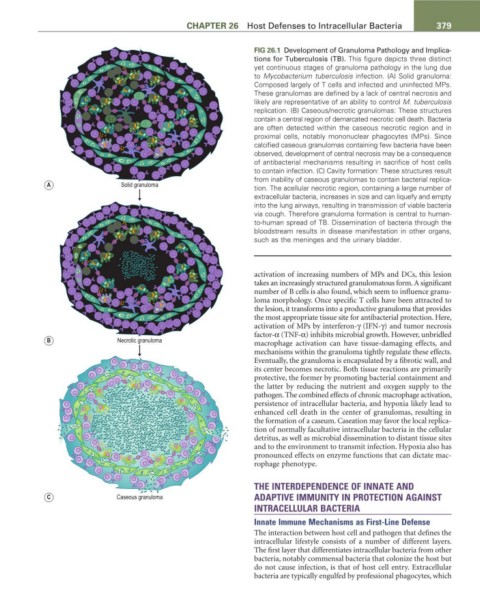
                                                                  FIG 26.1  Development of Granuloma Pathology and Implica-
                                                                  tions for Tuberculosis (TB). This figure depicts three distinct
                                                                  yet continuous stages of granuloma pathology in the lung due
                                                                  to Mycobacterium tuberculosis infection. (A) Solid granuloma:
                                                                  Composed largely of T cells and infected and uninfected MPs.
                                                                  These granulomas are defined by a lack of central necrosis and
                                                                  likely are representative of an ability to control M. tuberculosis
                                                                  replication. (B) Caseous/necrotic granulomas: These structures
                                                                  contain a central region of demarcated necrotic cell death. Bacteria
                                                                  are often detected within the caseous necrotic region and in
                                                                  proximal cells, notably mononuclear phagocytes (MPs). Since
                                                                  calcified caseous granulomas containing few bacteria have been
                                                                  observed, development of central necrosis may be a consequence
                                                                  of antibacterial mechanisms resulting in sacrifice of host cells
                                                                  to contain infection. (C) Cavity formation: These structures result
                                                                  from inability of caseous granulomas to contain bacterial replica-
             A                  Solid granuloma                   tion. The acellular necrotic region, containing a large number of
                                                                  extracellular bacteria, increases in size and can liquefy and empty
                                                                  into the lung airways, resulting in transmission of viable bacteria
                                                                  via cough. Therefore granuloma formation is central to human-
                                                                  to-human spread of TB. Dissemination of bacteria through the
                                                                  bloodstream results in disease manifestation in other organs,
                                                                  such as the meninges and the urinary bladder.


                                                                  activation of increasing numbers of MPs and DCs, this lesion
                                                                  takes an increasingly structured granulomatous form. A significant
                                                                  number of B cells is also found, which seem to influence granu-
                                                                  loma morphology. Once specific T cells have been attracted to
                                                                  the lesion, it transforms into a productive granuloma that provides
                                                                  the most appropriate tissue site for antibacterial protection. Here,
                                                                  activation of MPs by interferon-γ (IFN-γ) and tumor necrosis
                                                                  factor-α (TNF-α) inhibits microbial growth. However, unbridled
             B                 Necrotic granuloma                 macrophage activation can have tissue-damaging effects, and
                                                                  mechanisms within the granuloma tightly regulate these effects.
                                                                  Eventually, the granuloma is encapsulated by a fibrotic wall, and
                                                                  its center becomes necrotic. Both tissue reactions are primarily
                                                                  protective, the former by promoting bacterial containment and
                                                                  the latter by reducing the nutrient and oxygen supply to the
                                                                  pathogen. The combined effects of chronic macrophage activation,
                                                                  persistence of intracellular bacteria, and hypoxia likely lead to
                                                                  enhanced cell death in the center of granulomas, resulting in
                                                                  the formation of a caseum. Caseation may favor the local replica-
                                                                  tion of normally facultative intracellular bacteria in the cellular
                                                                  detritus, as well as microbial dissemination to distant tissue sites
                                                                  and to the environment to transmit infection. Hypoxia also has
                                                                  pronounced effects on enzyme functions that can dictate mac-
                                                                  rophage phenotype.


                                                                  THE INTERDEPENDENCE OF INNATE AND
             C                 Caseous granuloma                  ADAPTIVE IMMUNITY IN PROTECTION AGAINST
                                                                  INTRACELLULAR BACTERIA
                                                                  Innate Immune Mechanisms as First-Line Defense
                                                                  The interaction between host cell and pathogen that defines the
                                                                  intracellular lifestyle consists of a number of different layers.
                                                                  The first layer that differentiates intracellular bacteria from other
                                                                  bacteria, notably commensal bacteria that colonize the host but
                                                                  do not cause infection, is that of host cell entry. Extracellular
                                                                  bacteria are typically engulfed by professional phagocytes, which

