


Page 399 - Clinical Immunology_ Principles and Practice ( PDFDrive )
P. 399
380          PARt tHREE  Host Defenses to Infectious Agents


        include tissue macrophages, DCs, and PMNs. This uptake is   TABLE 26.2  Major Pattern Recognition
        enhanced by host components of the complement system and   Receptors Involved in Sensing of
        antibodies, which bind to complement receptors (CRs) and Fc   Intracellular Bacteria
                                              20
        receptors, respectively, on professional phagocytes.  M. tuberculosis
        actively targets macrophages, where it must counteract numerous   Pattern Recognition
        antimicrobial mechanisms operative in these cells (see below).   Receptor  Location       Ligand
        Intracellular  bacteria  also  use  elaborate  mechanisms  to  enter   toll-Like Receptors
        nonprofessional phagocytes, by which they must subvert host   TLR1         Plasma membrane  Triacyl lipoprotein
        endocytic processes that are normally engaged in traffic of cellular   TLR2  Plasma membrane  PGA, porins, LAM
        cargoes. In some cases, this provides a less hostile environment   TLR4    Plasma membrane  LPS
        because of their inability to efficiently mobilize antibacterial   TLR5    Plasma membrane  Flagellin
        effector mechanisms. Bartonella spp., unique among intracellular   TLR6    Plasma membrane  Diacyl lipoprotein
        bacteria, can enter red blood cells, thus allowing transmission   TLR7 (human TLR8)  Endosome  ssRNA
                                                                                                  CpG DNA
                                                                                   Endosome
                                                                 TLR9
        via blood-sucking insect vectors. This represents a particularly
        advantageous niche as red blood cells lack the machinery to   Scavenger Receptors
        drive the adaptive immune responses required for protection.   SR-A        Plasma membrane  LPS, LTA, CpG DNA,
        Entry into nonphagocytic host cells requires bacteria to induce                            proteins
        their own internalization. Bacteria that colonize the GI tract   MARCO     Plasma membrane  LPS, proteins
        (i.e., L. monocytogenes or salmonellae) or mucosal membranes   CD36        Plasma membrane  Diacyl lipoprotein
        of the urogenital tract (i.e., C. trachomatis) must mediate tight   LOX-1  Plasma membrane  Protein
        adhesion to the host cell membrane and be capable of mediating   SREC      Plasma membrane  Protein
        the uptake process. Broadly, two processes are utilized by bacteria   C-type Lectins
        to induce uptake into a nonphagocytic cell. The “zipper” mecha-  DC-SIGN   Plasma membrane  LPS, ManLAM,
        nism is mediated by binding of a bacterial cell surface protein                            capsular
        binding a cognate receptor on the host cell membrane.  L.                                  polysaccharide
        monocytogenes entry into intestinal epithelial cells depends on   MINCLE   Plasma membrane  Mycobacterial cord
        engagement of InIA to E-cadherin to mediate uptake.                                        factor: TDM
           Salmonellae and C. trachomatis use a “trigger” mechanism
        to induce internalization and inject multiple factors into the   NOD-Like Receptors
        host cell cytoplasm to mediate uptake. These proteins are delivered   NOD1  Cytoplasm     D-glutamyl-meso-
                                                                                                   diaminopimelic acid
        by the needle-like structures that form part of bacterial type III   NOD2  Cytoplasm      MDP
        secretion systems (T3SSs). These injected proteins then target   NLRP1     Cytoplasm      MDP
        host proteins involved in host cell signaling and actin remodeling   NLRP3  Cytoplasm     RNA, LPS, LTA, MDP
        to induce bacterial entry. The C. trachomatis–secreted proteins   NLRC4    Cytoplasm      Flagellin
        Tarp, CT166, and CT694 reversibly stimulate the Rho-family   Naip5         Cytoplasm      Flagellin
        guanosine triphosphatase (GTPase) Rac1 to trigger internalization.
        Similarly, salmonellae inject T3SS factors to stimulate the Rho-  AIM2-Like Receptors
        family GTPases Cdc42 and Rac1. The success of these mechanisms   AIM2      Cytoplasm      dsDNA
        of induced uptake enables intracellular bacteria to persist inside   IFI16  Cytoplasm     dsDNA
        diverse cell types. Rickettsia spp., C. trachomatis, M. leprae, and   StING/cGAS Pathway
        L. monocytogenes ultimately target vascular endothelial cells,   cGAS      Cytoplasm      dsDNA
        epithelial cells, Schwann cells, and hepatocytes, respectively, as
        their preferred intracellular habitats.                Note: We omit PRRs (e.g., TLR3, which binds viral produced double-stranded RNA)
           To prevent intracellular infection, the host depends on its   not classically associated with intracellular bacteria. AIM2, absent in melanoma-2;
        ability to discriminate between host and bacterial molecules.   CD36, cluster of differentiation 36; CpGDNA, cytosine-phosphatidyl-guanine DNA;
                                                               DC-SIGN, dendritic cell–specific intercellular adhesion molecule-3-grabbing
        As already mentioned, bacteria targeting the intracellular envi-  nonintegrin; dsDNA, double-stranded DNA; LAM, lipoarabinomannan;
        ronment often do so via mucosal surfaces already populated   LOX-1, lipoxygenase-1; LPS, lipopolysaccharide; LTA, lipoteichoic acid;
                                                               ManLAM, mannose lipoarabinomannan; MARCO, macrophage receptor with
        by commensal organisms (the microbiome) that do not alert   collagenous structure; MDP, muramyl dipeptide; MINCLE, macrophage-inducible
        host defenses. The host must, therefore, discriminate between   C-type lectin; NLR, NOD-like receptor; NOD, nucleotide-binding domain;
        commensal and pathogenic bacteria via recognition of conserved   PGA, peptidoglycans; PRR, pattern recognition receptor; SR, scavenger receptor;
                                                               ssRNA, single-stranded RNA; SREC, scavenger receptor expressed by endothelial
        molecular motifs of bacteria, named pathogen-associated molecular   cell-I; TDM, trehalose dimycolate; TLR, Toll-like receptor.
        patterns (PAMPs). This occurs via host receptors broadly defined
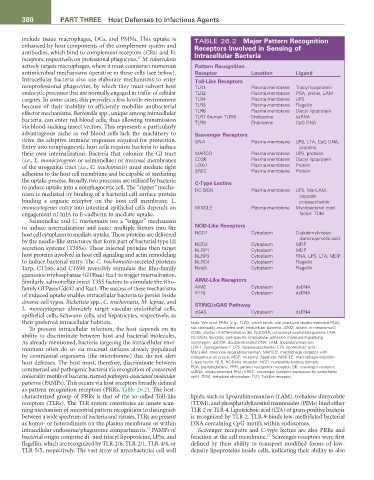
        as pattern recognition receptors (PRRs, Table 26.2). The best-
        characterized group of PRRs is that of the so-called Toll-like   lipids, such as lipoarabinomannan (LAM), trehalose dimycolate
        receptors (TLRs). The TLR system constitutes an innate scan-  (TDM), and phosphatidylinositol mannosides (PIMs) bind either
        ning mechanism of microbial pattern recognition to distinguish   TLR-2 or TLR-4. Lipoteichoic acid (LTA) of gram-positive bacteria
        between a wide spectrum of bacteria and viruses. TLRs are present   is recognized by TLR-2. TLR-9 binds low-methylated bacterial
        as homo- or heterodimers on the plasma membrane or within   DNA containing CpG motifs within endosomes.
                                                 21
        intracellular endosome/phagosome compartments.  PAMPs of   Scavenger receptors and C-type lectins are also PRRs and
                                                                                        22
        bacterial origin comprise di- and triacyl lipoproteins, LPSs, and   function at the cell membrane.  Scavenger receptors were first
        flagellin, which are recognized by TLR-2/6, TLR-2/1, TLR-4/4, or   defined by their ability to transport modified forms of low-
        TLR-5/5, respectively. The vast array of mycobacterial cell wall   density lipoproteins inside cells, indicating their ability to also

