


Page 407 - Clinical Immunology_ Principles and Practice ( PDFDrive )
P. 407
388          PARt tHREE  Host Defenses to Infectious Agents


        lipids presented by CD1c, and secrete many cytokines otherwise   Our deepening understanding of the molecular events governing
        associated with T cells, DCs, and macrophages. B-cell signaling via   intracellular bacterial infections is allowing development of novel
        MyD88 during S. typhimurium infection has been associated with   therapeutic and preventive approaches. The need for such
        B-cell production of IL-10, and mice with B-cell-specific deficiency   interventions is becoming all the more pronounced in the face
        in MyD88 were more resistant to infection demonstrating that,   of increasing levels of antibiotic resistance of bacteria, such as
        like T cells, B cells can perform regulatory functions. 53  M. tuberculosis, which render canonical drugs that specifically
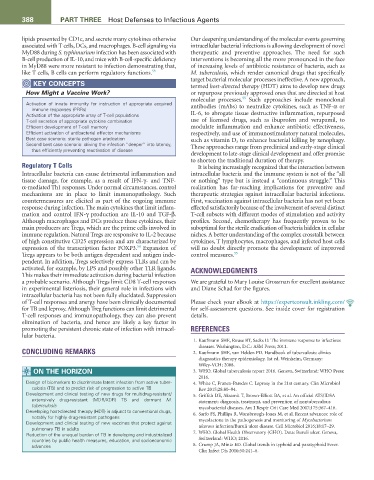
            KEY CONCEPtS                                       target bacterial molecular processes ineffective. A new approach,
                                                               termed host-directed therapy (HDT) aims to develop new drugs
         How Might a Vaccine Work?                             or repurpose previously approved ones that are directed at host
                                                                                55
                                                               molecular processes.  Such approaches include monoclonal
          Activation of innate immunity for instruction of appropriate acquired   antibodies (mAbs) to neutralize cytokines, such as TNF-α or
           immune responses (PRRs)
          Activation of the appropriate array of T-cell populations  IL-6, to abrogate tissue destructive inflammation, repurposed
          T-cell secretion of appropriate cytokine combination  use of licensed drugs, such as ibuprofen and verapamil, to
          Efficient development of T-cell memory               modulate inflammation and enhance antibiotic effectiveness,
          Efficient activation of antibacterial effector mechanisms  respectively, and use of immunostimulatory natural molecules,
          Best case scenario: sterile pathogen eradication     such as vitamin D 3  to enhance bacterial killing by xenophagy.
          Second best case scenario: driving the infection “deeper” into latency,   These approaches range from preclinical and early-stage clinical
           thus efficiently preventing reactivation of disease
                                                               development to late-stage clinical development and offer promise
                                                               to shorten the traditional duration of therapy.
        Regulatory T Cells                                        It is being increasingly recognized that the interaction between
        Intracellular bacteria can cause detrimental inflammation and   intracellular bacteria and the immune system is not of the “all
        tissue damage, for example, as a result of IFN-γ- and TNF-  or nothing” type but is instead a “continuous struggle.” This
        α-mediated Th1 responses. Under normal circumstances, control   realization has far-reaching implications for preventive and
        mechanisms  are  in  place  to  limit  immunopathology.  Such   therapeutic strategies against intracellular bacterial infections.
        countermeasures are elicited as part of the ongoing immune   First, vaccination against intracellular bacteria has not yet been
        response during infection. The main cytokines that limit inflam-  effected satisfactorily because of the involvement of several distinct
        mation and control IFN-γ production are IL-10 and TGF-β.   T-cell subsets with different modes of stimulation and activity
        Although macrophages and DCs produce these cytokines, their   profiles. Second, chemotherapy has frequently proven to be
        main producers are Tregs, which are the prime cells involved in   suboptimal for the sterile eradication of bacteria hidden in cellular
        immune regulation. Natural Tregs are responsive to IL-2 because   niches. A better understanding of the complex crosstalk between
        of high constitutive CD25 expression and are characterized by   cytokines, T lymphocytes, macrophages, and infected host cells
                                              54
        expression of the transcription factor FOXP3.  Expansion of   will no doubt directly promote the development of improved
        Tregs appears to be both antigen dependent and antigen inde-  control measures. 55
        pendent. In addition, Tregs selectively express TLRs and can be
        activated, for example, by LPS and possibly other TLR ligands.   ACKNOWLEDGMENTS
        This makes their immediate activation during bacterial infection
        a probable scenario. Although Tregs limit CD8 T-cell responses   We are grateful to Mary Louise Grossman for excellent assistance
        in experimental listeriosis, their general role in infections with   and Diane Schad for the figures.
        intracellular bacteria has not been fully elucidated. Suppression
        of T-cell responses and anergy have been clinically documented   Please check your eBook at https://expertconsult.inkling.com/
        for TB and leprosy. Although Treg functions can limit detrimental   for self-assessment questions. See inside cover for registration
        T-cell responses and immunopathology, they can also prevent   details.
        elimination of bacteria, and hence are likely a key factor in
        promoting the persistent chronic state of infection with intracel-  REFERENCES
        lular bacteria.
                                                                1.  Kaufmann SHE, Rouse BT, Sacks D. The immune response to infectious
                                                                  diseases. Washington, D.C.: ASM Press; 2011.
        CONCLUDING REMARKS                                      2.  Kaufmann SHE, van Helden PD. Handbook of tuberculosis: clinics
                                                                  diagnostics therapy epidemiology. 1st ed. Weinheim, Germany:
                                                                  Wiley-VCH; 2008.
            ON tHE HORIZON                                      3.  WHO. Global tuberculosis report 2016. Geneva, Switzerland: WHO Press;
                                                                  2016.
          Design of biomarkers to discriminate latent infection from active tuber-  4.  White C, Franco-Paredes C. Leprosy in the 21st century. Clin Microbiol
           culosis (TB) and to predict risk of progression to active TB  Rev 2015;28:80–94.
          Development and clinical testing of new drugs for multidrug-resistant/  5.  Griffith DE, Aksamit T, Brown-Elliott BA, et al. An official ATS/IDSA
           extensively drug-resistant (MDR/XDR) TB and dormant  M.   statement: diagnosis, treatment, and prevention of nontuberculous
           tuberculosis                                           mycobacterial diseases. Am J Respir Crit Care Med 2007;175:367–416.
          Developing host-directed therapy (HDT) in adjunct to conventional drugs,   6.  Sarfo FS, Phillips R, Wansbrough-Jones M, et al. Recent advances: role of
           notably for highly drug-resistant pathogens
          Development and clinical testing of new vaccines that protect against   mycolactone in the pathogenesis and monitoring of Mycobacterium
           pulmonary TB in adults                                 ulcerans infection/Buruli ulcer disease. Cell Microbiol 2016;18:17–29.
          Reduction of the unequal burden of TB in developing and industrialized   7.  WHO. Global Health Observatory (GHO). Data: Buruli ulcer. Geneva,
           countries by public health measures, education, and socioeconomic   Switzerland: WHO; 2016.
           advances                                             8.  Crump JA, Mintz ED. Global trends in typhoid and paratyphoid Fever.
                                                                  Clin Infect Dis 2010;50:241–6.

